
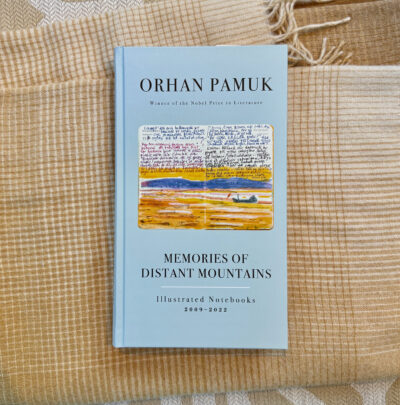
Orhan Pamuk’s Memories of Distant Mountains was published last year. I bought a copy right away but it’s taken me a while to review it!
I wrote about Pamuk once before, quoting a passage from one of his books where he talks about his grandmother keeping notebooks that she wrote in every day. He must have picked up a version of that habit himself, as Memories of Distant Mountains is full of spreads from Pamuk’s own illustrated journals kept between 2009 and 2022.
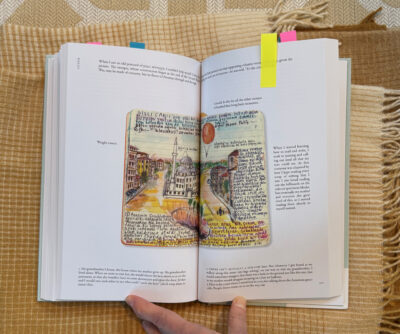
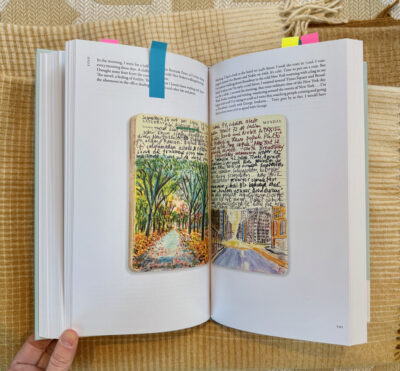
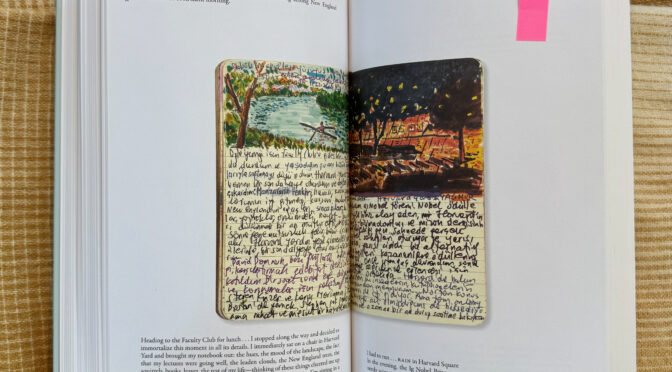
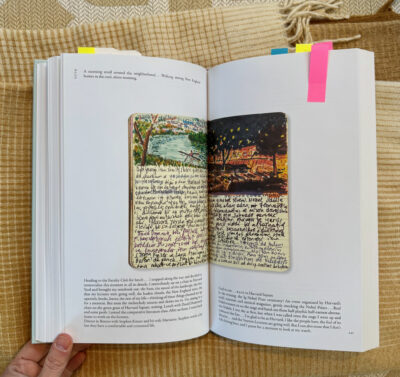
The pages are very densely packed with writing and drawing– scribbled words in what looks like ballpoint pen and markers, sketches in markers and perhaps crayon or colored pencil and watercolor. The images seem to be views of various places in Istanbul and from Pamuk’s travels, or perhaps imagined images and doodles in some cases. The pages are presented as actual-size spreads, more or less– some slightly larger, some slightly smaller, as far as I can tell. I think this is to accommodate varying amounts of translated text around the images (where all the writing is in Turkish).
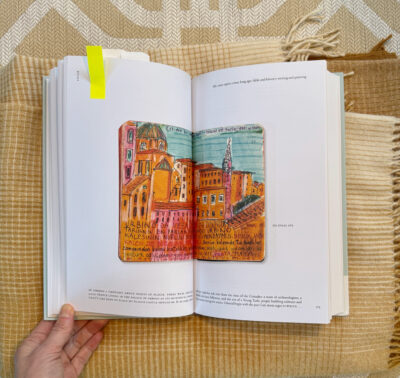
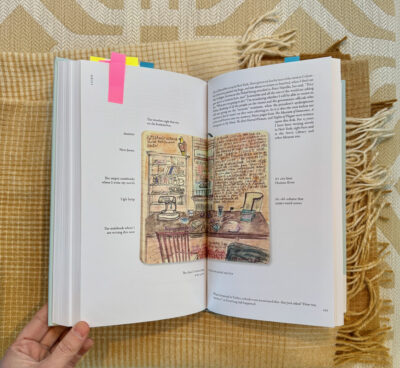
The way the notebook spreads are aligned with the book page spread allows for nice flexibility in how the translated text is arranged, but it’s a bit unfortunate to have some of the art right in the gutter between the pages, as the binding doesn’t open completely flat. I prefer the way the Spanish edition is laid out, in a landscape format book with the translation on the left hand page, and the notebook spread on the right.
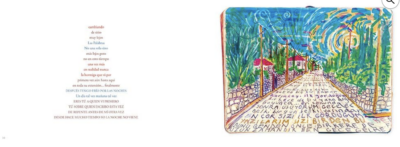
The texts are a mix of jotted phrases and words, almost like poetry, on some pages, and what sound like more traditional journal entries on other pages. Sometimes the text seems to relate to the image, but elsewhere Pamuk may just be pairing a sketch of where he happens to be while he’s writing.
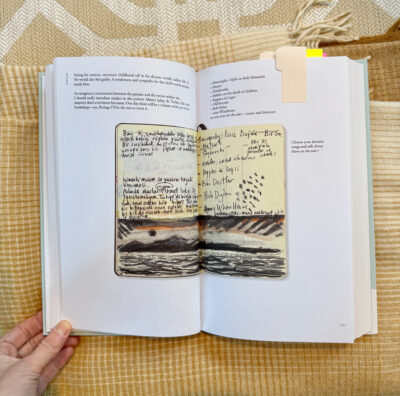
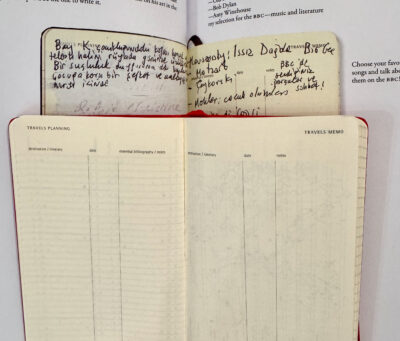
The notebooks themselves are all Moleskine planners. Most of the pages shown are from page-per-day diaries, but some have other formats. I think they are all pocket size, which seems to be confirmed by a couple of videos (here and here) where Pamuk pulls his current diary out of his pocket. Looking at my own Moleskine diaries, the daily spreads match my 2001 daily planner except that they started capitalizing the month names at some point, and I found an example of the travel notes spread in a weekly Moleskine diary I used in 2009.

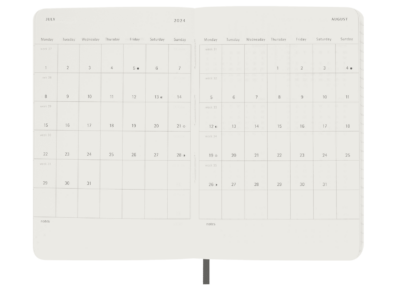
I had not seen a pocket Moleskine diary with the kind of month-on-one-page layout that appears in the book. I found an example of it in a 2010 post from Plannerisms, but that was in a large Moleskine diary. It seemed like the boxes would be too small to be useful on a pocket size page, so I thought Pamuk might occasionally use a large diary too, but Moleskine’s own site does show an image of a month-per-page spread in a listing for a 2024 pocket size planner.
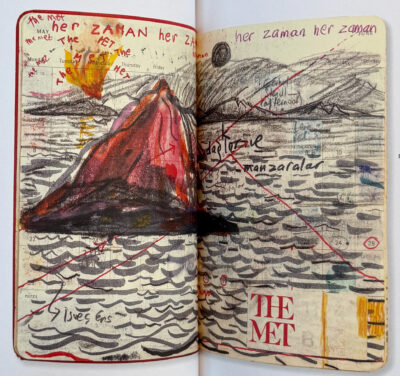
Aside from my notebook fascination, it’s hard to know how to approach this book. Some of the art is really stunning, and it’s wonderful just to flip through for visual inspiration, but I haven’t tried to read through very much of the text in order. “In order” is a strange concept here, as the dates of the pages skip back and forth in time. On some of the illustrated spreads you can barely see the day and date, but all pages of the book are annotated in the upper left corner with a year and sometimes a letter, as Pamuk kept multiple notebooks in some years. A “Chronology” at the end of the book gives broad strokes about what Pamuk was doing during the years he was keeping these journals but there’s no foreword or afterword or any other explanatory texts about the book as a whole.
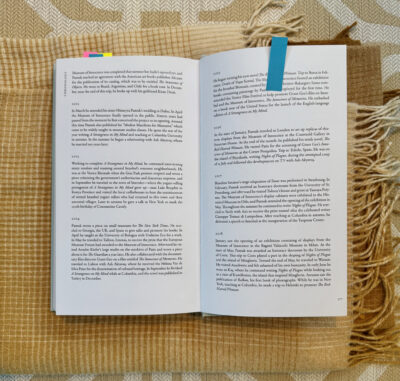
Ultimately, I kind of agree with some of the NY Times book critic Dwight Garner’s take on it:
Diaries and notebooks from writers (and others with a gift for language) matter because they’re forums for observations on manners and morals and art and food and sex and politics; they track another human being’s impulses, appetites and philosophies. They’re a groovy back door into a mind.
Pamuk’s notebooks lead us to such a door, then ask us to remain outside….
His wife warned him not to publish “anything too personal” in this book, and he has succeeded all too well. Sometimes the prose is gnomic: “If you follow the river you will reach the valley where words and images are one,” he writes. Duly noted. At many other times, he displays a tiresome sort of mock innocence. At a reading: “Lots of people! A large, jam-packed hall!”
The review is a bit harsh– it doesn’t have much to say about the art, and is mainly concerned with the bland and cryptic nature of the text. I guess if you are really a big fan of Pamuk’s writing and want to learn more about him, this book may not be the kind of rich source material you’d desire. I’ve read a couple of Pamuk’s books and enjoyed them, but don’t feel the need to delve into his psyche that deeply, so I can enjoy the book as an inspiring example of dense, colorful visual journaling by a very talented artist (Pamuk wanted to be a painter before turning to writing novels).
I’d like Memories of Distant Mountains even more if the text was full of more interesting storytelling about the author’s life, or more observations about the places he’s sketching. But if the text is sometimes a little obscure or banal, maybe that’s comforting in a way: I think anyone who’s ever kept a journal has probably questioned the point of recording boring, random things about their life. We wonder if our activities and ideas and feelings are really worth memorializing on paper. We cringe at the idea of anyone reading our inner-most thoughts. Well, here’s a book that shows that even a Nobel Prize-winning author isn’t filling his diaries with super-deep insights 100% of the time. The pressure’s off.
(This is off-topic, but it popped into my mind while enjoying this post…apologies!) I think you may have blogged about 5-year diaries at some point…? Have you seen any articles about that specific format? I finally finished the one I began in 2020 and wrote about my experience. I would enjoy reading about how others have experienced it. Here’s my blog about it: https://tina-koyama.blogspot.com/2025/11/my-longitudinal-study-continues.html