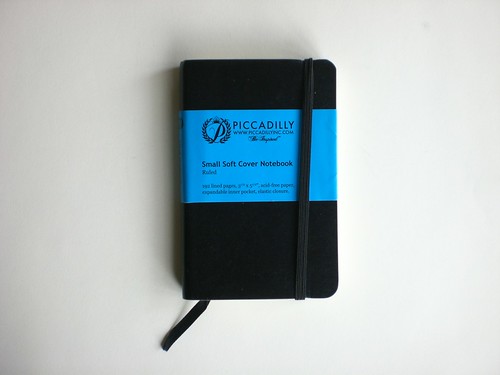
This is another notebook I bought about 3 years ago and then immediately shelved. When I first examined it after buying it, I pretty much hated it. I bought it because it was cheap and I’d never tried a softcover Piccadilly, though I’d liked using some of their hardcover ones with graph or plain paper. But this softcover notebook only comes in lined paper, which I really don’t like using. The reason I hated it, though, is that when I took off the shrinkwrap, I realized that the elastic was so incredibly tight that it was warping the whole notebook. The whole thing seemed stiff and warped and dented by the elastic, and I was just so disappointed by the quality that I’ve been putting off reviewing it ever since.


But a funny thing happened when I did decide to review the notebook. I started opening it and closing it and bending it, and just turning it over and over in my hand. I bent the spine back and forth, flexed the covers, and tested all my pens in it. And somehow by the end of all this, I had gone from thinking the notebook was a piece of crap to wanting to buy a whole bunch of them, if only I could get them with unlined or squared paper.
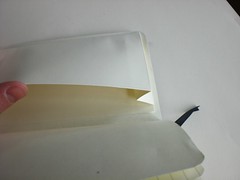
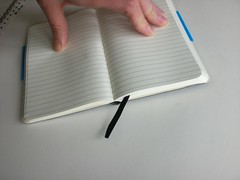
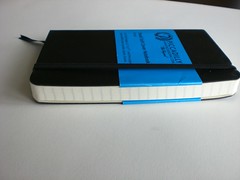
The stiffness I initially disliked is due to an extra layer in the cover that sort of makes these notebooks almost a hybrid between a hardcover and a softcover. It makes the notebook thicker and chunkier, and it seems like it would be much sturdier than the Moleskine softcover notebooks (shown below next to a softcover reporter-style Moleskine).
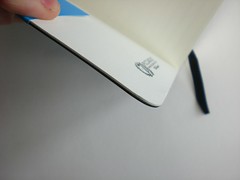
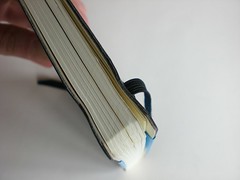
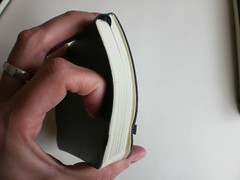
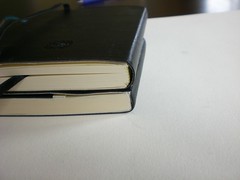
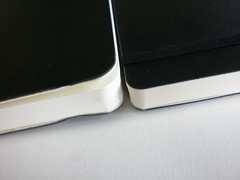
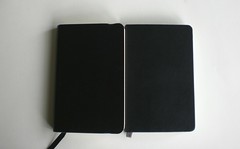
The notebook feels great in the hand, as it’s the perfect size and heft. And because it’s a softcover, there’s no annoying cover overhang, just a nice little brick of paper. Below is a comparison to a hardcover Moleskine:
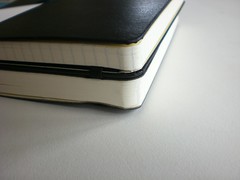
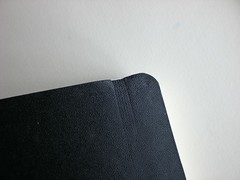
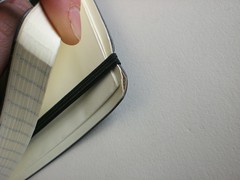
It does seem like the layers of the cover could start to become unglued– one corner is already coming apart a bit, but it’s in a spot that has been stressed by the tight elastic.
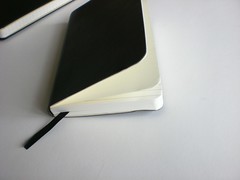
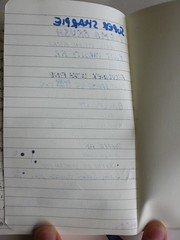
The paper is ok but a bit thirsty. If you stop for 5 seconds in one spot with a fountain pen, you get a pretty big blotch that soaks through to the next page. It felt good to write on with all my usual pens, but there was more bleed-through than average. Show-through was about average.

There’s something about knowing how cheap these notebooks are that makes me more willing to forgive certain flaws. The Piccadilly softcover feels like it could be a scrappy little notebook, not precious, not perfect– just something you can beat up and abuse and still enjoy even if it starts to fall apart. But you may disagree– I showed this notebook to a friend and asked her what she thought of it. She said she didn’t like it because it felt stiff and cheap, but when I told her how cheap it actually was (typical retail price $3-5), she said “Oh! Well in that case…” and agreed that maybe it wasn’t so bad.
It all depends on your personal priorities and preferences. If you are a fountain pen user and very picky about paper, it may not be the best choice. If you don’t live near a store where you can buy these in person after checking them over for defects, Piccadilly may not be for you. But for someone like me, the definition of a perfect notebook is more about size and shape and the absence of a cover overhang. I can tolerate almost any paper that feels good with a fine-point rollerball as long as it’s not lined or with overly dark graph paper lines. If the Piccadilly softcover came in squared or plain or dot-grid paper, I’d be searching stores to see if I could find good ones without too many flaws. I’m still surprised at how quickly I went from loathing this notebook to seeing it as a potential new favorite.

 .
.