Architects create some of my favorite notebook and sketchbook pages. Here’s one I just loved, from a project by Smout Allen, a landscape architecture partnership. It’s scribbly and collage-y and I love the touches of color. Just gorgeous.
This proposal for a technological topography for the Lanzarote lava fields and ash pits is conceived as drawings overlain and laid into photographic surveys of the geographical curiosities that dominate the island landscape.
I found this clipping in one of my boxes of old notebooks, tucked between some pages from an old Filofax. I don’t think I ever actually went to Hunting World to look at one of these diaries in person, probably because I did draw the line somewhere in terms of cost! (Maybe also because the idea of walking into a midtown New York City store called “Hunting World” just made my head explode.) Over $200 for a pocket diary, and even more outrageous, $55 for the refill! Seems crazy, especially for 1995. Looks nice, though!
That Hunting World New York store is long gone, but the brand still has some online presence, though their Instagram hasn’t been updated in several months…
This is a really cool idea that I might have to try myself!
Russell Stutler has been featured here before as a notebook addict. His website is a great resource for sketching inspiration, and he has done a deep dive testing popular pocket sketchbook brands, with Moleskine and Stillman and Birn among his favorites. But this binder idea is taking it to the next level! He cut up pages from his favorite Stillman and Birn sketchbook, hole-punched them and rounded the corners, and then put them in a pocket size leather binder along with a custom palette!
You might think this would make a big mess, but he came up with a clever way to protect the palette– a plastic sheet folds around it, front and back. You’d still have to make sure the palette is relatively dry, but it would keep the pans from smearing on the drawing page.
My only problem with having a palette in a notebook like this is that it becomes awkward to sketch on anything but the top page. One solution might be to attach the palette in such a way that it extends out beyond the notebook while in use, but then can fold back into the protective plastic:
You might need something that could fold out under the palette to keep it from flopping down while in use. Or maybe the binder could have an elastic closure strap that could be slipped around the user’s wrist to hold everything in place. I’ll have to play around with this idea! Stutler recommends a couple of nice slim pocket size binders that are popular in Japan (Pilot and DaVinci)– I might have to buy a couple to use as prototypes!
I’ve always had a soft spot for Quo Vadis products, ever since my college days when I used some of their vinyl-covered diaries to keep track of my classes and assignments. An updated version of the ones I used is still available! But Quo Vadis has kept up with the times and added new products to their line-up for today’s trends. The Life Journal Infinite is one of them. (The company sent me a free sample to review.)
The Quo Vadis Life Journal Infinite is a hardcover A5 format planner that gives the user an easy way to start a Bullet Journal. The outside is a soft, smooth material similar to what is used on the Rhodia Webnotebook. The logo on the front is quite large, which might not please everyone, but it’s a nice design. There is a wide cover overhang. An elastic closure, ribbon marker, and back pocket check all the usual boxes for handy features.
Inside, a few pages at the beginning provide some tips on how to use the formatted pages, including index pages, an annual schedule, and “collections” pages.
The planner is undated, but laid out in monthly sections. Each month starts with a blank page that can be used for decorative creativity or lists or general writing. Then you get a monthly calendar spread, with blocks of days laid out by weeks. This includes a grid section with a few lines and blocks for the 31 days of the month, perfect for a habit tracker. Then there are 5 weekly spreads, with blocks for each day of the week and a free-form dot grid section to use for a summary or to-dos or doodling.
All of these layouts are attractively designed and very practical. They align perfectly with all the basic guidelines for the Bullet Journal method. The modern calligraphy font used for headers is just like what you see all over Instagram! If you don’t want to go to the trouble of setting all these layouts up yourself in a plain journal, you will love the Quo Vadis Life Journal Infinite.
Some people might think this takes some of the fun out of creating a Bullet Journal– and if the design elements they’ve used aren’t to your particular taste, you’re out of luck. But if you are just starting out with the Bullet Journal method, I think this is a great way to get up and running quickly.
And another key fact: this planner is made with 90 GSM Clairefontaine paper. (QuoVadis and Clairefontaine are part of the same parent company.) The paper is bright white and silky smooth, and it works very well with almost any kind of pen or pencil. Fountain pens work beautifully, and only the very wettest pens bleed through. I would definitely consider it a fountain pen friendly notebook.
On Amazon, this currently retails for a little over $35. On BN.com, it’s only $23. If you factor in the cost of your time to set up all those Bullet Journal layouts by hand, even at minimum wage, that’s a great deal!
I’ve been meaning to do this for a while: a deep dive into the evolution of Moleskine notebook packaging over the 20 or so years they’ve been around.
I went through my collection of unused notebooks and found several distinct examples of different stages of their packaging design. I can’t 100% align these to when they were produced because I haven’t tracked exactly when I bought them all, and even if I had, I wouldn’t be able to tell exactly when they were manufactured. But I think I have a fairly accurate chronology here, based on my own memory and collection, increasing retail price stickers on some of the notebooks, and from the changing listing of products on the pamphlet included inside each notebook.
Here are the front covers of all the notebooks, followed by all the back covers. (You can see larger versions of all these images on Flickr here. I don’t link directly to the Flickr images because it seems to really slow down my website.)
Moleskine notebooks frontMoleskine notebooks back
You can see some pretty major transitions in the design, but there are subtle differences too. I laid these out in what I thought was chronological order, but after looking closely at everything, I realized that I probably should have put the sketchbook labeled S2 before S1, as I think the mention of watercolor on the front and the horizontal barcode on the back are indications that it is older. S2 also has a different ISBN number ending in -9414. I’m not sure why they would have changed it, but all the later examples have the ISBN ending in -1054.
G1 (for “graph”) is probably the oldest one I have. It is the only notebook that has two booklets inside– a simple one with the Moleskine story, and a separate one all in Italian listing various Moleskine products.
Squared Moleskine notebooks with bookletsModo e Modo Moleskine booklet, late 1990s?Flip side of Modo e Modo Moleskine booklet, late 1990s?
It is interesting to note that the 9×14 cm format is called “standard” and many of the page formats are only available in that size. Then there are various thick and thin softcover notebooks some of which also come in small (6.5 x 10.5 cm) and large (13 x 21 cm)– I guess these went on to be called Volants and Cahiers, but there is also mention of a 200 page “grande zibaldone” in the large size. The outside of the notebook has no barcode and doesn’t even mention Hemingway and Matisse. The booklet inside states “Moleskine is the legendary notebook that the European artists and intellectuals who made twentieth-century culture used…” and goes on to mention Matisse, Céline, Hemingway and Chatwin.
Moleskine sketchbooks with booklets
The ISBN number of the pocket squared notebook also seems to have changed along the way– G1 isn’t labeled with an ISBN, but the older G2 example ends in -9406. G3 ends in -102X, or -1023 in the 13-digit version– this ISBN is still in use. ISBN numbers usually don’t change when a product (typically a book) is substantially the same, so I’m not sure why they would have done this, other than wanting to have a distinction between newer and older stock for some reason. As you can see from the labels, it happened while they were still distributed by Kikkerland, before they switched to working with Chronicle in 2008.
G2 has the mention of Van Gogh, Matisse, Hemingway and Chatwin on the front. The pamphlet has a more familiar product line-up with two-page icons. The history begins “It is two centuries now that moleskine [note that it’s lower case] has been the legendary notebook of European artists and intellectuals…” and goes on to mention Matisse, Van Gogh, Hemingway and Chatwin. (I guess they decided Céline was too obscure.) S1 and S2 have this same booklet.
The spines of S1, S2, G1 and G2 have the European orientation where they are upside down while the notebook is face up. This then changes in later versions. In the earliest notebooks, the spine was the only way to tell the difference between ruled, squared or plain page formats.
Moleskine notebooks spinesSquared Moleskines inside front coversSketchbook Moleskines inside front cover
G3 and S3 show the first major design change to the bellyband. The open notebook icon now appears, and they’ve simplified the tagline to just “The legendary notebook of Hemingway, Picasso, Chatwin.” Despite the similar exteriors, G3 still says Modo e Modo inside, while S3 has changed to just “Moleskine.” (According to Wikipedia, the company name change happened in 2006.) G3 has the same booklet inside as S1 and S2, but S3 has an expanded booklet featuring color printing, since at this stage, they’ve moved to color-coding the belly bands by page type. Sketchbooks remain blue, but now instead of all other page formats being orange, they only use orange for ruled. Squared are yellow and plain are green, etc. The history begins “Moleskine is the legendary notebook used by European artists and thinkers for the past two centuries, from Van Gogh to Picasso, from Ernest Hemingway to Bruce Chatwin.” The word Moleskine is now capitalized throughout, so they are really pouring it on thick with the claim of a longer history.
Moleskine Sketchbook and booklet
S4 marks where Moleskine starts to go downhill, in my opinion. They’ve changed the front tagline to just “Legendary notebooks” after getting a lot of backlash because Hemingway and Matisse didn’t really use the Moleskine brand. The history in the pamphlet has now been toned way down: “Today the Moleskine® brand identifies a series of objects that accompany the creativity and imagination of our world… The Moleskine notebook is the heir and successor to the legendary notebook used by artists and thinkers over the past two centuries…” You can see that at this stage, the cover overhang gets much bigger.
Moleskine sketchbook and quality control stickerSquared and dot grid MoleskinesSketchbook and watercolor Moleskines
The later notebooks have booklets that just give the brand message and history and mention quality control. They have so many products at this point that they don’t even try to list them.
Art Plus Moleskine SketchbookArt Collection Moleskine Watercolor Album
Anything that looks like S4 and beyond, I mostly bought by accident or just to test out the quality and compare current models. You can see the change where the sketchbooks are broken out under the “Art Plus” branding, which then shifted to the current “Art Collection” logo (I only had a watercolor notebook handy to show that branding). The only recently manufactured non-Art Collection Moleskine I own is the dotted red notebook, D1. This is current as of 2019. The belly bands now have stuff printed on the flip side so you can label your notebook with notes about its contents– on this one, the assumption is that you’ve used it for travel as it has a space to note countries visited, etc. (On the sketchbooks, there are some art-related tools to help you measure angles or draw circles.) The overhang bugs me but the construction otherwise seems ok compared to similar brands. The paper looks much lighter, less creamy in color than the older notebooks. At some point, I will get around to doing a full round of pen tests on this notebook to compare it to older ones. The sketchbook paper in recent models also seems lighter, but I’ve found that it has had variation over the years– sometimes lighter, sometimes creamier. Sometimes smoother, sometimes a little toothier. The current paper seems maybe a wee bit lighter, smoother and thinner than the older ones in my collection.
If I see older stock on eBay, I only consider notebooks that have the look of the earlier models up to and including S3/G3. (And I have to see photos of the actual item, not an icon or generic image of the older design.) I prefer the ones that look like S1, S2, G1 and G2, though occasionally these are so old they have loose elastics, and I think somewhere between there and the S3/G3 era, they ramped up production so much that quality started to be a little less reliable. I’m still willing to take a chance on them, especially the sketchbooks, since Moleskine appears to be discontinuing them in the pocket size.
I’ve noticed a few other minor variations on the front and back taglines in other older Moleskines that I’ve used– after about 2013 or so, I started saving the bellybands in the back pocket for future reference. It is interesting to see how Moleskine has refined and changed the way they present their brand to the world– for better or worse, they’ve changed the way notebooks are marketed and created a whole new mystique around the tools of creativity.
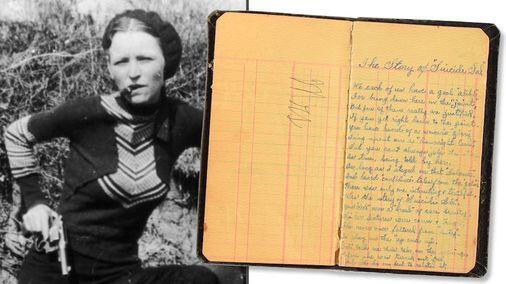
I usually don’t like to write about notebooks that are associated with crime– they usually involve the sociopathic journal entries of serial killers or mass shooters and I have no desire to give them any further publicity. But here’s a notebook that harkens back to an era of more romanticized (if not much less violent) crime. It belonged to Bonnie Parker, of the famous Bonnie and Clyde duo.
[R]are artifacts that will be auctioned off in Boston this weekend include Mickey Cohen’s pinkie ring and Sam Giancana’s gambling notebooks.
Bonnie Parker and Clyde Barrow’s sawed-off shotgun, Al Capone’s cigarette case, Mickey Cohen’s pinkie ring, and Sam Giancana’s gambling notebooks are among many rare artifacts from the world of crime that will be auctioned off in Boston [in September 2019]…
In addition to the sawed-off shotgun, the auction includes a wristwatch that Barrow wore when he died, a bulletproof vest that was recovered from Barrow’s car, and a book of handwritten poems that Parker wrote when she was in jail.
“Featuring a mix of Parker’s original creative compositions and renditions of popular folk ballads, these poems were written by Parker while she was held in Kaufman County Jail, Texas, in 1932, after being arrested for the botched armed robbery of a hardware store,†the auction listing states. “With little to do other than pine for Clyde and chat with her jailer, it is no surprise that Bonnie’s fertile imagination turned to poetry: of the ten poems in this book, five appear to be original compositions, largely drawn from her adventurous life on the road with the Barrow Gang.â€
Her black leatherette book includes works titled “The Story of ‘Suicide Sal,’ †“The Prostitute’s Convention,†“The Hobo’s Last Ride,†“The Fate of Tiger Rose,†(a narrative poem about a “woman of shame, who played a hard gameâ€), and “I’ll Stay,†(Just like the stars in heaven / fling around the moon at nite / I’ll stay with you forever / whether you are wrong or right).
Exciting times here at Notebook Stories headquarters… as I’ve mentioned in passing in a few posts, most of my notebook collection has been sitting in a storage unit for almost 2 years. It’s been quite frustrating to have all these notebooks in storage and not to be able to access them for blog posts and general fondling. But finally, after various moves and reorganizations and lots of schlepping, I’m almost ready to bring all these home:
Yes, 6 big boxes of notebooks sitting in a storage unit. Inside, there are 17 shoeboxes full of pocket size notebooks, plus various other larger notebooks.
You might think this would mean that there aren’t many notebooks close at hand in my home… well, not too many…
These are the boxes of to-be-reviewed notebooks, recently-reviewed notebooks, and other recently purchased notebooks:
These are the Moleskine City notebooks, plus a few facsimile notebook art books, tucked behind some cool little art inspiration books.
These are all the completed journals and sketchbooks from recent years:
These are the current daily carry notebooks, plus a few others that have been living on my desk. (And some fountain pens.)
And there are more books about notebooks on the next shelf up.
This is most of the collection, but there are a few other things scattered around the house that I’ve missed. And probably a couple more waiting in my post office box… It’s a constant battle…
I’m always interested to see other people’s notebook collections. Where do you keep them? What do you store them in? How do you keep them under control? If you want to share your own photos, email them to me at nifty [at] notebookstories [dot com].
The diaries, which Liveright Publishing plans to release in the United States in 2021 as a single book, offer a glimpse into the life of a literary figure whose sharply observed psychological thrillers, including “Strangers on a Train†and “The Talented Mr. Ripley,†became cultural touchstones. She was a secretive, often prickly woman who remained a cipher even to her friends and lovers, and a trailblazer who wrote one of the first mainstream novels depicting two women in love. But she could be blinded by her own bigotry and espoused racist and anti-Semitic views.
Scholars have long known about the diary entries, but they have not previously been available to the public. Spanning nearly 60 years, the entries reveal new facets of Highsmith’s life. They catalog her thoughts on such subjects as good and evil, loneliness and intimacy, and love and murder, which she saw as intertwined: “Murder is a kind of making love, a kind of possessing,†she wrote in 1950….
The diaries were discovered after Highsmith’s death in 1995, tucked away behind sheets and towels in a linen closet in her home in Ticino, Switzerland. The 56 spiral-bound notebooks, totaling some 8,000 pages, were found by her longtime editor, Anna von Planta, and Daniel Keel, the executor of Highsmith’s will and the literary executor of her estate.
I was not familiar with A Good Company when they contacted me to offer a sample for review. Based in Sweden, A Good Company offers a focused selection of stationery and household items, all designed to be environmentally friendly, and produced in line with a set of values:
We believe being completely transparent between ourselves, and with our customers and partners will spur us to push even harder.
We are completely transparent
We encourage our customers to understand exactly how our products are made.
We don’t make off-the-cuff statements without backing them up with proper facts.
We detail the environmental footprint of everything we do.
We benchmark ourselves against competing products & brands.
We are completely transparent about our suppliers & partners.
We ask suppliers & partners to provide us with hard proof about their practices.
We never take shortcuts
In the choice between different courses of action, we will always take the route that makes our company and our products better and more responsible.
We will always climate compensate our shipments, even if that comes at a cost.
We develop our own packaging material.
We say firmly no to cheap but harmful materials, such as BPA-plastics.
We evaluate our suppliers & partners on more than just the cost.
We avoid working with suppliers & partners that we can’t influence.
We refuse to become corporate
We think the traditional way of running a company — with a big office that no one else can use, a fancy reception, stale conference rooms, and faceless art — is out of date.
Our office is 100% remote: we work together, but we don’t share an office.
We believe in well-oiled teams and avoid becoming dependent on lone-wolf heroes.
We always recruit globally, to assemble a broad spectrum of experience and skill.
We accept and celebrate fast failures, and we learn from our mistakes.
We encourage a healthy & balanced lifestyle, that leads to higher productivity.
We strive to get as many certifications that can strengthen our cause – Read more about our certifications here.
I am not an expert on assessing claims of carbon-neutrality, sustainability, etc., but from what I’ve read, A Good Company seems to be going further than other notebook makers, not just in their choice of materials, but in climate-compensating their shipments. The result, they claim, is “the first climate-positive notebook in the world.” Let’s take a look.
I received an A5 hardcover notebook. (It is actually 6 x 8.5″, which is a bit bigger than official A5.) It comes in an elegant box that seems rather larger in relation to the notebook itself– it could hold 3 notebooks. The box says it is made of recycled stone and is climate-positive, so I’m trying not to see it as wasteful (but the materials aren’t free, so it must add to the price of the notebook). If I had to pick one adjective to describe my first impression of the notebook and its packaging, it would be “smooth.” The box feels smooth, the cover feels smooth, the paper feels smooth. Everything looks smooth!
The smooth texture comes from the paper being made of re-used stone. A Good Company is not alone in using this material–I’ve reviewed a stone paper notebook before, from Ogami, and have also noticed a brand called Karst that makes stone paper notebooks. Aside from the environmentally-friendly manufacturing of stone paper, it can be recycled after use (if you throw your notebooks away), and it has some other interesting characteristics, such as being tear-resistant and waterproof.
The exterior of the Good Company journal feels sturdy and elegant. The spine is squared, and the overhang is tidy and even all around. The company logo appears at the upper right corner of the front cover, with their website address on the back. There is also a small triangle logo on the spine. The dusty pink color would not have been my first choice but it is attractive, and various other colors are available.
Inside the front cover, there is information about the notebook, as well as a space to write your contact information and dates of usage. The notebook features a back pocket and ribbon marker, but no elastic closure.
I received a notebook with unlined pages– dot grid and lined are also available. The paper feels dense and somewhat floppy– this works out well in terms of the pages lying flat when the notebook is open. I like the feel of stone paper and enjoy how it works with most pens. Hard pencils work really well on this paper, at least if you want to see a darker line. When I first wrote with fountain pens, I was really pleased as colors seemed very vibrant and I didn’t see any bleeding or feathering. But it seems to take a while for ink to fully react with this paper– when I looked at it later, some of the wetter inks had feathered, and the Pilot Varsity fountain pen had faded to a completely different color. I have also seen discussion on fountain pen sites about how the stone paper can abrade nibs. So whether or not this paper works for you will depend on your choice of writing instrument– with some, it is great. And overall, while showthrough is about average, not a single pen I tested bled through.
On the whole, I think the Good Company notebook is well-made, and if you are most concerned about the values behind the company that makes your notebook, it should be a great choice. The hardcover A5 journal I received is $29, so you are paying a pretty significant premium over similar sized journals from brands like Moleskine, Leuchtturm and Rhodia. (Discounts are available if you buy multiple copies, but even buying 5 and getting 15% off, it is still expensive.) But if you think that is pricy, A Good Company also sells 64-page A6 pocket softcover notebooks, in a 3-pack a la Field Notes and Moleskine Cahiers. Each 3-pack is $37! I will admit that I have spent a lot on some of the notebooks in my collection, for less defensible reasons than saving the planet, but I would not pay that much for notebooks for regular use. A Good Company points out in their own marketing info that sometimes a bargain isn’t really a bargain: “Better deals come at a hidden cost. If I’m not paying, someone else is. Sometimes the bargain item is manufactured by people who earn too little and work too hard. Sometimes nature pays the environmental cost. Low prices just aren’t sustainable. What we need moving forward are fair prices.” What price is fair, and what price you can afford is a choice everyone will have to make on their own.
My only other beef about A Good Company is that they send you a LOT of emails once you’re on their list. Some of this is just trying to be helpful, like telling you your notebook has shipped, and giving you the tracking number… AND telling you it’s in transit, AND telling you it is scheduled for delivery, out for delivery, delivered, etc. But then it got to be a little ridiculous– a few weeks after my notebook arrived, I got a message suggesting that I might have used it up already and encouraging me to order another one. That was a bit much, even for a notebook addict like me!
I couldn’t believe it– just after posting about my 2020 Nolty Diaries and how I’d had to order them from Japan, I went to Kinokuniya Bookstore in New York and there was a huge display!
I think they have a bigger selection than when I first spotted the 2018 Nolty diaries for sale two years ago. The line-up includes the new larger sizes of the Efficiency Notebook, both the regular and smaller Travelers Notebook Passport size compatible Efficiency Notebooks, various other Nolty diaries, and planners from their Pagem brand, which feature more colorful and cute designs.
I’m glad they’re back, and surprised, since I never saw them at this store last year, and when I asked, the staff seemed to have no idea what I was talking about. I figured they’d tried them for one year and given up due to poor sales. But maybe I just missed some window of time when they were available.
In any case, I was kind of annoyed to see this so soon after my order from Japan arrived, but A) Kinokuniya didn’t have the leather Nolty Gold, and B) their prices are higher than what I paid for the regular Nolty diaries. Factoring in shipping, which was about $20 total for the 3 diaries I ordered, and NY sales tax, it’s almost a wash, so if I continue to splurge on the leather covered version, I’ll keep ordering from Japan.
Notebooks, journals, sketchbooks, diaries: in search of the perfect page…