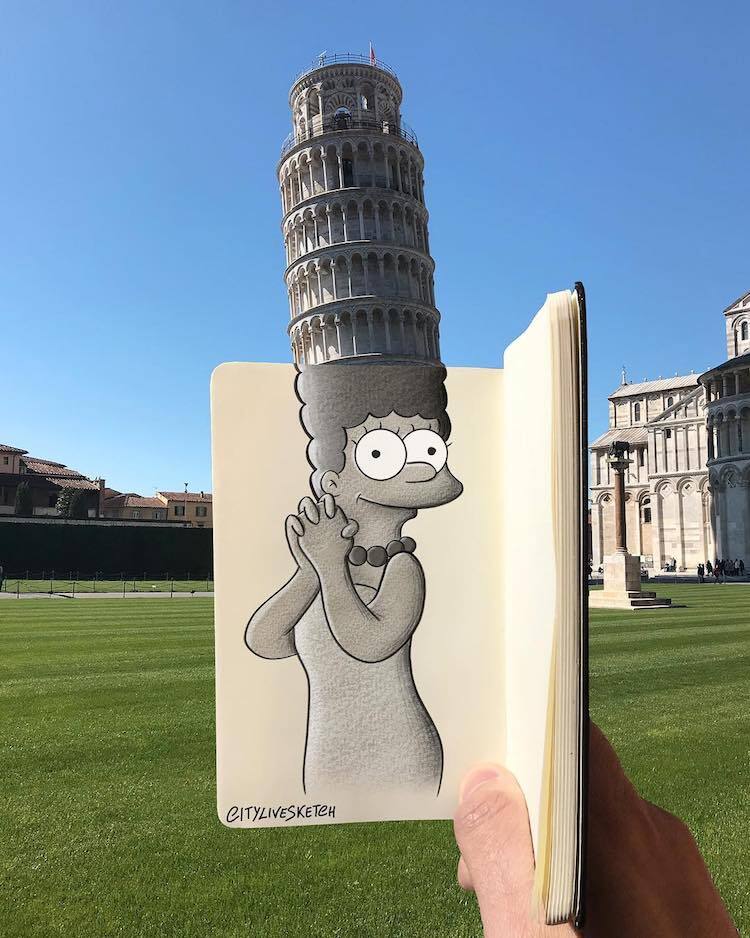
Have you seen the leaning tower of Marge Simpson’s hair?
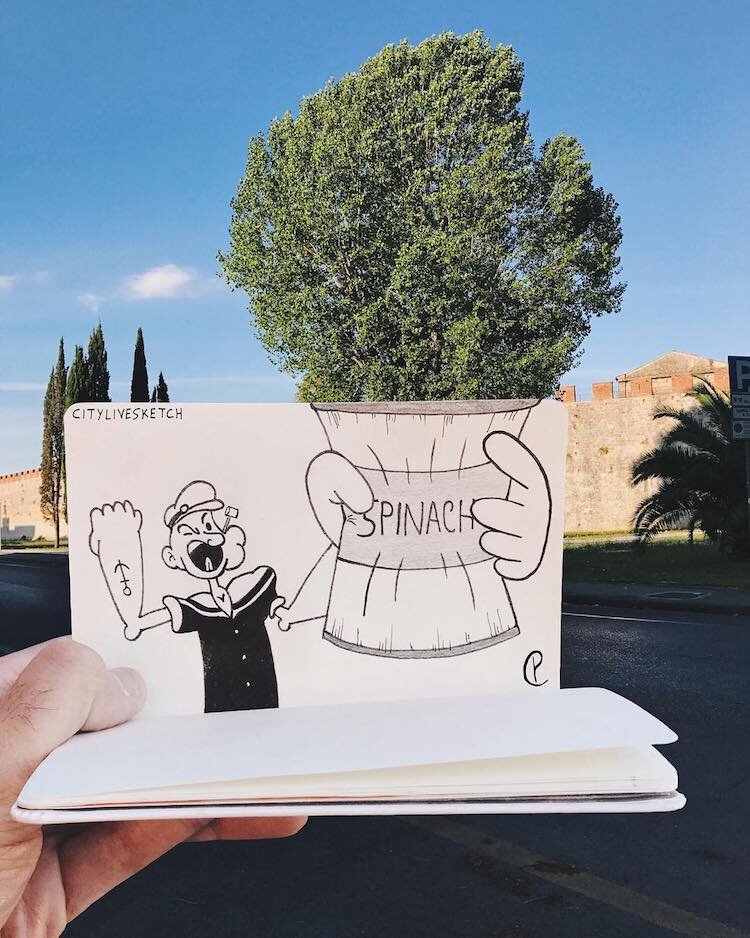
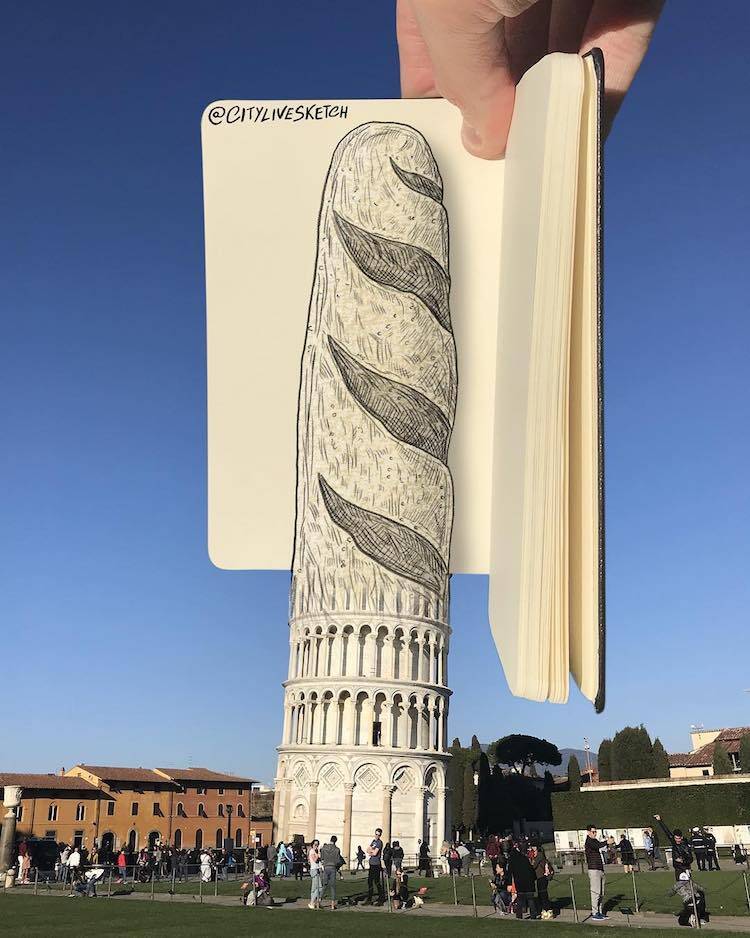
Italian artist Pietro Cataudella takes his sketchbook everywhere he goes, but his drawings don’t just depict of the places he visits—they become part of the landscape. His ongoing project, titled CityLiveSketch, features architectural 3D drawings that seem to jump from the artist’s journals, depicting famous landmarks as part-real, part-illustrated. Most recently though, Cataudella took his imagination a step further by playfully merging buildings and everyday objects with unexpected characters and cartoon worlds.
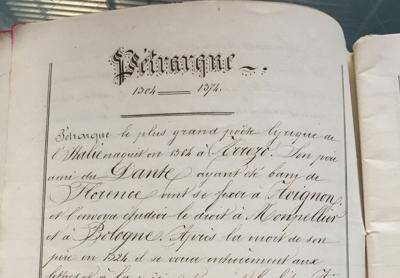
This lovely notebook belonged to Ian McTaggart Cowan, a Scottish-Canadian zoologist and conservationist. The image is from the archives of the University of Victoria, where you can flip through the rest of its pages. (The text is also transcribed next to the images, in case you can’t read the small handwriting!)
The journal covers 1957-1958, when he journey to Japan, Singapore, Thailand and England.
As a follow up to last week’s review of the Arteza Sketchbook and Watercolor Book, Arteza has kindly agreed to offer a giveaway! 2 lucky winners will be selected from all eligible entries:
On Twitter, tweet something containing “Arteza Sketchbooks @NotebookStories @ArtezaOfficialâ€, and follow @NotebookStories and @artezaofficial
On Facebook, “like†the Notebook Stories page and the Arteza page, and post something containing the words “Arteza Sketchbooks†on the Notebook Stories page.
On Instagram, follow @Notebook.Stories and @artezaofficial and comment on my Arteza giveaway post, tagging a friend and adding a hashtag of your favorite adjective describing the Arteza sketchbook or watercolor book. (Example: “@myfriendsally #heavypaperâ€)
On your blog, post something containing the words “Arteza Sketchbooks†and “Notebook Stories†and link back to this post, also leaving a comment below with the link in case the trackback doesn’t work.
Please note that the prize can only be shipped to a US or UK address. The deadline for entry is Friday August 9, 2019 at 11:59PM, EST. Please allow a couple of weeks for me to announce a winner. Good luck everyone!
I always love seeing articles about writers’ archives. I’d love to go through some of those boxes and see all the notebooks within, even if I haven’t read that writer’s work! Saul Bellow is an example… I haven’t read his books, but he left an extensive archive including lots of notebooks, one of which is shown below. Interestingly, his handwritten pages have been used as part of the set design for a theatrical production of one of his novels.
Saul Bellow used 20 notebooks for the draft of his novel “The Adventures of Augie March.” It is on display with other Bellow documents at the University of Chicago’s Regenstein Library. (Abel Uribe / Chicago Tribune)
A look at the Saul Bellow Papers at the University of Chicago, and how they are used to inform the first stage production of “The Adventures of Augie March”…
Created by set designer (and DePaul University Theatre School dean) John Culbert, it’s plastered with Bellow’s handwriting. Even the proscenium arch, crafted to resemble the steel girders of a Chicago elevated train line, is covered in Bellow’s thin, flowing script. That handwriting is culled from the centerpiece of the Saul Bellow Papers, the 20 commonplace notebooks into which Bellow poured the first draft of “Augie March†in 1947. These ledgers were part of Bellow’s initial deposit to the university, and if you believe that “Augie March†endures as one of the great American novels — or at least the Great Chicago Novel, the tale of a Humboldt Park immigrant who discovers his identity amid a cacophony of cultures, compromises and allegiances — then their unvarnished, direct-from-his head-to-the-page scratchings can take on the hallowed aura of seminal, consecrated literary gold.
Make the trek to the top of the Overlook Trail and you are treated to a terrific view and the chance to take a minute to write down whatever’s on your mind. “My feet hurt.†“I didn’t trip once.†And “I’m proud of myself,†are all recent entries in the Hikers Notebook, a spiral-bound treasure trove of thoughts sitting on a stone bench in a plastic box complete with pens and the invitation “Share Your Thoughts or Just Sign In.†…
Roy Tennant is a volunteer trail steward who has been hiking the trail every day for almost a decade. He writes blog entries about his thoughts and findings on the trail’s website, overlookmontini.org, and for its social media pages. He’s now read all 23 of the filled hikers notebooks and is writing about the most interesting comments for the blog. “I wondered what we were doing collecting all these if you are not going to share some of the entries,†he said. “I’ve been plowing through them and photographing the most interesting pages.†He started in March and said “the vast majority express gratitude and encouragement.†Since the writers have not given their permission for their words to be printed names are not shown in the photographs of pages included in the blog. (Names are also not included in this story.) “It’s very interesting and hugely gratifying,†he said about the project. “It’s wonderful to see how much people appreciate the trail.â€
I’ve been seeing Arteza art supplies popping up on social media for quite a while and was curious about the brand. When I noticed that they offered a nice chunky looking 3.5 x 5.5″ sketchbook, I was even more intrigued! The company kindly provided me some samples to review, so let’s take a look.
Arteza Sketchbook
First, that sketchbook that initially caught my eye. I have to say right off the bat that part of the eye-catchingness is the price! Arteza Sketchbooks are sold in 2-packs, for $13.99! (Currently even less at Amazon.) Under $7.00 per sketchbook is a pretty hard price to beat for a hardcover in this format.
The Arteza sketchbook is a bit thicker than some of the competition– it reminds me of the HandBook Artist Journals, or the Hahnemuhle Travel Journal. The black cover of the Arteza looks pretty standard at first, but when you see it in person, it actually has an immediate distinguishing detail– it has an unusual texture somewhat reminiscent of a handmade paper with plant fibers, or perhaps like icy frost on a window in winter. The cover overhang is pretty minimal, which was another thing that caught my eye. The Arteza brand name is stamped on the back cover but it’s almost impossible to see due to the cover texture.
Arteza pocket sketchbook front
Arteza pocket sketchbook back
Arteza pocket sketchbook compared to red HandBook Artist Journal
Arteza vs. Handbook Artist Journal
Arteza vs. Handbook Artist Journal
Arteza vs Moleskine sketchbook
Arteza vs Moleskine pocket sketchbook
The ribbon marker is red, which provides a nice pop of color. The two-tone elastic closure and clear plastic pocket in the back are additional similarities with the HandBook Artist Journal.
Inside the front cover there is a space to write your name. The endpapers are otherwise plain, but they are actually quite surprising. Or perhaps I should say there aren’t really endpapers at all. Normally, endpapers are a totally separate sheet glued to the inside front cover and the first signature of pages, but in the Arteza sketchbook, it’s like they sewed an extra folded sheet into the endpapers so you have 4 pages tucked in there, separate from the rest of the signatures. I have never encountered this in any other bound notebook or book. I suppose it could theoretically add strength to the binding to have stitching as well as glue holding the end papers to the rest of the book block, and it means you don’t get that unusable page right at the beginning where the glue prevents it from opening all the way… but you still get a glued page a few pages further in. And in the Arteza sketchbook that I tested, I found that the binding was already coming loose at the point, especially in the back of the sketchbook where it totally separated almost right away. I think the stress at this point is caused by the stiffness of the cover around the spine– it isn’t soft enough to tuck inwards, and it doesn’t bend out into a round shape to take the pressure off the attachment points to the front and back cover.
Arteza sketchbook inside front cover
Extra pages inside endpapers
Arteza sketchbook clear plastic back pocket
Arteza sketchbook spine
Arteza sketchbook
The paper inside the Arteza Sketchbook is 175 GSM, noticeably thicker than the paper in my HandBook Artist Journals though it has a similar toothy texture. To me this texture what I want to use for writing, but I found that it felt ok with fine gel ink pens. It did get quite feathery with fountain pens and a few others. But it is very good on bleedthrough and showthrough. It works well for pencil and charcoal and seemed to hold up fine to moderate use of watercolor paints.
Arteza sketchbook watercolor test
Arteza sketchbook back of watercolor test page (left) and pen test page
Again I have to call out the similarity to HandBook Artist Journals, as they use a similar grey linen cloth cover on their watercolor sketchbooks, though HandBook doesn’t offer one in this size. I love the soft feel of the cover, and the color is really attractive. On this one, the brand name is even harder to detect on the back– if you are looking for it you can see that something’s there but they might as well not have bothered. The Arteza watercolor book also feels nicely thick and chunky– you can see below how much thicker it is than a Moleskine watercolor book.
Arteza watercolor book
Arteza watercolor book
Arteza watercolor book
Arteza watercolor book vs. Moleskine watercolor book
Arteza watercolor book vs. Moleskine watercolor book
Inside, Arteza has again used the weird extra page inside the endpapers but the spine is more rounded so it seems to be holding up a little better to being opened flat.
The paper inside is cold press 230 GSM with a fairly smooth texture. I thought it worked fine and held up to wet washes without buckling much, though it did warp slightly more than the Hahnemuhle Watercolor Book I reviewed recently. I also thought colors looked a wee bit more vibrant in the Hahnemuhle. But the Hahnemuhle book costs twice as much!
Arteza watercolor book test page
And that brings me to the conclusion on these Arteza sketchbooks– they are an incredible value at this price. I have some concerns about how well the bindings will hold up, but they are really appealing sketchbooks that won’t break the bank. If you are a professional artist who is really picky about materials, or if you are a traveler or hiker who needs something super-durable, they might not be for you, but for students, kids, casual art journalers, and everyday mess-around-ers, they are a great alternative to some of the more expensive brands. I’m quite curious to try Arteza’s other art supplies– they offer a wide array of well-priced goodies for all kinds of arts and crafts, perfect for beginners who want to try something new!
If you order directly from Arteza using these links (SketchbookWatercolor Book), use coupon code NiftyNotebook1 to get 10% off. The coupon code is valid until Aug. 31, 2019. Or if you prefer, use the Amazon affiliate links below (I receive a small commission on orders placed via Amazon links.)
Here’s an interesting question for those of us who have fragile antique notebooks– how do you protect and preserve them?
Q: I have my grandmother’s 105-year-old notebook with her beautiful calligraphy. The ink is fading, and the pages are becoming more and more brittle. What is the proper way to preserve it? And is there someone who could digitize the notebook and make high-quality copies of the pages without damaging it?
In this case, the recommendations include contacting a professional conservator who can assess the paper and ink and potentially treat the notebook to combat acidity.
First discovered by the journalist Nick Bryant, Mr. Epstein’s little black book has resurfaced as part of the current investigation into the sex crimes Mr. Epstein, a 66-year-old financier, has been charged with. (Last week, a federal judge denied his request to await trial at his $56 million Upper East Side mansion.) Alfredo Rodriguez, Mr. Epstein’s former house manager, attempted to sell the book; it was published in 2015 by Gawker, with the telephone numbers redacted. Described in an F.B.I. affidavit in 2009 as “a small bound book,†the item contains the names of people who viewers theorized may have known Mr. Epstein socially. Being in the book suggested a fuzzy complicity: Might these people also have known, or had some sense, of his crimes?
…
Mr. Epstein’s book has become a symbol of the exclusive world of the very famous and very rich, and the secret life the financier lived. That makes it the latest in a line of “little black books†that have played key roles in crime stories as far back as the mid-18th century, when Samuel Derrick conspired with Jack Harris, the “Pimp General of all England,†to create an annual guide to London’s prostitutes and their specialties. It ran hundreds of names long and was known as “Harris’s List of Covent-Garden Ladies.†Ever since, the term “little black book†has come to represent something of a secret directory both in true crime tales and in the arts; a list passed along among insiders and conspirators; a source of illicit knowledge and a record of it that could be weaponized. The little black book has transcended mere notebook status to become a cultural trope, symbol and narrative device. (Also, on occasion, a gift item.)
The article goes on to trace various examples of little black books being used to hold lists of ex-lovers or other sorts of scandalous contacts. Unfortunately, there aren’t any pictures of the notebooks except for this one!
I’ve had many little black notebooks, but the only one that might have qualified as a “little black book” was a black plastic looseleaf notebook that I used as a pre-teen. In it, I created pages about various kids I knew at school, noting whether I liked them or not, whether they’d been mean or nice to me, whether they were smart, or pretty, or good at sports, etc. Nothing all that scandalous, but I remember looking back at some of my comments and being embarrassed enough that I’d never show it to any of those people today!
Whenever I see stories like this, I cringe! As far as I can remember, I’ve only lost one notebook in my life, a rather cool one I was using in 7th grade that was probably stolen rather than lost. I never did find another one like it, and it’s haunted me ever since! So I very much empathized with this Milwaukee TV news video about an artist losing a sketchbook. She is offering a $100 reward.
MILWAUKEE (CBS 58) — A local artist needs your help after losing a precious piece of her artwork. Judith Friebert of Shorewood lost a sketchbook after attending church services at the First Unitarian Society on Astor Street. “It’s just a terrible sinking feeling when you’ve lost your sketchbook,†Friebert told us. It was a quick mistake that caused Friebert to lose the collection of sketches.
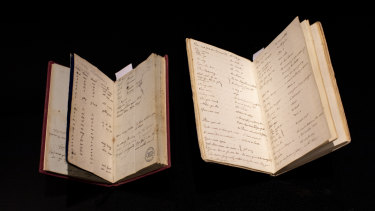
Some fascinating historic notebooks recording the first contact between British settlers and Aboriginal people in Australia:
A set of 1788 notebooks recording the first attempts at communication between British settlers and Indigenous Australians reveals language that is still in use in Sydney Aboriginal communities today.
The Dawes notebooks, named for First Fleet officer William Dawes who recorded his discussions with Aboriginal people of La Perouse, are on international loan from the UK for the State Library’s landmark exhibition, Living Language: Country, Culture, Community, which opened [July 13, 2019].
The notebooks include exchanges between Dawes and Woollarawarre Bennelong, as well as his second wife Barangaroo. Bennelong served as an interlocutor between the British and the native people.
“Lieutenant Dawes was just really interested in not just the culture, but getting to know the people and their nuances,” said the Library’s Melissa Jackson, a Bundjalung woman who previously lived in La Perouse.
“I’ve been able to read them before on microfilm – but to see them in the flesh is just very humbling.”
The notebooks are incredibly important to Aboriginal people because they retain the conversational context which is crucial for contemporary language revival work today.