
Yikes. I have to admit it took me a minute to realize this was satire!
Notebook Addict of the Week: Austin Kleon
Bestselling author and artist Austin Kleon keeps some great notebooks (see here for other posts I’ve done featuring his work) , and I love this shot of some of his collection. Based on the dates, he goes through about 8 per year, and this photo was from March 2018, so I’m sure there are quite a few more by now! Definitely qualifies as an addict. [UPDATE: a reader asked what brand these are. I believe they are Zequenz notebooks. Miquelrius also makes a similar thick softcover notebook. He also uses Moleskine daily planners.]
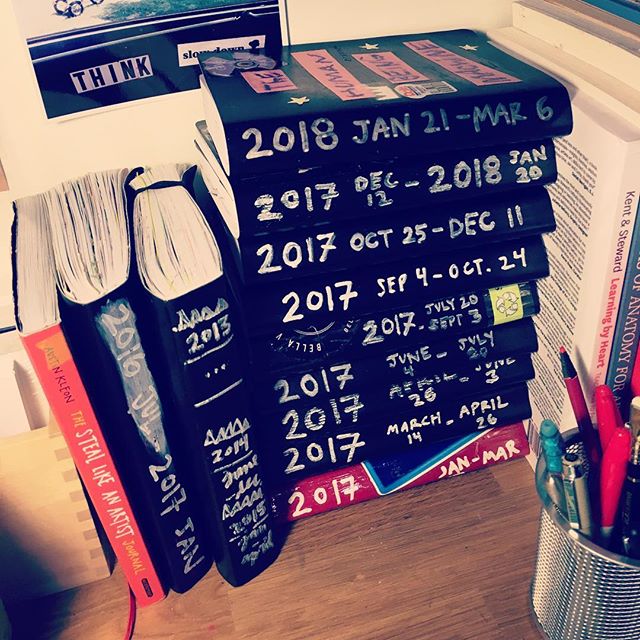
See lots more from Austin Kleon on Instagram and his website. And check out his books, the newest of which is coming out in April 2019:


Richard Diebenkorn’s Sketchbooks
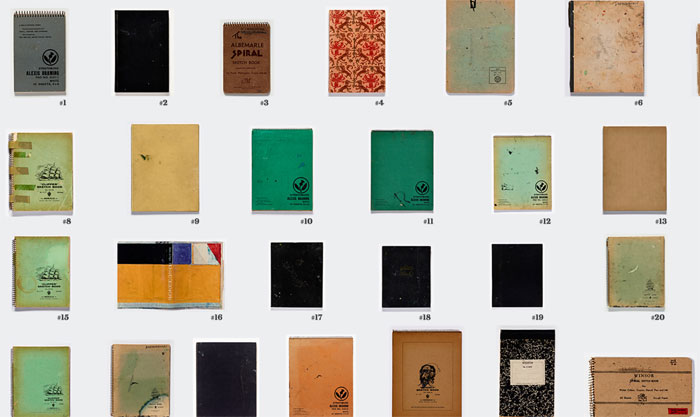
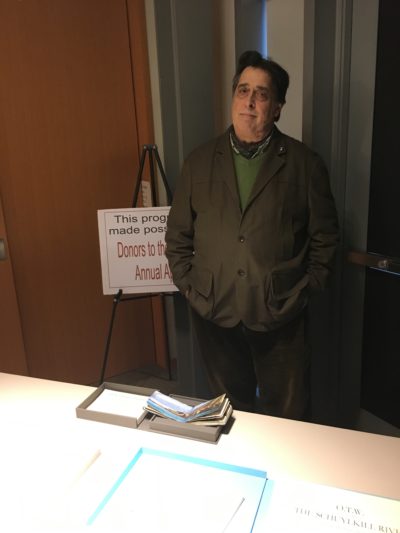
I love this image of the artist Richard Diebenkorn’s sketchbooks. Such an interesting variety, and they’re all digitally archived at Stanford.
“The Cantor Art Center completed the digitization of all twenty-nine books, making them accessible in the exhibition on touchscreens and here on the museum’s website. With these, one may now leaf through the books digitally and see every sketch in the order conceived, gaining insight into the way Diebenkorn experimented with line, shape, form, and perspective and creatively tackled challenging subjects.”
(Source: Richard Diebenkorn: The Sketchbooks Revealed)
The interactive flip-throughs on the Stanford University website are fantastic.
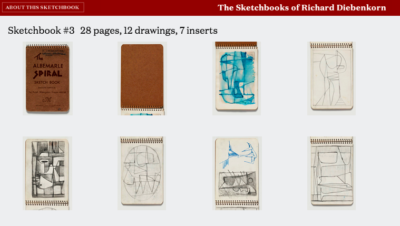
Throughout his long career, seminal California artist Richard Diebenkorn (Stanford BA ’49) always kept a sketchbook—a “portable studio,” as he called it—to capture his ideas. The books contain 1,045 drawings that span the artist’s career and represent the range of styles and subjects he explored—both gestural renderings of mundane, everyday items and powerful vignettes of intimate family moments. In the pages of these books, we see brief visual meditations upon vistas encountered through travels, carefully built-up studies that would become the large-scale Ocean Park paintings we know so well, and a multitude of renderings of the people who surrounded him over the years, revealing his fascination with the human figure.
A couple of Diebenkorn’s sketchbooks are “Clipper” sketchbooks similar to one I used in high school.


I wondered what had happened to the Morilla Co. There isn’t much information online about them, but it seems they were acquired by Canson, though there is no mention of them in Canson’s company history. The Clipper sketchbook has sailed off over the horizon…
The Christmas Notebook Tradition
A sweet notebook story for Christmas! Happy holidays to all!
Every year around the end of November, my family starts decorating for Christmas. There are trees (yes treeS) and lights, ornaments and Santa figurines, but my favorite thing is a little orange spiral notebook. Let me explain…
When my parents were married, almost 36 years ago, my Dad had just enlisted in the Navy. As luck would have it, he got his first set of orders right at Christmas time. Unfortunately, this meant that every few years my family had to pick up and move across the country right at the height of the holiday season. Well, this did not sit well with my mother who worried about never being able to recall which location we were in each year, and thus the Christmas notebook was born!
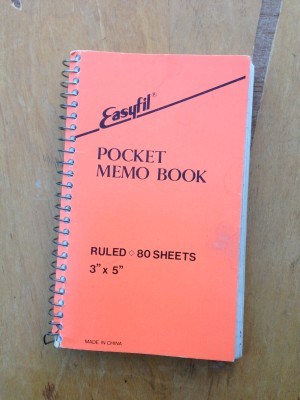
Read more: The Christmas Notebook: The Christmas tradition from a semi-nomadic family | Offbeat Home & Life
Review: Samsill Pocket Journal
Samsill is another brand I’d not heard of until browsing around on Amazon. The company is an independent manufacturer of business accessories such as ring binders and laptop cases, founded in Texas in 1953, and now making their products in partnership with manufacturers in China and Mexico, while still maintaining headquarters and some manufacturing facilities in Texas. Their company history is actually quite fascinating.


I didn’t know all that background about the company before I ordered, but from what I could see online, this notebook seemed worth a try: 3.5 x 5.5″ format, red cover with stitched edge, and at 240 pages, it has a sort of thicker look without too much overhang. Shown with a pocket size Moleskine for comparison below.
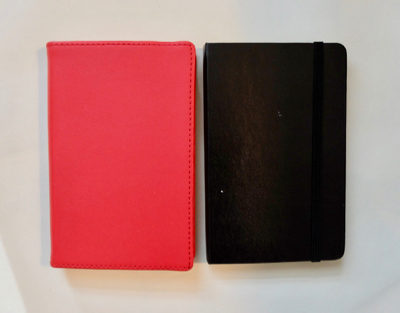
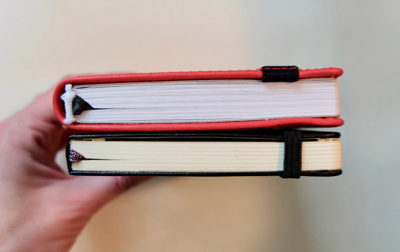

When my order arrived, I thought the notebook looked pretty good– everything noted above was true to the description. The bright red cover feels nice and substantial. The wide elastic band seems sturdy, and it’s tight enough to sit neatly on the back cover without flopping around when you aren’t using it. But then the dream started to die…
First I noticed the headbands– I prefer not to have these at all, since they are almost always decorative and don’t add any strength to the binding. To me it just looks stupid to have a little string glued on there, and on the Samsill notebook, it looks particularly bad as they are rather frayed.

I also noticed that the elastic closure is attached in an unusual way– it goes all the way over the top and bottom of the cover and is stitched on, and presumably glued under the back cover. Maybe this is stronger than the way most elastics are attached through holes in the back cover, but it seemed like it might cause the stitching to come loose over time. There is no pocket in the back.
This is how the back cover looks when the elastic is wrapped around the front of the notebook:
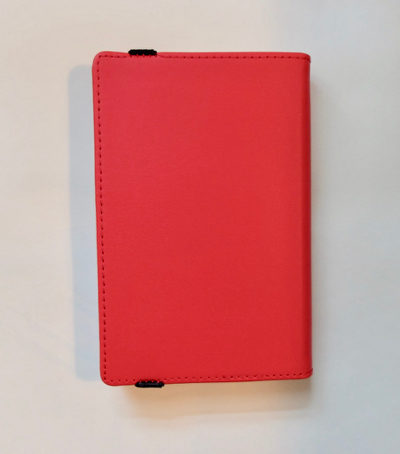
When you aren’t using the elastic to hold the notebook closed, it looks like this on the back:

It’s when you open the notebook that the disappointment increases. The binding is really stiff, and there is an extra piece of cardboard under the endpapers that makes it feel like you’ll break the binding if you open it all the way. Once you’ve crushed it open and flexed the spine a bit, the notebook does open fairly flat, but it offers a lot of resistance against staying open, and after you’ve opened it, it won’t stay closed all the way without using the elastic.
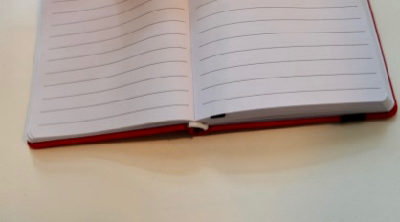

The cool white paper has relatively dark lines that do not go all the way across the page, and there is a wider header space at the top. I wish I could say that the paper made up for this notebook’s other faults, but alas, it did not. Fountain pens, and many others, were feathery messes. There was slightly more than average bleed-through. Show-through was about average. My favorite gel ink Uniball Signo RT 0.38 pen felt great as the paper is quite smooth, so if you only use this or a Pilot G-2, you’d be fine.


I was shocked to see that the black pocket size version of this notebook currently costs $21.50 on Amazon! Amazon often has some weird price fluctuations, but that is pretty shocking, given that the red pocket version is only $8.42. (I paid $8.95 when I ordered mine, about a year ago.) Blue and green are also available, as are larger sizes– strangely, a 7.5 x 10″ black notebook is only $5.56 right now! A dot grid version is available, though currently only in a medium size. But honestly, I can’t really recommend that you buy this notebook unless you plan to just hold it in your hands and never open it. One other possibility could be to cut out the paper and use the cover to bind some other paper– I am seriously considering trying this to see if the binding can be made more flexible.
After learning about the history of the company, I really wanted to like the Samsill notebook more– I’m always happy when I find an American stationery company that hasn’t been swallowed up in corporate mergers. Journals don’t seem to be a major part of their product line, but it would be nice if Samsill tweaked their notebook design a bit to improve the quality while maintaining the mostly attractive and sturdy exterior.
“Leuchtturm1917 is Breaking My Heart”
A regular reader contacted me to share her woes about her favorite notebook brand: Leuchtturm 1917. I’ve reviewed this brand but never used one long-term, so I was happy to be able to share the thoughts of someone who has had more experience with Leuchtturm over the years:
I thought it might be interesting to update you on my current experience with this brand and how the notebooks have lasted over the years. My go-to notebook is the softcover pocket Leuchtturm1917. I initially found one with a white cover in a local bookstore and fell in love with everything about it, in particular the fact that it lies flat and has creamy off-white paper that is very lightly lined and feels soft to the touch. After that I purchased quite a few more from the Kikkerland Design website, which they no longer carry. For a while they even had a light blue softcover version available in pocket and medium size, which I suspect were their “trial” designs that probably did not see enough sales and were discontinued. Softcover Leuchtturm1917s are now sold in a variety of colors, but I have yet to find another softcover in light blue or white; however, the cover color is the least of my woes. I have witnessed how over the course of only three years the Leuchtturm1917 has slowly met the same fate as the Moleskine brand. Sadly, they too have drastically declined in quality. In my humble opinion, Leuchtturm1917, whose motto is “Details Make All The Difference,” dropped the ball and is breaking my heart.
The very first batch of Leuchtturm1917s I have feel like an entirely different notebook compared to what is currently available. This goes for online orders from Amazon or the Leuchtturm1917 website. Even in my travels I have noticed these notebooks are all facing the same fate world-wide. They now have the double bookmark, but apart from that supposed improvement everything else about the notebook has taken a turn for the worse.
The current Leuchtturm1917s have a stamp on the last page that reads “Made in Taiwan,” whereas the original ones did not have any markings as to where it was made. I recently tried out a dotted softcover version and noticed the stamp now reads “Made in China,” and this version has the worst paper and horrible binding that no longer lies flat. In fact, the notebook is so poorly constructed that the cover does not close at all. The binding appears to have more signatures than the original ones, but still the same number of pages. The paper is just plain white and has a rough texture like a regular sheet of paper, and the lines/grid/or dots are all much darker than before. The hardcovers I’ve seen in stores all have cover overhang, a pet peeve you and I both share! Interestingly, I even noticed the older Leuchtturm1917 weight a little more than the new ones, further proving that they have switched to cheaper paper but still charge the same price.
I had written to them on their website to bring attention to the quality issue, but have yet to receive a response. This reminded me of your posts about the Moleskine brand and how you were on a quest to find the “good” ones after they declined in quality. I am afraid Leuchtturm1917, just like the Moleskine, are becoming mass produced and no longer the same great notebook it was when it started.
I have included some photos of my collection to demonstrate comparisons of the old Leuchtturm1917 and the new, unimproved.

Leuchtturm notebook comparison 
Leuchtturm notebook binding comparison 


Leuchtturm notebook index comparison
A coworker of mine recently showed me her new Leuchtturm, having not used one before, she thought it is great but I could see the decline in quality. Sometimes I think brands do not really care about disappointing long term users of their products, because a lot of “newbies” who don’t know what they are missing out on come to replace us in greater numbers.
I am glad I have my little stash of the old versions and just wish I had saved more, had I know this would happen.
I can’t say I’m surprised. I’ve read that the cost of paper has increased a lot recently, and I’m sure every notebook brand is struggling to stay competitive. I’ve written quite a bit about Moleskine’s declines in quality, and in recent years I’ve noticed other brands like HandBook Artists Journals where the stock in stores is not as nice to older ones in my collection. Must all good things come to an end? Has anyone else noticed changes in their favorite notebook brand?
My thanks to our correspondent for her detailed comments and photos.
James Lancel McElhinney on Painted Books

I am always inspired by artists working in sketchbooks, so it was a treat to attend a talk by a master of the form. At the Ridgefield, CT Library, the artist James Lancel McElhinney spoke on “Painted Books: From the Age of Exploration to the Digital Era.” McElhinney traced the history of art created on pages, from Egyptian papyrus scrolls to illuminated manuscripts to Native American ledger art to the sketchbooks of fine artists, explorers and naturalists. He also touched on more recent work by artists who are using book-like forms or transformed books in sculpture or installations.
Before the invention of printing and mass reproduction, painting and drawing on pages was the only way to capture art in a book. More recently, many artists have used sketchbooks just as a way to capture ideas and memories in the field, to be transformed into paintings in the studio or to be reproduced as prints, but McElhinney reminded us that the book form itself can be considered an alternate surface for an artwork, on the same level as a canvas or panel or wall. The sketchbook IS the artwork, not just a byproduct of the process. The audience collectively winced when McElhinney told the story of an art dealer who had bought an intact antique sketchbook (I forget who the artist was) but then cut it up so he could re-sell the painted pages within as individual sheets.
McElhinney’s own journal paintings are gorgeous, and he showed us quite a few of them after the end of his formal talk and Q&A. He said that in recent years, he’s become much less interested in standing at an easel in the studio, and prefers to paint in watercolor in small sketchbooks/journals (he uses pocket size Moleskine watercolor albums), capturing views of landscapes along the Hudson River, in Iceland, and in Hawaii, among other places.

His paintings strike a lovely balance between loose immediacy and polished realism. He tends to lay out his compositions with an orange pen, which adds a unique glow when it peeks out from under his intense, skillfully modulated watercolors. I asked him for his thoughts on using a sketchbook to just roughly capture a quick idea vs. executing a more refined painting. His response was that he does both: he stops when he’s finished learning from a page.

McElhinney has sold some of his sketchbook art in portfolios of prints which beautifully capture the physical sketchbook spreads with page edges and cover edges peeking out and slight shadows making them look three-dimensional. He said he would even sell an original sketchbook under the right circumstances, but I couldn’t help wondering how he could bear to part with it! Some of the other attendees also wondered about the difficulty of creating art you can sell while executing your work on both sides of the page in a sketchbook that you keep in your pocket. McElhinney agreed there are challenges: “you’ve got a book that’s 90% full and you take it out in the field and you’re worrying what will happen if it falls down a storm drain…” I shudder to think of it!

I so enjoyed getting an up-close view of the original Hawaii journal he brought to the event, and of course agree with his closing comment that “the book as a form is really wonderful.” You can view animated flip-throughs of some of McElhinney’s sketchbooks on his website. On this page, you can view full PDFs of his painted journals. McElhinney is also the author of several books. You can keep up with his news and events at this page or via his blog. Check out his work in person if you have the chance! Any sketchbook lover will find it inspiring.
Fred’s Notebooks

I love it when readers share their own notebooks, whether it is a whole collection or just one. Fred, a reader from the Philippines, sent these photos of his notebooks, which contain a great mix of drawings and collaged items.


Notebook Addict of the Week: Alan Reed
I saw Alan Reed’s sketchbooks on Twitter and had to stop and gaze for a while… a lovely collection.

You can see more of Alan’s work at his website, AlanReed.com. He posts some great painting videos too!
PAIPURÂ Notebooks
Here’s a notebook with a layout I haven’t seen before: dot grid on one side and ruled on the other.
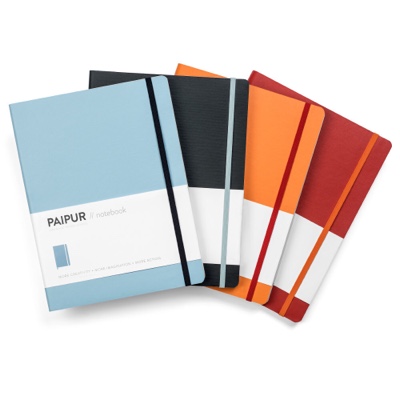
They make a few different versions, each of which comes in various colors.
Wide spaced with 100 GSM paper
Narrow spaced with 100 GSM paper
Fountain pen edition with 120 GSM paper (available with blank, wide or narrow spaced pages)