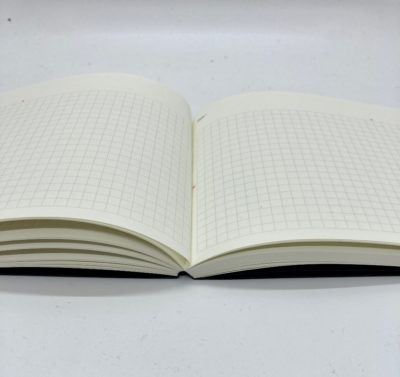
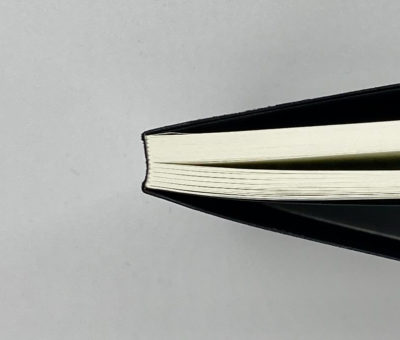
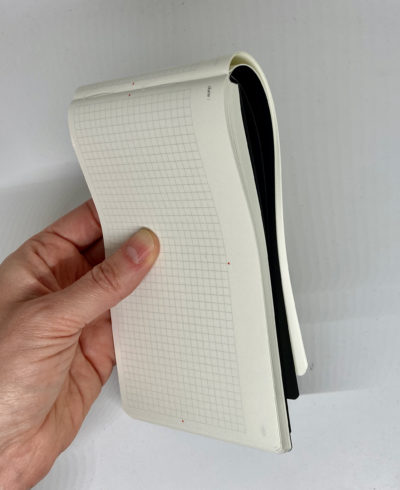
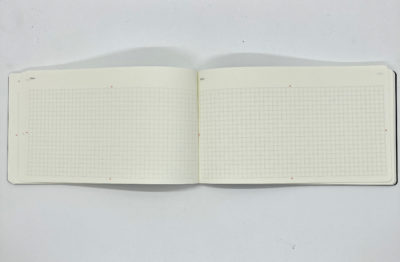
If you’ve wanted to try a Nolty Gold planner but haven’t wanted to deal with shipping from Japan and high prices, now might be your moment!
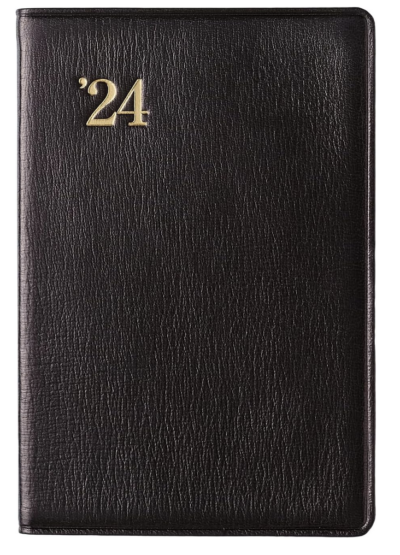
I just spotted a listing on Amazon.com for the model 3121 that I use, the 95 x 145mm size, with a gorgeous leather cover. The price I am seeing as of this writing is $45.86 with free shipping. That is a lot less than any other price I’ve seen for US delivery. Snag it while you can! 2024 is still young!
This post contains affiliate links, from which I earn a small commission on any purchases.
I had never seen the movie Elf. The 20th anniversary re-release has had people talking about it, and several people I know said it was their favorite Christmas movie, so I decided to watch it. It was pretty cute, but of course my favorite part was the appearance of a notebook!
The notebook belongs to the character Miles Finch, a children’s book author who has filled it with story ideas.
I would guess that the notebook in the movie is a very common 4×6″ hardcover sketchbook similar to ones made by various manufacturers, such as Canson, Stillman & Birn, Daler Rowney, and Artlicious, among others.
There’s also a “Miles Finch” notebook for sale on Amazon, which is a cute idea, but it doesn’t sound like the same type of notebook at all, as it is larger than the one in the movie. It’s basically just a 6×9″ paperback lined notebook that says Miles Finch on the cover.
Hope your holidays are happy and full of notebook sightings!
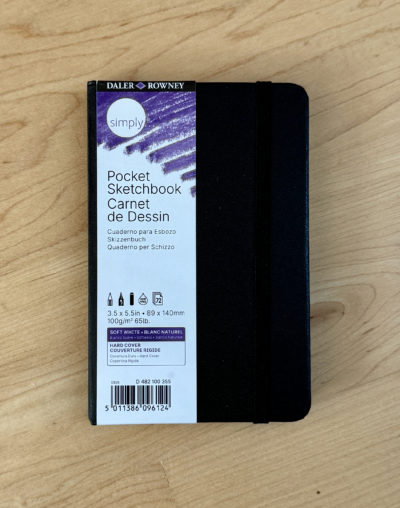
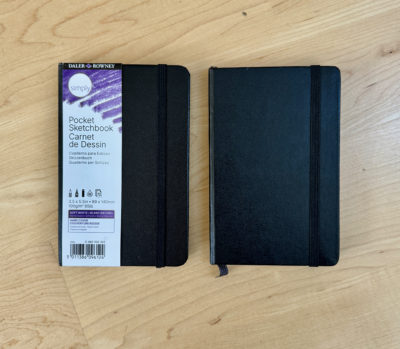
I first heard about the Daler Rowney Pocket Sketchbook on an art supply website somewhere– unfortunately I’ve lost the link, but it was a glowing review that got me very intrigued, especially since it was said to be available at a very low price from Walmart. It took me a few tries to find a Walmart store that actually had one on the shelf, but let’s take a look at the one I bought.
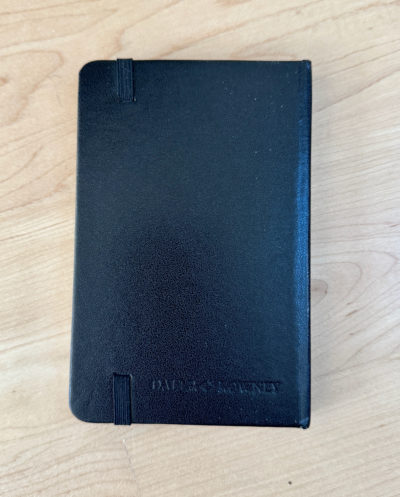
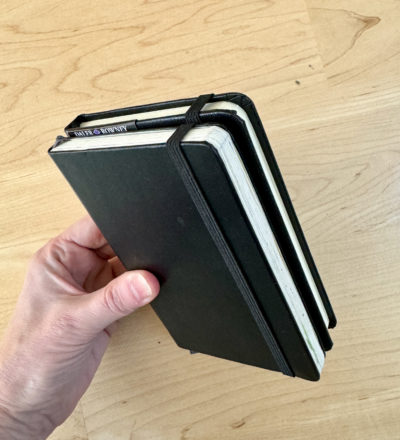
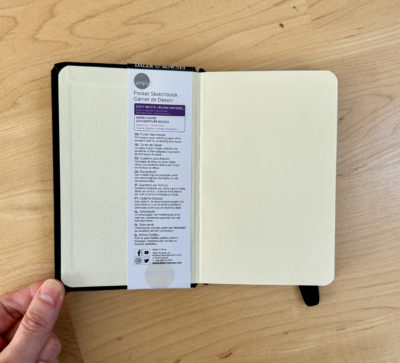
My first impressions of this notebook were really not promising. It has a very standard black Moleskine-clone look but with a rather cheap feel to it, with the exterior reminding me of the Piccadilly notebooks I bought years ago. The branding is all on a removable paper band except for the Daler Rowney name stamped on the back cover. So many notebook brands mark their name in this spot, but oddly, Daler Rowney doesn’t center theirs in the middle of the back cover like everyone else, instead putting it to the side, sort of centered between the elastic band and the spine.
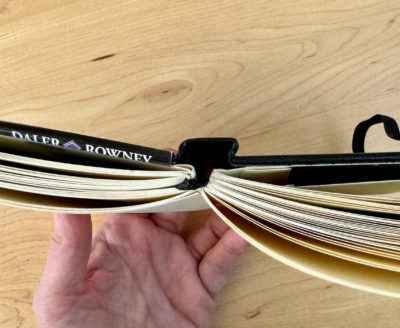
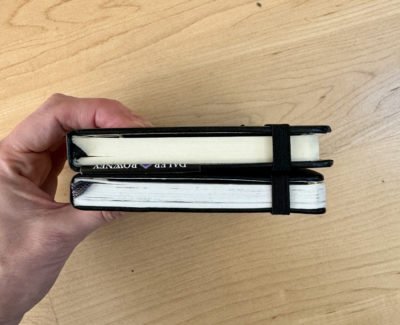
What bugs me most about the Daler Rowney sketchbook is that the corners are a little askew and there is a huge overhang. The spine seems like it will be susceptible to splitting where it bends.
The Daler Rowney is shown compared to an early-2000s Moleskine sketchbook below:
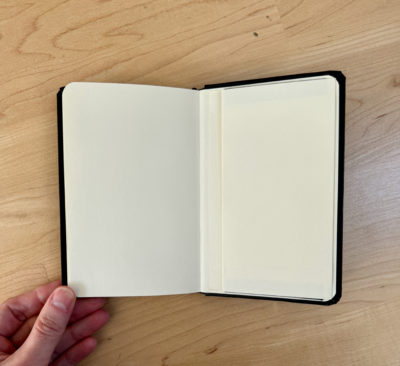
Inside, the Moleskine-ish-ness continues with a ribbon marker and a back pocket.
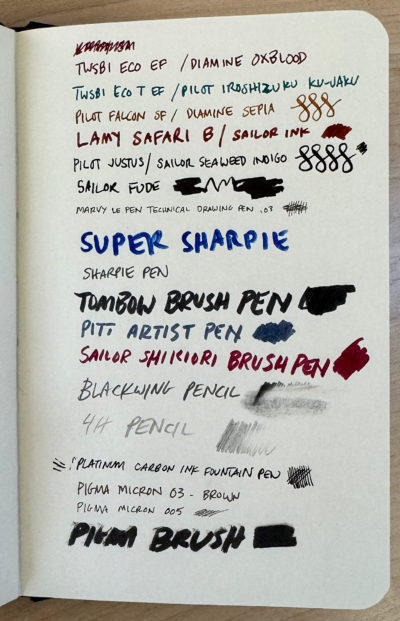
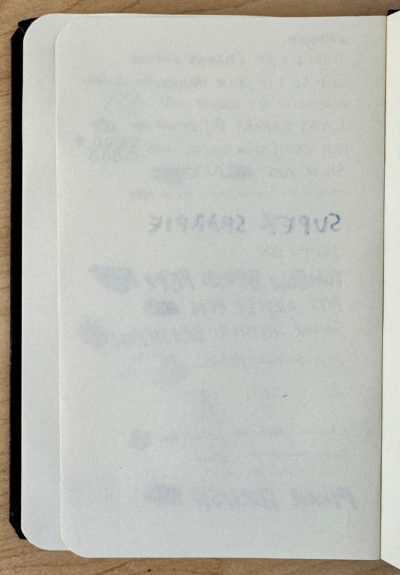
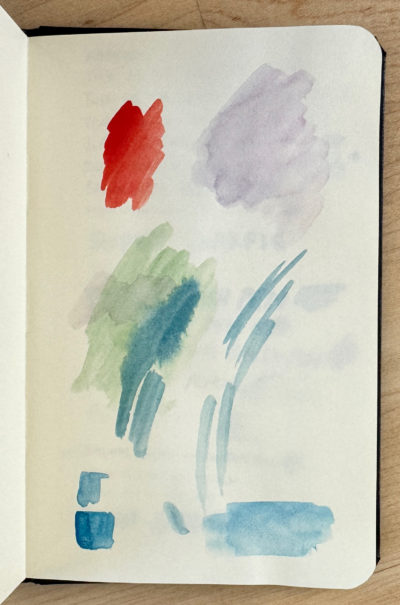
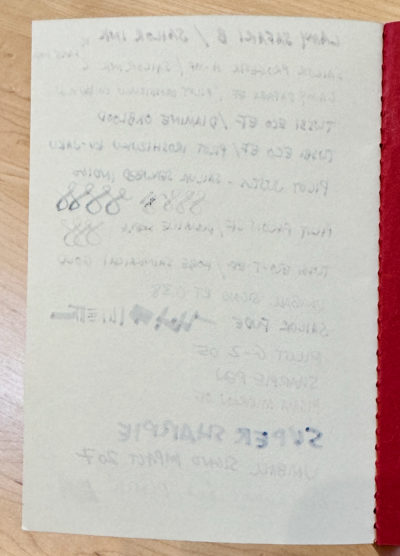
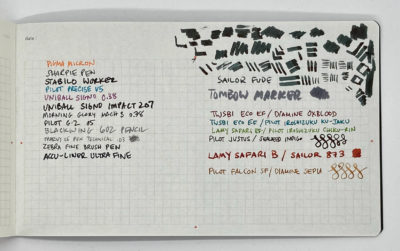
The paper also has a creamy tone and smooth texture (described as “medium grain”) similar to a Moleskine sketchbook. But there the similarities end. The Daler Rowney sketchbook paper feels thinner than Moleskine’s sketchbook paper. But Daler Rowney’s paper is 100 GSM, and it actually works really well with a variety of materials! Fountain pens, markers, gel ink, pencil– all my usual tests resulted in better than average performance on show-through, and no bleed-through or feathering except for the Super Sharpie. I also tested some moderate watercolor usage and it seemed fine, without the paper disintegrating or warping too much. This would be a great sketchbook to use as a visual journal where writing and sketching could be combined with marker or watercolors. (And it’s a huge improvement over the last Daler Rowney sketchbook I reviewed in 2014!)
Best of all, this sketchbook is an incredible bargain! At Walmart, it’s only $5.84, and a pocket size softcover is also available for $2.17. You can also find Daler Rowney sketchbooks in various sizes and binding types on Amazon— most are very inexpensive, but for some reason this exact 3.5 x 5.5″ hardcover sketchbook costs a lot more on Amazon.
I can’t 100% recommend this sketchbook due to the construction feeling a little inferior– if I have a chance to use it for an extended period and feel that it holds up well, I’ll update this review, but aside from my suspicions about its durability, it’s just not ideal aesthetically. However, if you want a budget-friendly Moleskine alternative that you can pick up at your local Walmart, this is a great option!
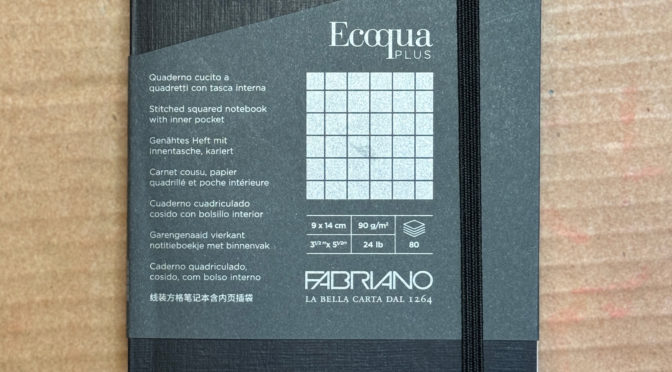
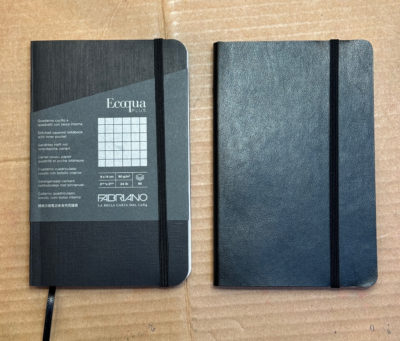
In all the years I’ve been blogging, I don’t think I’ve ever reviewed a Fabriano notebook. This seems like a strange omission, as I am pretty sure I’ve bought Fabriano notebooks before, but as far as I can tell, the only one currently in my possession is this Ecoqua Plus softcover notebook, purchased quite recently.
I’ve seen displays of Fabriano notebooks in stores for years, usually in larger sizes, or staple-bound formats. But it’s only recently that I’ve seen hardcover and softcover notebooks in my preferred pocket Moleskine-ish format of 3.5 x 5.5″. I decided it was time to take the plunge and try one!
I chose a rather un-adventurous black softcover notebook, with squared pages. It is very similar to a Moleskine softcover in a lot of ways– ribbon marker, elastic closure, back pocket. Various exterior colors are available, as are different page layouts: plain, lined, squared, dotted. But there are some important differences that make these a lot nicer than a Moleskine (shown below for comparison).
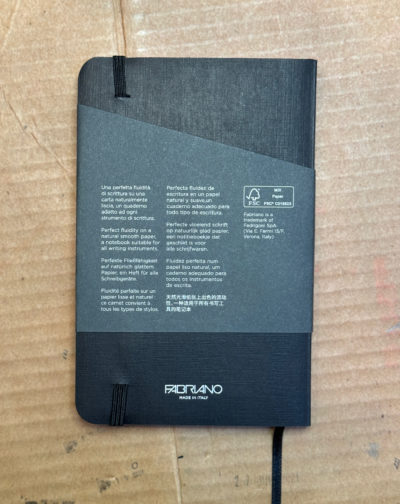
The exterior cover is a sturdy paper, with a smooth surface and a faux-cloth texture. The Fabriano logo appears on the back cover in a silver metallic ink, but otherwise, it’s totally plain once you remove the paper band with the product info. If you prefer the faux-leather texture of the Moleskine cover, you might not like the Fabriano material, but it looks attractive and feels sturdy.
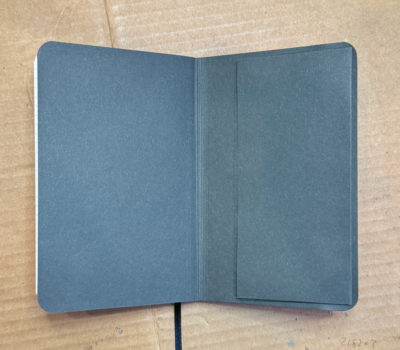
The inside covers are plain black paper, or perhaps charcoal grey, as they are slightly lighter than the black of the cover. I love the look of black endpapers, though they limit what pens you can use to write on them.
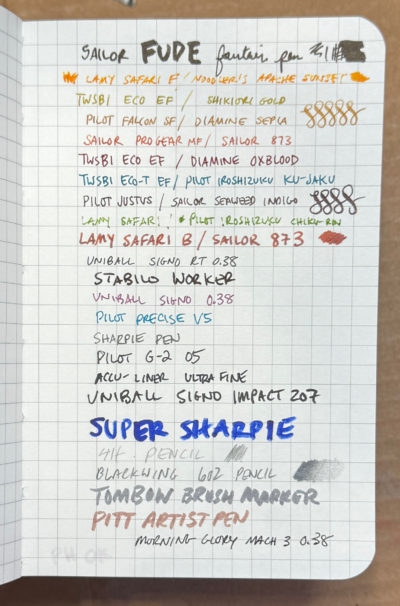
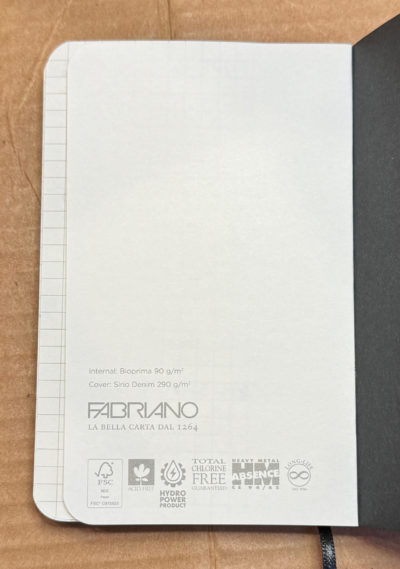
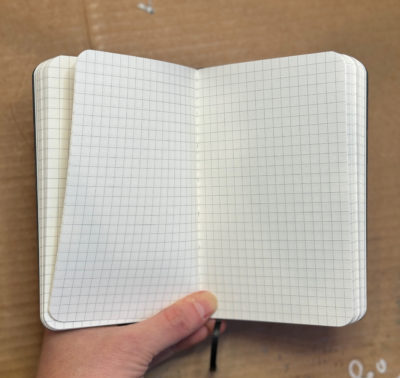
Inside is where the Fabriano Ecoqua Plus notebook really shines. The paper is fantastic– white with a fine grey grid, the color is a little less creamy than Moleskine paper. It feels similarly smooth, but you can tell right away that it’s heavier: 90 gsm. And when you write on it, it really shines: fountain pens are vibrant, with nice ink shading. There’s no bleedthrough, and less show-through than average. It’s fantastic paper. And they have quite a few ecological certifications too.
My only issues with this notebook are these: the spine is a bit stiff. I”m not sure if mine just has a little extra glue, or a little missing glue, but on one end it sticks pretty closely to the page signatures, and on the other it pops out when you open the notebook. The notebook will open flat and if you press down on it, it will pretty much stay open, but then when you close it, it won’t stay totally closed. This might change as the notebook breaks in with use.
Issue 2 is that the grid squares are wider at the page edges. It’s not a big deal but I don’t know why they didn’t continue the grid rulings in exact squares all the way to the top, bottom and sides.
Issue 3 might not even really be an issue, but it’s that the notebook is made of 5 signatures of pages. In looking at a Moleskine softcover notebook I have (which is an older model, and perhaps not representative of their current construction), it’s made of 10 signatures. I always like seeing more signatures with fewer pages, as I feel like it makes for a more supple spine.
Other than that, I love this notebook and plan to try it for daily use someday. It will be interesting to see how it stands up to heavy usage– I loved my first softcover Moleskine too, but found that the corners of the cover got a little ragged, and the page block was not very securely attached to the cover. This may just be a tradeoff that comes with softcover notebooks: the softer the spine and cover, the more likely they are to fall apart. I kind of wish I had tried a hardcover version of the Fabriano Ecoqua Plus notebook too, to see if the stiff spine issues also appear in those. I will probably buy one, now that I know how much I like the Fabriano paper.
I see various Fabriano Ecoqua Plus notebooks listed on Amazon, including other colors, sizes, and styles. If you click through this listing for the “stitch bound” notebooks, you’ll see all the colors and sizes listed as additional options. I bought mine at Jerry’s, where the list price is $14.30 for the pocket size, but they are discounted to $8.58 as of this writing! I’ve also seen them at Blick and in independent art supply stores.
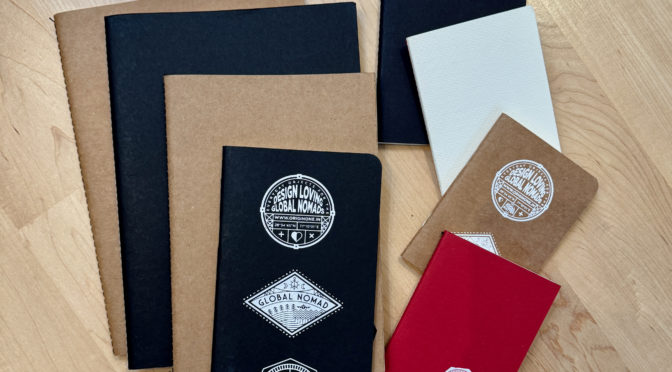
I recently received a selection of goodies from Origin One, a company based in India. Founded in 2015, Origin One describes themselves as “a collection of everyday stationery, handmade rugs, and elevated basics made for the design loving global nomad.” Their website very attractively presents a wide variety of notebooks, planners, stickers, stamps and other stationery, as well as housewares such as table linens, kitchenware, and framed art.
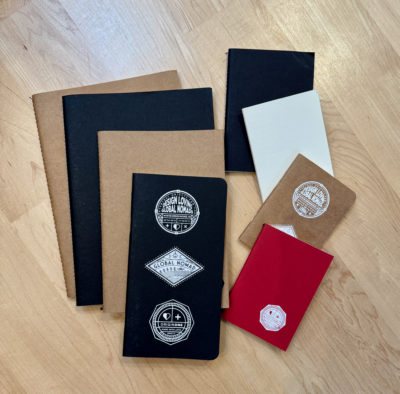
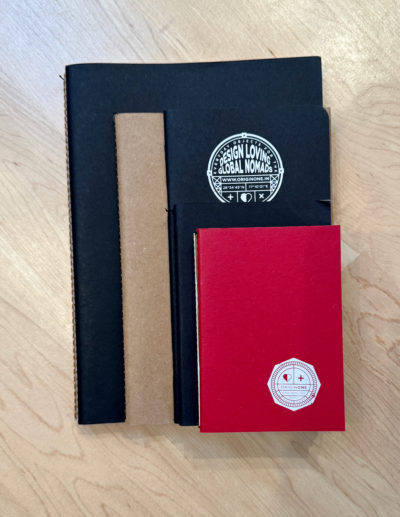
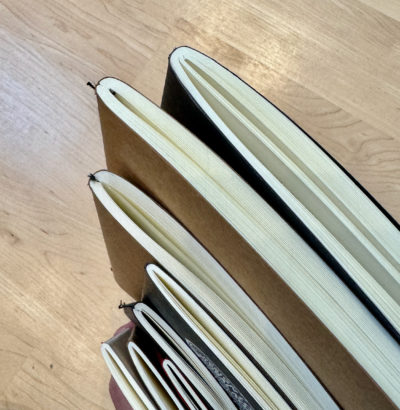
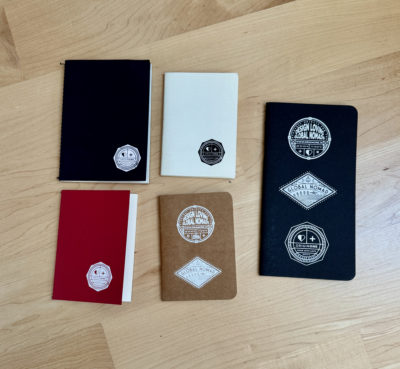
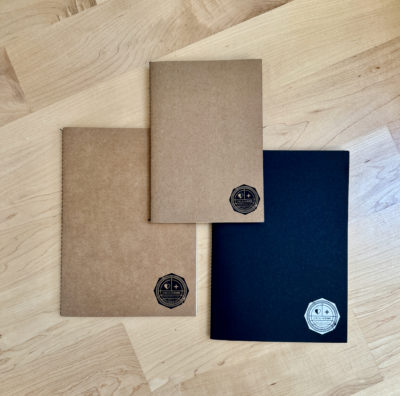
The Origin One notebooks I received are blank, lined, and squared notebooks in a variety of sizes. These are all single-signature notebooks, with either stitched or stapled spines. The materials all have a nice feel– substantial card stock covers in different colors and textures and smooth, creamy 112 GSM paper.
The designs vary: some just have the Origin One logo on the front, and some have other logos that say Global Nomad, or are a more elaborate Origin One logo with the tagline “Everyday Objects for the Design Loving Global Nomads.” I personally prefer a cleaner front cover, with one subtle logo or none at all. But that’s a matter of individual taste, as the person I live with came in and said “ooh, those are cute!” while I was photographing these samples!
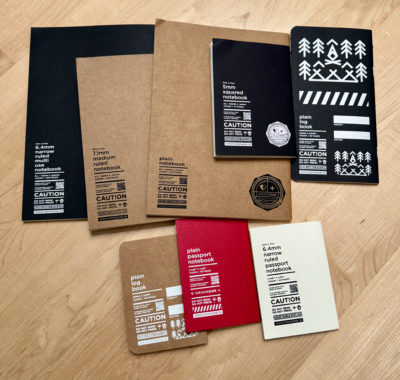
The back covers have even more going on, with product details, brand info and other verbiage and design elements. I’m not sure why they have all these warnings about bending and pressing! Like any notebook, they’ll get creased if you bend them in certain ways, but what’s the big deal? It’s a sturdy notebook, so it should survive normal wear and tear perfectly well. The “caution” and “handle with care” warnings just seem a bit silly. I like the little tree and campfire graphics, though!
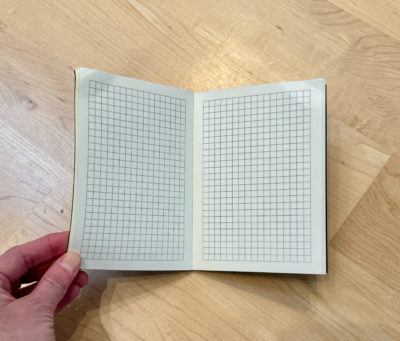
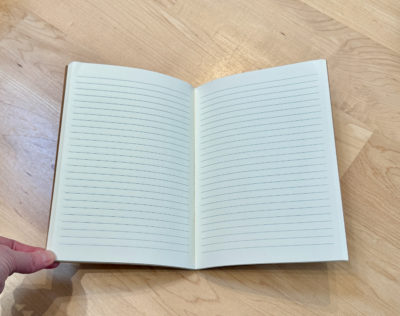
There’s no branding inside the Origin One notebooks. The lined and squared versions have quite wide margins around the lined/squared areas. It’s a bit unusual but it will be a matter of personal preference whether you consider this a good or bad thing.
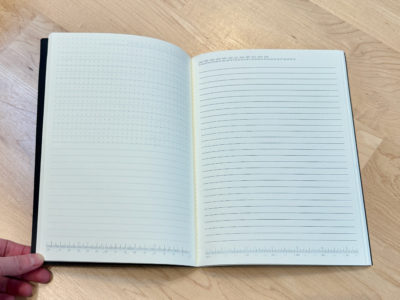
One of the large notebooks I received is Origin One’s “Multi Use Notebook.” This has an interesting layout I’ve never seen before, with the left page half dotted and half plain, and the right page all lined, with months and dates at the top so you can circle them (similar to Stalogy notebooks). At the bottom of both pages, you get a ruler– centimeters on the left and inches on the right. I could see this being a really handy layout for designers or anyone who needs to sketch and take meeting notes, perhaps. Or it could be used for a daily journal that incorporates both writing and drawing, or just some fun space for doodling. Though as you can see, there is some show-through of the alternate layout from the back of the page.
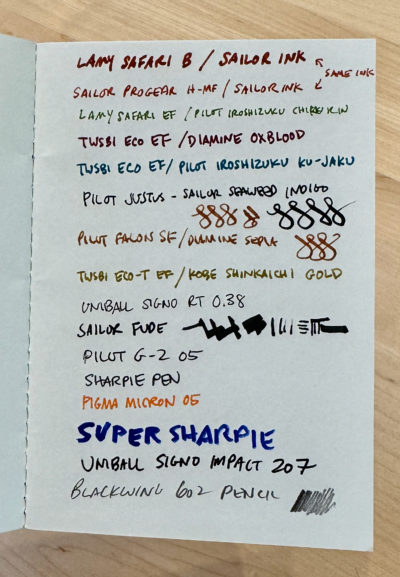
I tested the paper in one of the passport-sized notebooks. It feels really smooth and nice to write on, especially with gel ink pens. With fountain pens, colors look vibrant and drying time is very fast. But there is a little feathering and some bleed-through. Show-through is about average. There’s a lot to like about this paper, but you might not want to be using both sides if you use a lot of juicy fountain pens.
So will these Origin One notebooks truly appeal to design-loving global nomads? There is definitely a lot of design going on– maybe a little too much, with all those logos and warnings everywhere! And if you’re a global nomad, it’s quite likely that your notebook will get pressed or bent from time to time while stuffed in your luggage. But on the whole, I think these are attractive, good-quality notebooks, and if you use either of the standard sizes of Travelers Notebooks, these are a nice option for refills.
If you want to try some Origin One notebooks yourself, they ship internationally, but depending on where you live, the cost may be high in relation to the notebooks. For example, two A5 notebooks costing approximately $9 USD each would cost about $30 to ship to the US.
You can also enter my giveaway! I will select two random winners and each will receive a selection of Origin One samples. Please note that I will only ship to US addresses. I haven’t done a giveaway in a while and I’m feeling lazy about all the social media stuff, so all you have to do to enter is leave a comment on this post no later than 11:59pm EST on Sunday October 29, 2023! Make sure you include your email address in the comment form so I can contact you if you win.
I received these samples for free, but was not compensated in any other way for this review, and all opinions are my own.
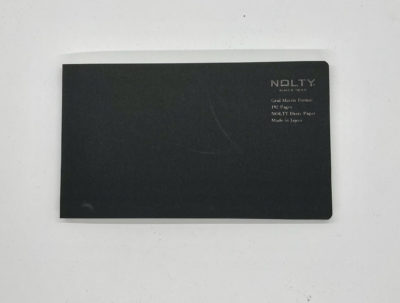
In Fall 2021, I threw a extra notebook into my Nolty planner order, just for the heck of it. Then I let it sit around for almost 2 years without reviewing it! Let’s get this situation rectified tout suite. (Or 今すぐ , imasugu, as may be more appropriate.)
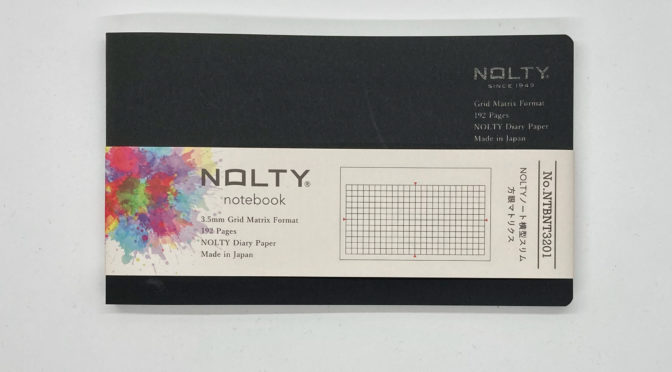
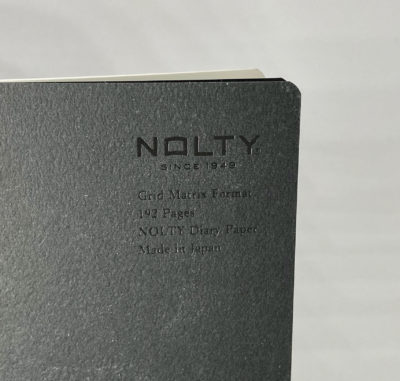
This Nolty Notebook is model # NTBNT3201. I can’t read most of the packaging as it’s in Japanese, but it’s pretty clear that the paper band around it specifies measurements of 91 x 156 x 9mm, 192 pages, and paper with a 3.5mm grid. The paper is noted as being “Nolty Diary Paper.”
From the minute you take it out of the package, it feels rather sleek. The black card stock cover has a slight texture, with the product information stamped in one corner, very subtly with just a bit of lamination so the letters are shiny in contrast to the matte surface of the cover. The back cover is blank.
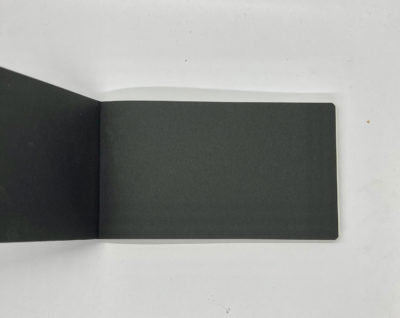
Inside, there is no branding or product information. Just the same black paper as endsheets, which looks great– though if you’re in the habit of writing your contact details on the inside front cover, you’ll have to use a white or metallic pen, or paste in a label. The notebook opens nice and flat, thanks to carefully sewn signatures and a light application of glue.
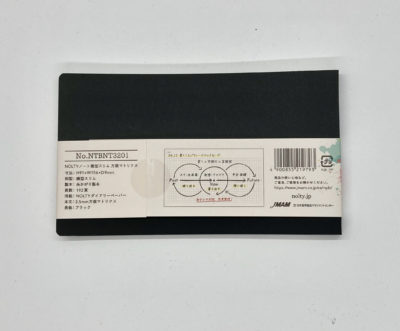
The paper throughout is an interesting layout. There’s a margin around the edges, wider on the top with a space for the date, and then a grid section inside the margin. There are 4 red triangles marking the mid-point of each edge of the grid area. I’m not quite sure how this is intended to be used, but it looks cool! The packaging shows a page with some kind of diagram of past/now/future, but I don’t know if that’s meant to be a suggested layout or just a sample of an idea or project sketch. If anyone can translate it, I’d love to know more.
The paper feels silky smooth. Though it’s said to be the same as Nolty diary paper, I think it feels even smoother than the paper in my Nolty planner. It is wonderful to write on, and most pens don’t bleed through at all. There is some show-through, as you’d expect of a paper this weight. (No paper weight is specified but it feels quite light.)
If you want a landscape/horizontal format notebook, perhaps to lie in front of a keyboard, I think this would be a very satisfying choice. It could also make a great reporter-style notebook, as you can easily bend the cover back fully.
I paid 770 yen for this notebook, not including shipping. That still seems to be the suggested retail price on the Nolty online store. At the current exchange rate, that is about $5.18, which seems quite reasonable for a notebook of this quality. Shipping from Japan to other countries will add quite a bit, but if you’re ordering other things from Japan via a proxy shipping service, it might not be too much to add on. If you don’t want to deal with all that, ordering from Amazon.com is also an option– as of this writing, they have this notebook available for $20.21. Pink, beige, and ruled versions are also available.
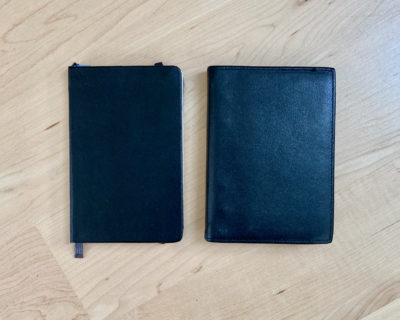
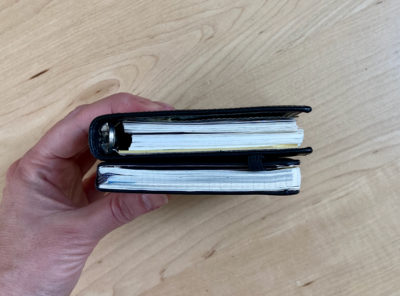
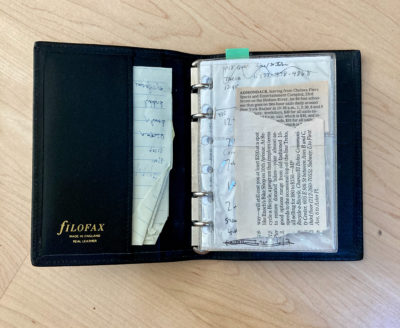
Here’s another trip down memory lane with a Filofax from my collection of refillable notebooks. This Filofax must have been bought before the two Pocket Chelsea models I wrote about recently. At first, I thought it might be more recent, because it is in such good condition, but it only has 4 rings, a configuration that Filofax phased out. It is stamped “Made in England,” but no model name is identified. (Shown below with a pocket Moleskine for size comparison.)
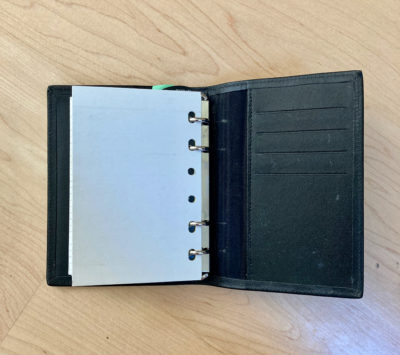
I really loved this Filofax, and I think I used it quite a lot for several years though it’s still in excellent shape and looks almost new. It’s made of a sturdy, smooth leather, which doesn’t feel especially soft or luxurious but I prefer its slightly stiffer structure to the floppiness of my Guildford Extra slim. It also still has a wonderful leather smell. I love the minimal, straightforward interior pockets. The interior has a fabric lining to it, like my older kid leather Filofax— I think it looks nice, but I wonder why they sometimes show more of the fabric and sometimes less. On the Pocket Chelseas, there is fabric inside the pockets but it’s not visible around the rings.
With no snap closure or pen loop, the overall shape is close to perfect, but it is a teeny bit too square and wide for me. The problem is that it has larger rings, which are great in terms of being able to fit more pages in, but they force the whole notebook to be a bit wider because the paper sits further from the spine, even if you don’t use tabbed dividers. My Pocket Chelsea with the larger rings is about the same width, but it’s slightly taller, and I think because the leather is softer and more broken in, the edges have bent a bit, making it feel a little narrower even though it really isn’t. What would really be great, maybe even “perfect,” would be a version of this notebook with small rings and the extra slim dimensions of the Guildford. Sigh.
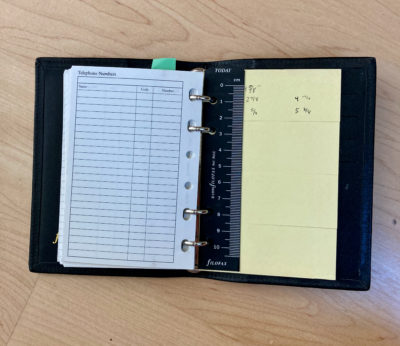
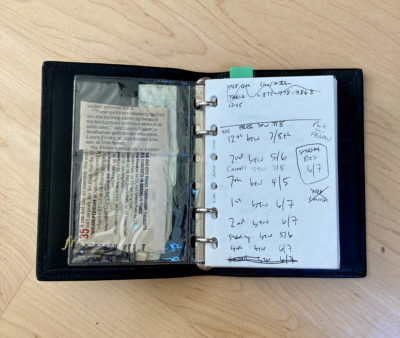
I primarily used this as a straight-up notebook, I think– or at least, that is how I used it most recently, perhaps while using one of my other Filofaxes as more of a wallet and planner. This one is loaded mostly with unlined paper, though there are a few pages of lined paper and telephone number sheets at the end, as well as a pad of sticky notes.
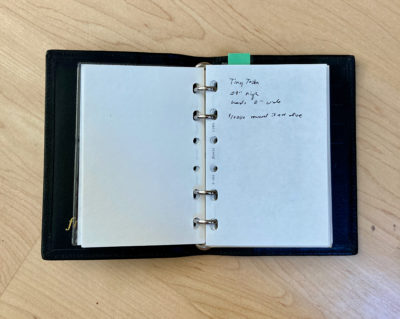
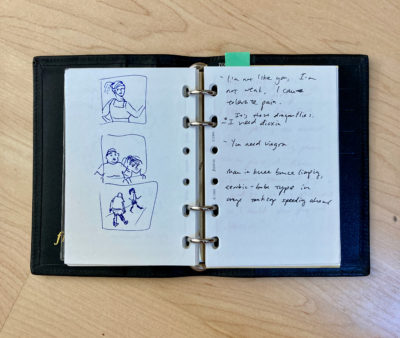
There were some fun jottings and sketches, particularly some notes on a trip to Coney Island– phrases from a sign promoting a sideshow act called Tiny Tasha (“$10,000 reward if not alive!”), and an overheard conversation between a rather mis-matched couple. At least one note in this Filofax was a transcription of a voicemail that I remember receiving on 9/12/01, so I must have been using the notebook in the late 1990s and into the very early 2000s.
So the mystery was why this Filofax has no name. And when exactly did I buy it? My earlier kid leather Filofax didn’t have a name either, but it had three letters stamped inside a pocket, which would have been some indication of its model. I was curious as to when Filofax started naming the models, so I took a deep dive into the archive of old Filofax catalogs at Philofaxy— an incredible resource! It was fascinating to research the history of the pocket Filofax.
At first, I didn’t think I was seeing anything like this model, but after scouring many catalogs, I think I identified it! It actually does have a name: the Lincoln. Everything about the Pocket Lincoln matches, except that I could never find a listing for a “slim” version without the fastener. However, it seems they would sometimes offer variations in different markets, so it’s possible this slim pocket Lincoln was only sold in the US, so wasn’t shown in the UK catalogs. The Lincoln was only listed in UK catalogs in 1992 (as “new”) and 1993. 1994 was when Filofax switched all their pocket models to having 6 rings, so 1992-1993 is the likely time-frame for this model, though I could have bought it from stock that remained in a store at a later date. I’m not sure how rare these “slim” Lincolns are, but I saw some listed on eBay for a great price back in 2019… the kind of new old stock sale that haunts my dreams!
I have a vague memory that I might have had a second one of these that was in a bag I had stolen on a trip to France in 2000… I didn’t keep a very detailed diary back then, and I suppose if I had, it might have been in that stolen Filofax anyway! I guess at this point I’ll never know, but I’m glad I have this pocket Lincoln in my collection, as it’s a lovely example of Filofax’s made-in-England quality from back in the day.
In my last post, I shared a photo of the notebooks I had with me on my end-of-summer vacation. Commenter Vic, from Portugal, noted that for a “short vacation,” 8 notebooks was maybe kind of a lot, especially since I was in a place where I could (and did) easily buy more notebooks.
Guilty as charged! I was only away for 7 nights, so it does seem a little ridiculous to have more than a notebook per day of my trip. But here’s a breakdown of what I brought, and why.
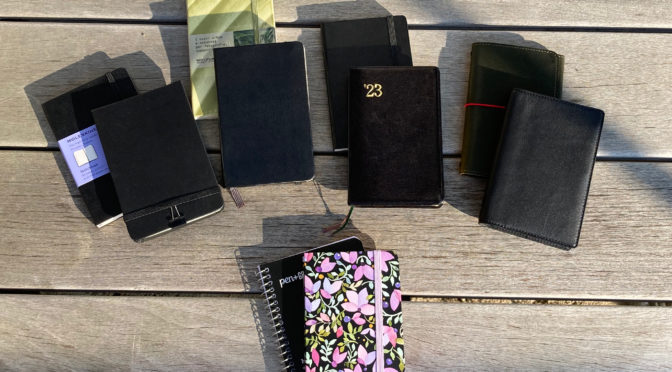
In the photo above, I’ll go from left to right. First, we have a Moleskine watercolor sketchbook, on top of a regular Moleskine sketchbook. The watercolor sketchbook only has a few pages used so far. The other sketchbook is one that I started for drawings devoted to a particular subject, and only a few pages are used. I thought I’d want to add to these sketchbooks on my trip, but in the end, I didn’t. (Not for lack of art supplies: I brought plenty, including two watercolor sets.)
The next pile has a black squared Moleskine on top of a green Moleskine Zoom notebook, also squared. The black one is my current journal. It’s about 3/4 finished, so I got a little anxious that I might have a burst of introspection and finish it during my trip. The Zoom notebook was my backup in case I needed to start a new journal. Which I didn’t. I only covered about 10 pages in my current journal. Better safe than sorry though, right?
Then we have my Nolty Gold planner, on top of another Moleskine sketchbook. I did all my usual jottings in the Nolty, and I did one drawing in the sketchbook, so those earned their place in my bag. (The sketchbook only has a few blank pages left, so I probably should have brought a spare so I wouldn’t have to encroach on my single-subject one or the watercolor book. I don’t know what I was thinking!)
At far right, we have a Filofax Guildford Pocket Extra Slim on top of a Louise Carmen notebook. The Filofax is something I have had for a while but not used until recently. I’ve been wanting to try using some kind of looseleaf notebook again, so I’m trying this Filofax for some long-term lists and work notes. I haven’t totally settled on a system yet, so its purpose may evolve. I love the size of this Filofax, and have it filled with Plotter inserts, which suit it perfectly. I did jot some notes in it during the trip.
The Louise Carmen notebook holds a Field Notes insert, and I am currently using it for French class notes. I could have left it at home, as I did not really use it, other than to remind myself that my homework assignment was indeed what I remembered it to be. It’s one of two Louise Carmen notebooks I had with me, but the other one functions only as a wallet, so I didn’t include it in my photo. It’s kind of silly to be using this one for my French notes, but I didn’t feel like just leaving it stored. I spent way too much money to order it from France, because this green color was what I originally wanted when I bought my wallet in the natural leather. At some point, I might swap it into use as my daily wallet, and give the natural leather one a rest. Or maybe I’ll just save it as a spare.
In the bottom row are two Pen & Gear notebooks I bought at Walmart. I’ve been hearing that these are fountain pen friendly so was curious to review them, especially since the Exceed notebooks I’d bought from Walmart were so great. These two notebooks cost less than $4.00 total, so how could I resist?
So… 7 nights, 8 notebooks. 4 notebooks used, 4 notebooks not used. 2 new notebooks bought. That’s my idea of a fun vacation!
Whoops, I forgot to celebrate the 15th anniversary of this blog yesterday! 9/12/2008 was my first post. 15 years and 2,373 posts later, I’m still here, still posting (if not as frequently), still buying notebooks (maybe a little less frequently), and still writing in lots of notebooks (even more frequently). And I love that people are still reading my posts, and following on Instagram, Facebook, and Pinterest too. Thank you for all your support over the years!
My biggest goals for the future of this blog are to get back on a more regular schedule of posting, and do more video content on YouTube. (I’ve done a few in the past, but so infrequently that I keep losing access to the channels I’ve started and can’t figure out how to get them back!) If there is anything else you’d like to see more of on this site, please leave a comment!
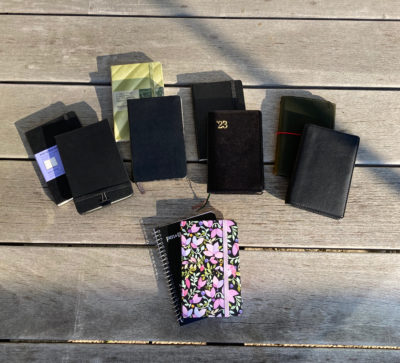
I’m spending this 15th anniversary on a short vacation at the beach, so I’ll leave you with a photo of all the notebooks I have brought with me! Plus two new ones I just bought during my trip, to be reviewed soon. Stay tuned!
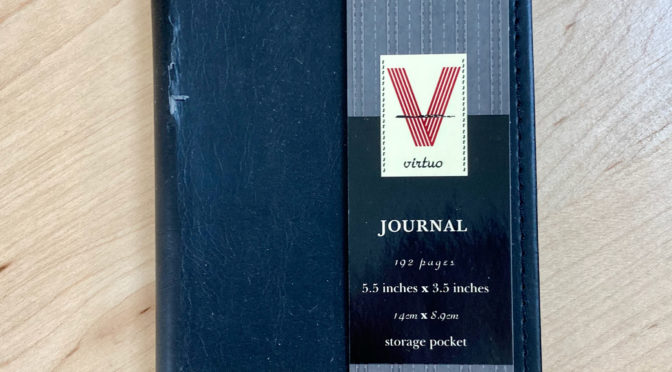
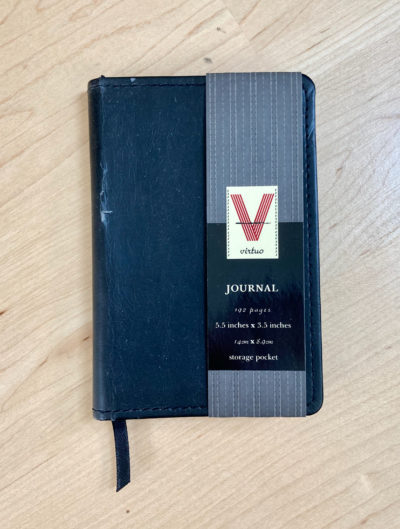
The Virtuo Journal is something I bought on eBay as part of a lot with other notebooks I actually wanted. I was curious about it anyway, because it was a brand I’d never seen before. Evidently Virtuo is a proprietary brand sold at OfficeMax… or I guess I should say “was,” as I can’t find any Virtuo products currently listed on their website. So let’s review this notebook that you won’t be able to buy unless another one shows up on eBay!
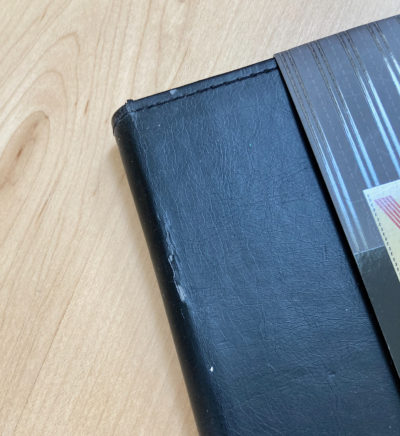
The Virtuo Journal reminds me a little bit of the C.R. Gibson Markings notebook, in that it’s a kind of crappy fake leather notebook with stitching around the edges. But I don’t think the Markings cover got all flaky and cracked like the Virtuo has.
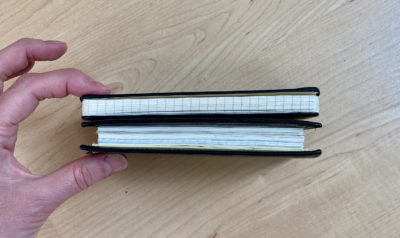
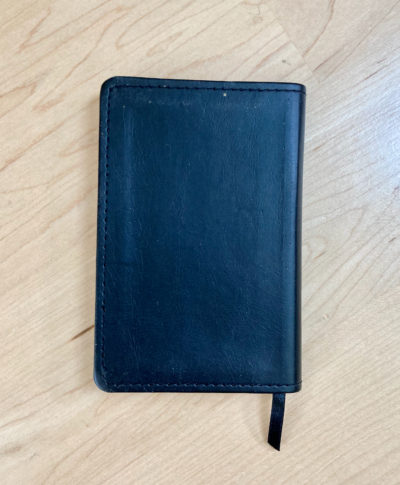
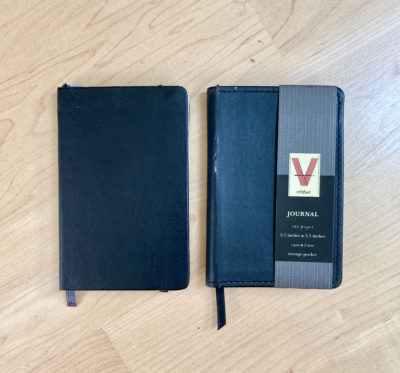
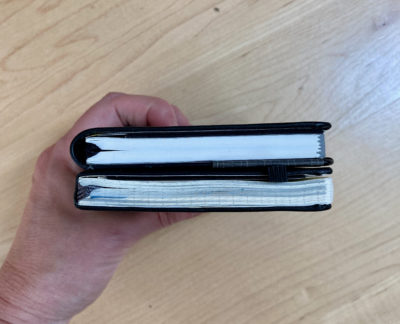
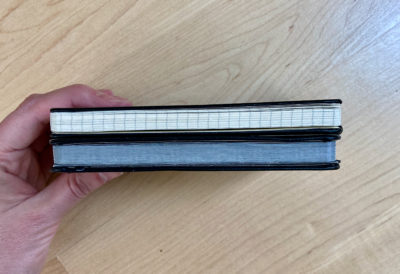
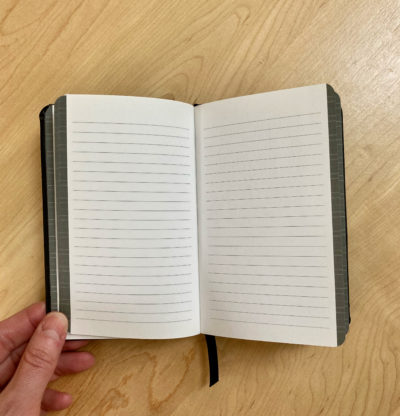
The outside is pretty standard other than the stitching– black cover, totally plain. There isn’t even any logo stamped on the back. It measures about 9×14 cm or 3.5 x 5.5″. There’s no elastic closure but there’s a ribbon marker and a pocket in the back. A removable paper band has all the brand info. Photos below show it next to a squared Moleskine pocket size notebook for comparison.
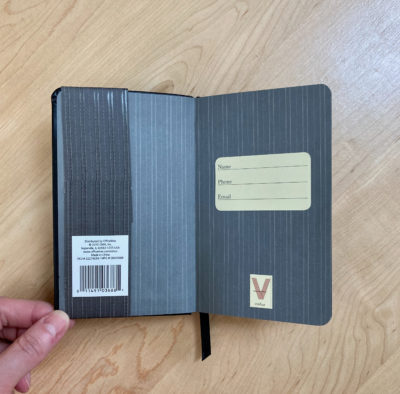
Inside the front cover is where it gets a little different. The pinstripe design that’s on the paper band is also featured on the endpapers. I guess someone thought this should look “business-y” so they decided to use a pattern that would recall a grey flannel suit. They liked this motif so much, they even carried it onto the pages, running it up the outer edge of every single page. Odd. Other than that, the pages are lined in a pretty common way, with the lines not going all the way across.
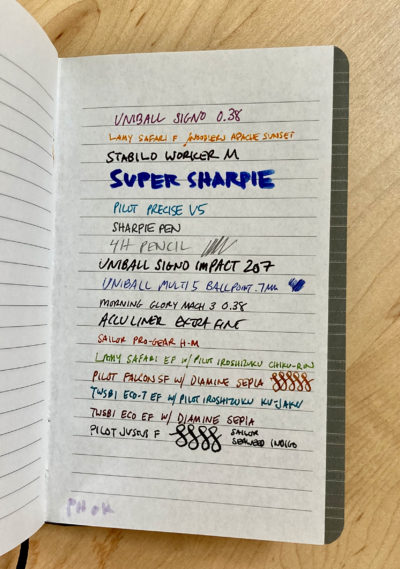
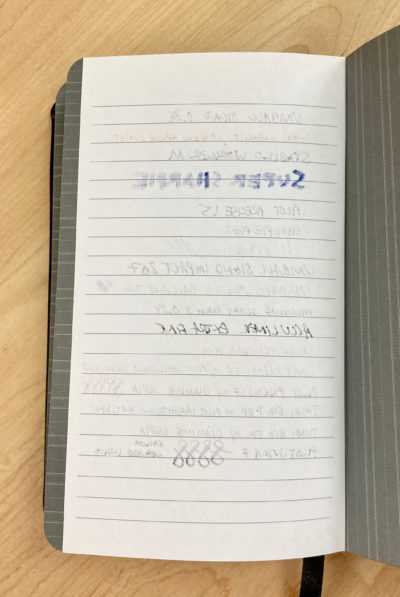
The paper performed better than I expected given the low-quality feel of the cover. Fountain pens worked pretty well, without too much bleedthrough, at least with fine points.
But otherwise, there’s not that much else to say about the Virtuo Journal. I guess there’s a reason this brand has gone bye-bye! I’ll file this one in the part of my collection I think of as the graveyard of notebook mediocrity.
Notebooks, journals, sketchbooks, diaries: in search of the perfect page…