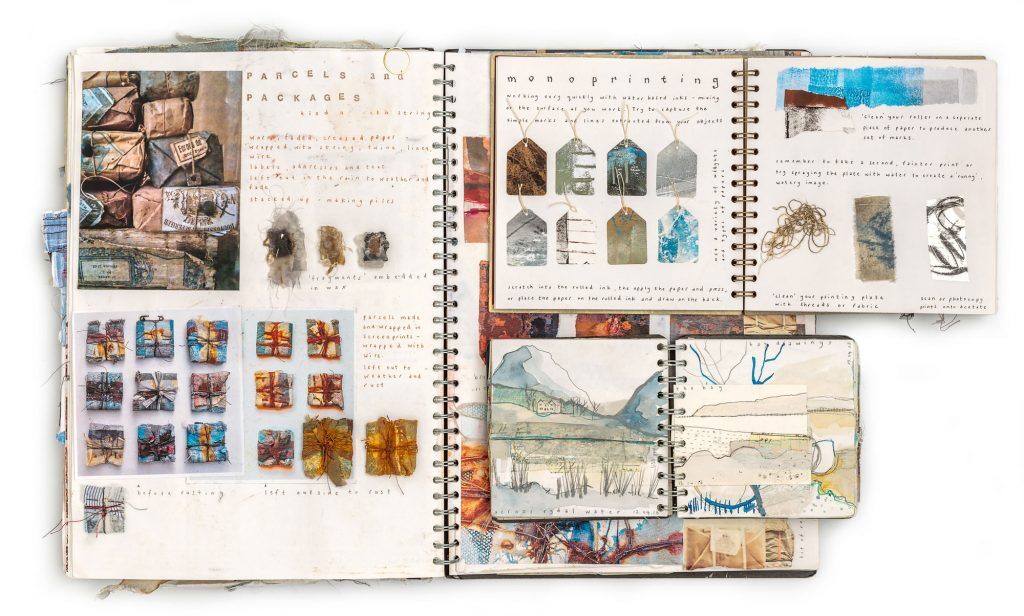
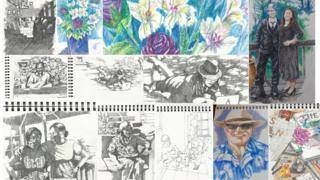
Australian artist John Lovett has a great article on his website about different kinds of sketchbook-keeping. Aside from using sketchbooks to capture ideas and practice drawing, he talks about using a notebook or sketchbook in the studio as a working book, for recording technical stuff about materials and methods:
Artists Studio Notebooks
I always have a working notebook in the studio where I test out new colors, experiment with color arrangements or write down little things I want to remember about the behaviour of different materials. These become a handy source of reference – especially years later when ideas and experiments are long forgotten. They don’t need to be attractive or carefully planned – just a way of preserving and keeping everything together.
He says they don’t need to be attractive, but these pages can be beautiful, as seen in his example above!
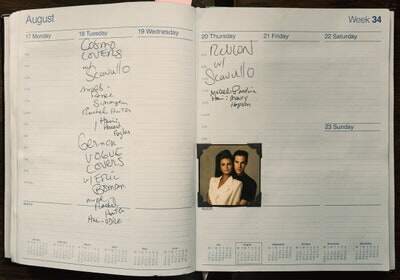
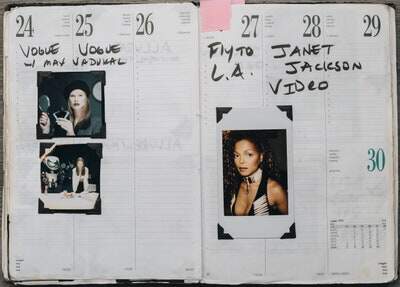
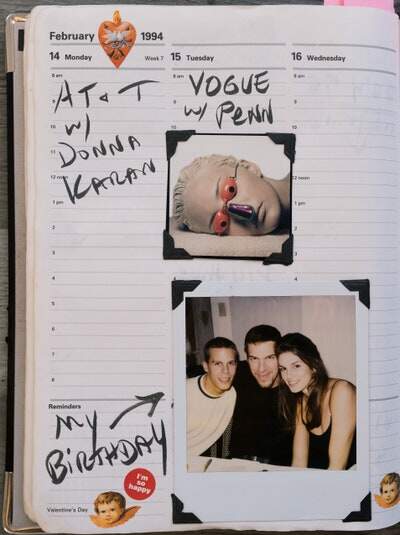
A fun look inside the world of Kevin Aucoin, the celebrity makeup artist who sadly died way too young. He seems to have used a variety of diaries in a similar format but with different page layouts. I’m not sure what brand any of them were.
Kevyn Aucoin was a makeup artist decades ahead of his time. Long before the age of Instagram, the late legend furiously—and intimately—documented his life and career, recording it all with a Polaroid camera or VHS camcorder glued to one of his famously large hands, as well as in his precious collection of scrapbook-style journals, which haven’t been seen publicly until now.
Today, the Makeup Museum unveils a vast, never-before-seen digital archive of the journals that Aucoin, widely considered the world’s first celebrity makeup artist, kept between 1983 to 1994. They document his Hollywood rolodex (Hello, Tina and Liza!), meetings with all-star collaborators and supermodel confidantes (Cindy, Linda, and Paulina…to name a few), and candid Polaroids snapped on iconic photoshoot sets, from Vogue editorials with Irving Penn to a Chanel campaign with Claudia Schiffer. Altogether, Aucoin’s personal notebooks offer a raw and authentic look into his day to day, the hustle and glamour of it.
I love it when I come across textile sketchbooks, such as the ones below by mixed media artist Shelley Rhodes. She works in textiles and collage so her pages have lots of color and texture that go beyond just drawing and painting. If you are inspired by Shelley’s work, you might want to check out her book Sketchbook Explorations, which is specifically targeted at artists working in mixed media and textiles.
Textile sketchbook by Shelley Rhodes
From a Q&A interview with Shelley at the School of Stitched Textiles:
What was your first memory of creating a sketchbook – who taught you or were you self-taught?
As a child I used to love to ‘cut and paste’. A favourite activity was chopping up old magazines and making collages. However, I really started working in sketchbooks whilst at art college in the 1980’s, when I studied graphic design. My sketchbooks have changed a lot over the years and developed further when working towards my City and Guilds in Creative Embroidery. Â
What’s your development process for your sketchbooks, if any?
I usually work in several books simultaneously. I always have a current ‘workbook’ for new designs, developing ideas, exploring and experimenting with material and concepts as I work towards finished pieces for exhibitions. I always carry a small sketchbook (about A6) for my ‘one a day’ daily creative act. This could be a drawing, collage, painting, stitched sample, arranged collection, manipulated photograph – in fact anything goes. I usually have a couple of other ongoing sketchbooks. For example at the moment I have one with black paper, one specifically for recording marks, patterns and shapes related to my ongoing coral project and another for exploring and experimenting with text, gestural and asemic writing.
Another addict from Reddit, who posted this helpfully annotated photo:
I like how many of the notebooks themselves have been labeled. In the comments on the post, Root39 says some of these notebooks are from Muji, one is a composition book from the US, and the rest are mostly local brands, which I believe means from India.
These are so simple and beautiful! From My Modern Met:
No matter the weather, Azerbaijan-based artist Fidan Zaman takes to the shores of the Caspian Sea to paint the seawater and the sky. From dark, murky waters and gray clouds to turquoise waves and sunlit horizons, Zaman captures the beauty of the beach during all four seasons. Each seascape lives inside her sketchbook, but it becomes part of the landscape when she holds it up to the shoreline to photograph it.
I recently posted a couple of photos on Instagram of my collection of books about sketchbooks, journals and notebooks. The posts got a lot of responses, and Ana from The Well Appointed Desk commented “This needs to be a more in-depth blog post. I’ve zoomed in on this photo but I can’t read all the spines. It‘s killing me. I want more info. More details. Opinions. Favorites? If you could do it all over, are there books you would buy again or skip? I have one or two but I also have different ones. I heard about YouTube bookshelf tours. I challenge you. Gauntlet is thrown.“
When Ana talks, I listen! Gauntlet caught! Or picked up! Or whatever it is you do with a gauntlet. I’m more of a writer than a YouTuber, but I will endeavor to give you an in-depth look at each book, including a video flip-though of some representative pages.
This is going to be a series of posts, as I have a LOT of books to cover. I’m going to start with 4 books that are a great starting place for creative inspiration, as they all survey a variety of artists, designers, illustrators and creatives on how they use their sketchbooks.
Drawn In: A Peek Into the Inspiring Sketchbooks of 44 Fine Artists, Illustrators, Graphic Designers and Cartoonists
By Julia Rothman
This is one of my favorite books about sketchbooks, not just because it includes a wide variety of gorgeous artwork, beautifully presented. What I love most about this book is that every sketchbook spread is shown in full, to the page edges and beyond. You see the covers and ribbon markers poking out. You see the full shape of the page. You see torn edges, bent wire-o bindings, ragged post-its stuck between pages. This gives you a really intimate, hands-on feel for each artist’s sketchbook. In the introductory text, Julia Rothman says that she asked each contributor to send her some of their actual sketchbooks so she could handle them and photograph them herself, which makes me feel very jealous! If the artists had just sent her their own digital images, I don’t think the book would have been as successful.
The text is presented in a Q&A format. Each of the 44 creators responds to a few questions. Some questions are repeated, such as “what mediums do you use in your sketchbook,” “when did you get your first sketchbook,” or “how many sketchbooks do you have? Where do you keep them?” There are also questions specific to particular aspects of an artist’s background and work. Some of the artists talk about their sketchbook usage habits, why they use a certain brand or size of sketchbook, or how it feels to look back at old sketchbooks. From the way the questions are framed to the visual presentation, I get the feeling that Julia Rothman really shares my appreciation of sketchbooks as objects and tools that are interesting in their entirety, not just as a surface for parts of an artist’s process.
Julia Rothman used to write the excellent “Book By Its Cover” blog, which included a regular series devoted to sketchbooks. The blog is gone, sadly, but the archives are still viewable via the Wayback Machine. It includes lots more sketchbook artists who aren’t in this book.
Graphic: Inside the Sketchbooks of the World’s Great Graphic Designers
By Steven Heller and Lita Talarico
This book’s introduction begins with a great question: “What is it about sketchbooks that makes them so appealing to touch and smell?”
Graphic is a huge book with 110 contributors, who actually include illustrators, comic artists and other creative types beyond just graphic designers. Each is covered in 1 to 3 two-page spreads. The text is very brief but includes quotes from each contributor, pulling out interesting and unique observations about their sketchbook habits, including methods and materials and how they’ve accumulated sketchbooks over the years.
The images vary in how they are presented: many are great photos of open sketchbooks showing the edges and exteriors beyond the page spread. There also are some photos of sketchbook collections. But many of the images, perhaps about a third of the book, are close-ups and cropped photos where there is no sense of the true size of the sketch or how it fits into the sketchbook. In some cases, photos of finished projects are juxtaposed against sketches in a way that makes it unclear whether all the images are part of the sketchbook itself. But the variety of images is fascinating, from highly detailed and polished paintings and drawings, to colorful collages, to basic lined notebooks with scribbled thoughts.
Much of the content in this book really does make you feel like you can almost touch and smell these sketchbooks, but for me, the inclusion of cropped sketches without the context of the sketchbook itself is a disappointment. Still, if you can’t afford to buy too many books about sketchbooks and want to start with just one, Graphic is so massive and varied, you can’t help but find satisfaction poring over these pages.
Sketchbook: Conceptual Drawings from the World’s Most Influential Designers
by Timothy O’Donnell
This is another book that shows a nice appreciation for the sketchbook as an object: the cover and introduction have images of exteriors of various sketchbooks, and though there are some cropped images within, the visual content is mostly nice scans showing the entire sketchbook beyond the page edges so you get a good sense of context.
This book is oriented more towards how designers use sketchbooks as part of their work process, so it also includes images of finished work so you can see what developed from the sketches. The coverage of the 35 designers (some of whom are also featured in Steven Heller’s Graphic) is a bit more project-oriented than in the other books I’ve reviewed. Each has a brief intro text and some quotes that address specific images. There are also a few longer Q&As with selected designers. Again there is an interesting mix of imagery and approaches, providing plenty of creative inspiration.
The main body of the book is divided into 3 sections: “Rough,” “Refined,” and “Random.” It was not really clear to me what the difference is between these sections, as they all seemed to cover sketches and finished projects in similar ways. At the end of the book, there is another section called “Revealed,” which shows the sketches the author made when he was conceptualizing and creating the book. This “making of” section was quite interesting.
O’Donnell’s approach is very much about exploring the creative process but he also appreciates sketchbooks as “fascinating and often beautiful pieces of ephemera in their own right.”
Sketchbooks: The Hidden Art of Designers, Illustrators & Creatives
By Richard Brereton
This is another compilation of images from the sketchbooks of various creative people. There is a foreword and then an alphabetical presentation of the 41 creators, each with an introductory bio and a brief statement from the creator about their sketchbooking practice.
A lot of interesting artwork is included, but more than half of the contributors are shown with mainly cropped images, so if you enjoy the context of the sketchbook itself as I do, you may find it a little disappointing. The author, Richard Brereton, says this towards the end of his foreword: “After a while I was almost tempted to keep a sketchbook myself.” My jaw dropped when I read that, but I felt like it sort of explained what makes this book less satisfying than the 3 others I’ve written about in this post. The author is concerned with sketchbooks as the unseen, private origins of the creators’ other work more than as objects of interest for their own sake.
Guess what? This book is also out of print. (Art books like these tend to be printed in Asia in fairly small runs, and the economics and timing of reprints are often challenging. So if you see an art book you love, snag it before it sells out!) But again, you can find copies on Amazon.
I will be back with more book review posts soon. In the meantime, you can check out my lists of interesting notebook/sketchbook/journaling books. I earn a small commission on any purchases made via these links:
My storefront at Bookshop.org is still a work in progress, but I’m building up lists of active, in-print titles divided into lists such as “books about sketchbooks,” “books about journaling,” etc. Moleskine notebooks and various other sketchbook and journal brands can also be ordered through Bookshop.org. A portion of all proceeds go into a fund that benefits independent bookstores, so it is a great way to support small local businesses.
My storefront on Amazon includes out of print books that can be ordered when stock is available through 3rd party sellers. In addition to my various notebook/sketchbook/art supply lists, see these book lists:
This week’s addict is another Reddit r/notebooks find. User Hopsfyquin shared this image and a brief description of their uses. You can see more comments at the original post.
They all have their own set purpose, some may overlap with other notebooks but there is a distinction I’ve set between them. ie: I have many art journals, but one is for practising, another is for experimenting with styles, one is for doodling, and another is for painting (acrylics)
Such a cheery rainbow color scheme, with no two alike! The original poster mentions that a few are Leuchtturms, and I think the lavender one with a partly covered wire binding is a Filofax notebook. Otherwise I’m not sure about brands. There are a couple of workbooks/guided journals at the right:
Wow, it’s been a while since my last “using now” post. I can’t say I have any totally earth-shattering news to report about the daily carry notebooks I’m using but there is one new item that wasn’t even on my radar at that time.
Notebooks I’m using as of July 2020. Most of them, anyway.
First of all, I suppose the concept of “daily carry” has been a little weird for the past few months due to the COVID-19 lockdown. When you rarely even leave home, the main place you’re carrying your notebooks is just from room to room. And for me, in the first few months of lockdown I barely carried anything with me when I did go out, figuring it was better to travel light and have less to worry about disinfecting. (Though I did think about whether I should be disinfecting my notebooks!)
Nowadays, I’m back to carrying a small bag when I go out on errands. I bring my Nolty Efficiency Notebook Gold and sometimes a squared Moleskine. The Nolty has my shopping list in it, so that is really the only one I need, but the Moleskine is what I’m using for my general scribbles and journal entries and notes so I kind of like having it along.
I continue to always have a Moleskine sketchbook going, but that generally stays home these days, unless I’m going for a hike somewhere and might want to sketch a view, in which case it’s probably the only notebook I’m carrying. I’m also using my Nolty Daily Book for brief notes about my day along with a simple drawing, or maybe a sticker or something pasted in.
When I am home, as I mostly always am these days, I have all four of these notebooks and a pen nearby, carrying them around the house as needed. So I think they truly count as daily carry notebooks. At one point I also started carrying around a Moleskine Watercolor Notebook, but that seemed like overkill so I’ve gone back to generally leaving it on my art table with all my watercolor paints. I have another watercolor sketchbook in process there, an old one from Pen & Ink.
On my desk, I also have an old Kikkerland Writersblok notebook that I use for notes for a French class I’m taking via Zoom, and an Appointed notebook that I had used at my old job where I now occasionally sketch out garden or home project ideas if I need a larger than pocket size page. I am also still using my old A3 size Moleskine sketchbook occasionally for larger drawings– it’s currently propped up on a tabletop easel.
Some random inside pages from my notebooks and sketchbooks and diaries.
That pretty much covers all the notebooks I’m using these days! I am definitely feeling like 4 primary daily carry notebooks is a bit much. Since the Nolty Daily Book isn’t going to be produced for 2021, that will get me back down to 3, I guess. I’ll really miss having a daily diary, even though I have often been feeling like the two diaries are overkill. There is some overlap in how I am recording things, and I wish I could streamline my diary/planner/journal method, but there are also very good reasons to have separate notebooks. Maybe by January 2021 I’ll be ready to try a new approach!
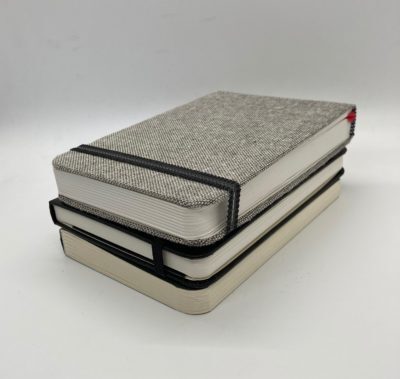
Moleskine Watercolor Notebook (portrait) on right, Moleskine Watercolor Album (landscape) on leftMoleskine Watercolor Notebook (portrait) on right, Moleskine Watercolor Album (landscape) on left
I don’t know why more manufacturers don’t offer a hardcover portrait format watercolor notebook in this size. Landscape is great, but sometimes it’s nice to be able to paint in a notebook that matches the orientation and size of other everyday notebooks. And since this one opens quite flat, it also gives you the option of painting across a bigger spread. I know Stillman and Birn has softcover pocket size notebooks in portrait format with paper that’s good for watercolors (Beta, Delta and Zeta series), and there are other sketchbooks like the HandBook Travelogue Journal and Hahnemuhle Travel Journal where you can get away with using some watercolors, even if they don’t have true watercolor paper. HandBook Journal Co. also makes a sketchbook specifically for watercolor, but not in a pocket size. The closest thing to ticking all the boxes would be Hahnemuhle’s Watercolor book, which does come in a really nice A6 hardcover with an elastic and ribbon marker (no back pocket). At approximately 4 x 6″, it doesn’t go with my collection of 3.5 x 5.5″ sketchbooks, so it’s not quite right for me. But if the size doesn’t bother you, I would recommend it. (See Hahnemuhle sketchbooks review for more details.)
Moleskine Watercolor Notebook vs. A6 Hahnemuhle Watercolor BookMoleskine Watercolor Notebook vs. Arteza Watercolor Sketchbook and Stillman & Birn Delta pocket softcover sketchbook
The construction of the notebook is typical of current production Moleskines– a little more overhang than I’d prefer, and corner folding that isn’t as tight as they used to do 15 years ago, but the one I bought doesn’t have any obvious defects. The cover has a slightly waxy feel, which is different from the older Moleskines I have. And I almost didn’t notice this at first, but there is no ribbon marker. I just looked at my old watercolor sketchbook comparison to check, but I guess Moleskine has never put ribbon markers in their watercolor books. In the landscape format this seems fine, but I wouldn’t mind having one in a portrait format watercolor notebook– maybe I’ll just glue one in!
Moleskine Watercolor Notebook vs. old Modo e Modo Moleskine in foregroundMoleskine Watercolor Notebook vs. old Modo e Modo Moleskine in foreground
The 60 pages are bound so that each spread is its own signature, unlike the pocket size landscape format Moleskine Watercolor Album, whose 60 pages are bound in 5 signatures. All my other watercolor sketchbooks are also bound in multi-page signatures. It will be interesting to see if the binding splits with use, as those skinny signatures don’t allow a lot of edge for glue to adhere to, but this allows it to open nicely flat, and might allow more easy removal and preservation of pages with paintings across spreads.
Moleskine Watercolor Notebook at right vs. Watercolor Album at left
To me, the paper in the Moleskine watercolor notebook is ok but not great. For many people it will most likely be fine for casual use, but I’d personally prefer a somewhat smoother texture. And I’m not sure if it is the texture itself or something else about the paper, but it seems like certain colors don’t go down evenly, particularly if you try to layer a few strokes to build up color. I am by no means a skilled user of watercolor, so when I noticed a blotchy look I thought it was my fault, but I then saw customer reviews on Amazon saying it is a defect of the paper. And comparison to other watercolor books I’ve used seems to confirm that it’s not just me being a bad painter! (From what I’ve read from various online sources, Moleskine’s watercolor paper used to be considered quite good, but in recent years has changed for the worse. It’s worth reading other reviews to get a sense of how people’s different painting styles work with this paper.)
Winsor & Newton watercolors and Tombow Irojiten colored pencils on Moleskine Watercolor NotebookWinsor & Newton watercolors and Tombow Irojiten colored pencils on Moleskine Watercolor NotebookWinsor & Newton watercolors and Tombow Irojiten colored pencils on Moleskine Watercolor Notebook
If you like to draw on watercolor paper with fountain pens, this paper should be fine. A medium nib looked a little feathery but the other pens I tested worked fine and didn’t bleed through.
Assorted pens in Moleskine Watercolor Notebook
The pages do buckle slightly when you do wet washes, and I found that even keeping the notebook closed with the elastic for a couple of days didn’t completely flatten them back out. All that said, though, I wouldn’t say this paper is dramatically different from others in pocket size watercolor notebooks I’ve tested, though I do think the paper in the Hahnemuhle Watercolor book is better.
Moleskine has discontinued their pocket size Sketchbook, which was always a favorite of mine for drawing. I liked the heavy, smooth, cream colored paper with most pens and pencils, but it could be really weird with watercolor due to the texture and color. So in a way, it’s nice that they’ve replaced it with a portrait format watercolor sketchbook with bright white pages. The page count on the Watercolor Notebook is only 60, vs 80 for the pocket Sketchbook.
Moleskine Watercolor Notebook vs. Moleskine Sketchbook
The suggested retail price of the Moleskine Watercolor Notebook in pocket size is $17.95. This may seem a little expensive, but I don’t think it’s crazy compared to other watercolor books this size– nicely bound hardcover watercolor books with good paper are just expensive, period. Arteza sells a 2-pack of hardcover watercolor sketchbooks in 3.5 x 5.5″ landscape format for $17.98, which is an amazing value, though I’d say their overall quality is lower than Moleskine’s. An A6 Etchr watercolor book with 52 pages is $25.00 for 1 or $54 for 3, but that has a higher quality 100% cotton paper. The A6 Hahnemuhle watercolor sketchbook is $17.49, for 60 pages and similar features but somewhat better paper. Pocket size Stillman & Birn sketchbooks are $10.99 but they lack a hard cover, elastic, and back pocket, and have only 56 pages in the heaviest papers. On all of these, many retailers discount from the list price. The lowest price I’ve seen on the Moleskine Watercolor Notebook is at Blick, for $13.51.
So the bottom line on the Moleskine Watercolor Notebook? If portrait format, exact size and standard Moleskine features like a hard cover, elastic closure and back pocket are most important to you, try one out and see how you feel about the paper, as many users seem to be quite happy with it. I will probably buy a few more myself. But if paper quality or price are more important factors, you will probably prefer to stick with other options.
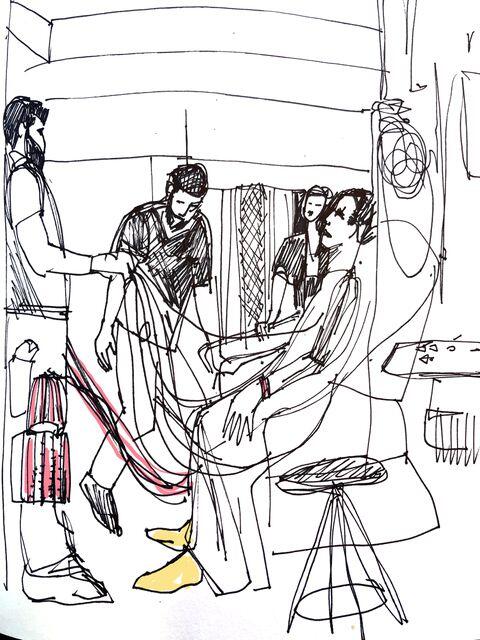
I’ve seen various stories about people documenting their time under coronavirus lockdowns, using sketchbooks or journals. Here’s one example, a visual diary kept by a Scottish architect:
Prof Alan Dunlop has filled six A4-size sketchbooks since the start of restrictions to limit the spread of the coronavirus.
He has sketched scenes inside and outside the family home in the Queen Elizabeth Forest, near Aberfoyle.
“There are around 120 drawings in total, one or two for each day of the 10 weeks of our lockdown,” he said.
“I’ve been thinking about what I could do with the books, as far as I am aware no-one has produced a drawn diary chronicling the days of lockdown and isolation from almost the beginning in March to the easing of restrictions and end of isolation.”
I’m surprised Prof. Dumlop hadn’t heard of anyone else doing the same thing, but they are definitely out there! Here’s another, from writer and artist Gayle Kabaker:
I love being alone. The older I get, the more alone time I crave. I’m careful about who I say this to, because so many people are having a hard time social distancing, but I actually like many aspects of this simplified life with so few choices and a lot of time spent quietly in my studio. I am lucky to be married to a fellow artist who feels the same way. We are really good at giving each other plenty of time and space to be quiet and creative.
I’m actually shocked at how well we’ve gotten along these past four months. Granted, I have some sketchbook pages that I’d never show anyone, but that’s the beauty of a sketchbook/journal. You get a chance to get all that crap out onto paper.
After thinking about how she could connect more with other people during the crisis, Kabaker decided to offer outdoor, socially-distanced drawing lessons to kids in her neighborhood, in hopes to get them started with their own sketchbook habits.
And the New York Times published an article about how these kinds of journals and sketchbooks may be useful to historians:
As museum curators and archivists stare down one of the most daunting challenges of their careers — telling the story of the pandemic; followed by severe economic collapse and a nationwide social justice movement — they are imploring individuals across the country to preserve personal materials for posterity, and for possible inclusion in museum archives. It’s an all-hands-on-deck effort, they say.
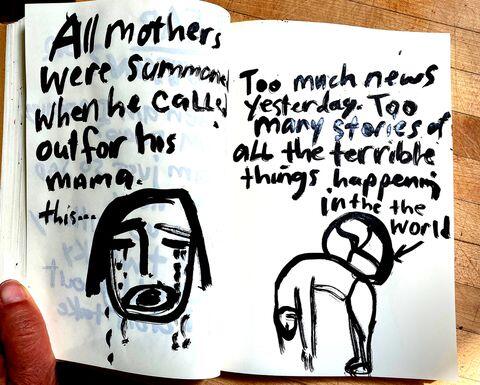
The article included this image of a diary kept by Tanya Gibb, who came down with COVID-19 symptoms in early March: