These are some pretty amazing nature journals! The site where I first saw Jo Brown’s images described them as being in a “Moleskine” but that page layout doesn’t look like any Moleskine brand notebook I’ve ever seen. Does anyone recognize it?
Many artists find inspiration in the diverse beauty of the environment. UK-based illustrator Jo Brown documents the discoveries she makes during outdoor excursions in her colorful Nature Journals. Each notebook spread contains exquisite drawings and notes of plants and animals that she sees in the Devon countryside. What makes her Nature Journals particularly eye-catching is the way Brown utilizes the entire page for her full-bleed illustrations. By doing so, her vibrant compositions appear to pop off of the page.
I was very pleased to get my shipment of 2021 Nolty diaries straight from Japan in mid-September. Ordering directly from JMAM worked great! Because I was buying multiple notebooks, the shipping costs worked out well, but if I’d only ordered one or two notebooks, I might have been better off paying Kinokuniya’s higher retail prices and picking up in their NYC store to save on shipping.
I got another leather Nolty Gold diary, which will be my third.
I decided to try this year’s dark green version of the regular Efficiency Notebook. The green is so dark, it almost looks black in some light. (Shown with a 2020 diary in black for color contrast.) The plan is to use this as an image diary, as I’ve done the past 2 years.
This red one is for a friend.
I got 2 of the 2021 Nolty Notebooks. The only thing that is dated is one page with a 2021 yearly calendar. The entire rest of the notebook is graph paper. I don’t really love the shade of pink on the “Sakura” notebook , and am generally not someone who likes pink, but I bought it to have something different. Now I kind of wish I had gotten the Mulberry shade instead. The charcoal grey color is much more my style, though I was surprised that the grey notebook has a smooth texture on the cover. The mottled look is due to color only. I’m not sure if any other Nolty notebooks have this cover texture. I’m looking forward to using these for general note taking, or perhaps I’ll try doing a page a day, as a replacement for the Nolty Daily Book, which wasn’t continued for 2021.
My order came with this little packet of sticky note tabs– so cute! What a nice free surprise.
So that’s all my 2021 Nolty diaries. I am looking forward to another year using these sleek, practical, fountain pen friendly notebooks!
Here’s another fun eBay find: a vintage Marquette looseleaf notebook. I’m always quite excited to find vintage notebooks like this that are in excellent condition despite being at least 60 or 70 years old.
This notebook is pocket size, measuring approximately 3 5/8 x 5 1/2″. The cover is faux leather and somewhat flexible. Aside from a bit of wear on the corners, it doesn’t seem to have been heavily used.
The inside back cover shows the model number, 1-126, and notes that it was made in the USA. I’m guessing it is from the 1940s or 1950s, when almost all stationery sold in the USA would also have been made here.
I love how the original cover sheet for the filler paper is included, noting that you can buy more at long-gone Woolworth’s. It includes a helpful note on how to open the rings.
The other fabulous detail is the set of hand-made dividers that someone made labels for using a typewriter. None of the previous owner’s actual notes are included, unfortunately. I’d love to know more about what books and records and gifts this person was making note of (I’m assuming “records” referred to record albums, but it may have meant records in the sense of medical data and other information.) and what sort of wedding they were planning.
The notebook also came with additional filler paper, still with the original wrappers: Marquette brand lined paper, and National brand unlined paper, with cool red edges. (I already have some of this exact paper from another eBay purchase, which you can see in this post about a Japanese looseleaf notebook.)
I have another Marquette diary in my collection, but hadn’t been able to find out much about this brand. From the few images I’ve seen of Marquette products, there is usually a W logo on them, which leads me to believe that it was a proprietary brand made for Woolworth’s. An Etsy listing for a packet of filler paper, probably from a later time period, refers to Woolworth and lists the manufacturer as Geo. Seelman & Sons of Milwaukee, WI.
Etsy listing by RedStarVintage
The Seelman stationery company no longer exists, but various online tidbits show that it was founded in 1906 by an immigrant from Germany and dissolved in 1993 by a Joseph Seelman, who was probably a great-grandson of George, and just died in 2019. The company registered the Marquette trademark in 1957, though it was obviously in use long before that. According to a Wisconsin history site, Seelman’s headquarters was also the home of the Milwaukee Envelope Co. Based on a patent application and some biographical data I found, it seems that the Envelope Co. was founded by Seelman, and he also either founded or bought out the Milwaukee Blank Book Company. Seelman & Sons was probably a fairly large stationery company at one point, but may have gone out of business due to competition as other companies formed large conglomerates. From what I could find, it does not seem like the Seelman company was bought out or merged with anyone. I always go down quite a rabbit hole researching these things, often it’s a microcosm of American history.
I love finding notebooks like this, that were totally normal, basic stationery items many decades ago, yet seem quite rare and special now, compared to the similar items you can buy today. It has a slightly musty smell, a wee bit cigarette-y, that manages not to be unpleasant, and really evokes a sense of the past. The Marquette looseleaf notebook is another reminder that they don’t make ’em like they used to.
Since then I my notebook collection has grown substantially and I recently uploaded a video on my Youtube channel featuring my entire journal collection.
I love to take my notebooks on trips and jot down my impressions and capture moments that move me deeply. You can find me on Instagram under: https://www.instagram.com/thejournaljoy
She has quite an awesome collection! Here are a few photos, but definitely check out her video for more info. You can follow her YouTube channel at JournalJoy.
Many thanks to JournalJoy, for sharing her addiction and staying in touch!
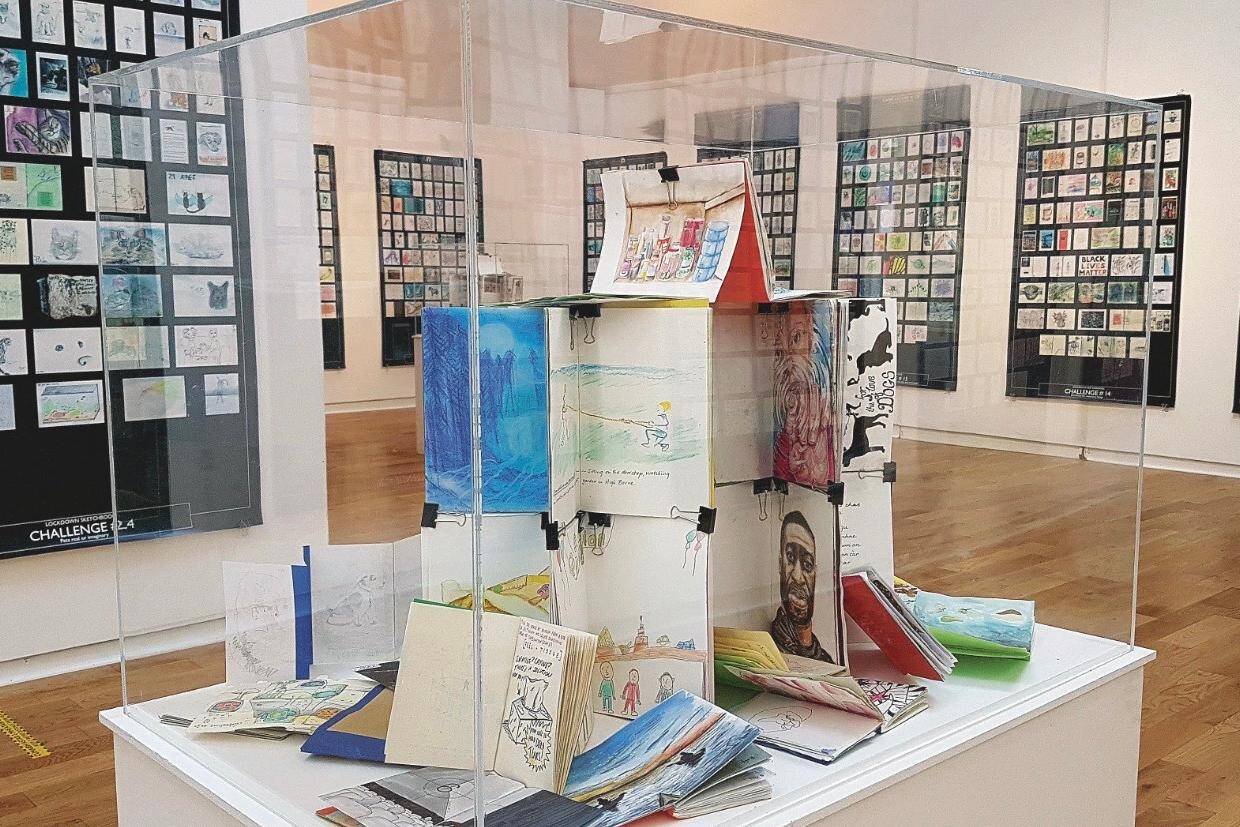
The gallery exhibition below at An Lantair in Scotland looks like quite an amazing presentation of sketchbooks. The sketchbooks were created during the lockdown, and of course with pandemic precautions continuing, it’s difficult for many people to view it in person. But you can see it online in their virtual gallery.
[An Lantair’s] Lockdown Sketchbooks exhibition is the collected results of a rather remarkable project. At the beginning of lockdown sketchbooks were sent out to over 100 participants. This was then followed up over the course of a month with emails setting a daily challenge. The completed sketchbooks were then sent back and put together into a show. If you can find your way on the An Lanntair website to the “virtual tour†of the exhibition – it’s not that easy, but do persevere – you can see the enormous variety of the results and the evident enthusiasm the project inspired. The challenges included such things as “the middle of the night,†or “the contents the fridge.†There is humour, poetry, a lot of skill and much else in the very diverse results. A selection of the responses from people who have taken part is also included and these are as interesting as the drawings themselves. The whole thing was clearly a big success and at a time when there wasn’t much of that about.
Yet another reason why I’m dying to visit Japan! In Tokyo, a bar called Decameron opened recently, despite the fact that other bars in the neighborhood have been closing because of the COVID-19 pandemic. In part due to concerns over the transmission of the virus through droplets spread while speaking, and in part due to the bar’s literary theme, the owner decided that Decameron would require everyone to be completely silent and communicate only in writing:
Unlike other bars in Kabukicho, this one comes with several notebooks on the counter, where customers can write down their orders, along with anything else they’d like to communicate. While stopping the spread of coronavirus is one primary reason for the writing system at Decameron, another reason is to provide everyone with an opportunity to rethink the ways in which they communicate.
Some of the notebooks they are using look really nice, from what I can see in the photo. They seem to be pocket size hardcovers with a tan linen cover and black page edges, a combination I don’t recall seeing anywhere else. Of course I am dying to know what brand they are! In a couple of the photos you can also see that they are using Blackwing pencils.
In amongst the noise and bright lights of Shinjuku’s Kabukicho is a quiet oasis where you can hear the sound of pencil on paper.
One of the more recent entries to the world of digital/analog notebooks is the Thinkers Notebook and its companion app. When the makers contacted me to offer a sample for review, I wasn’t sure what yet another proprietary notebook/app combo would do to distinguish itself, but the Thinkers Notebook actually fills a niche.
The Thinkers Notebook is a landscape format design, 9 inches wide by 6 inches tall. The notebook is disc-bound, so you can easily remove or rearrange pages. The front cover is an attractive matte black with dots and the company logo in a coppery orange. The back cover is plain white, in a heavier cardboard that allows the notebook to stay fairly rigid if you aren’t using it at a desk. At the beginning of the notebook, there is a 2-sided sheet with information about the companion app and how to use it with the notebook.
The body of the notebook is 50 sheets of specially designed paper. One side is dotted, and the other is lined. Both sides have a footer with space for a title and date, boxes you can tick to assign tags, and a QR code recognized by the app. The page design is attractive, but I wished the QR code was a bit smaller. Some users might prefer the option of a larger notebook– the 9 x 6″ size is nice, but it’s not a ton of space for sketches, especially when you lose a lot of the margin to the footer and the rings.
The paper quality is great: bright white, smooth and pleasant to write on. Fountain pens work beautifully, with no feathering or bleed-through and almost zero show-through.
The app can be downloaded for Apple or Android devices. You can sign up for an account via Apple, Google or Facebook, or just using an email address. A few quick introductory screens instruct you on how to capture a page image, but it is very intuitive. The camera will automatically snap a photo when you are correctly aligned. The first image I shot came out upside down even though I had turned the camera to the correct orientation, but that problem did not reoccur. Once you have captured the image, you can save it as is, or convert to black and white, or greyscale. It is uploaded to the Thinkers Notebook cloud. The notebook has boxes where you can assign 4 tags by striking through the boxes. I tried a single strike-through, which was not recognized, but an X worked. In addition to these 4 tags, you can create additional custom tags in the app. You can’t rename the built-in tags.
While editing your image, you can crop and rotate it if you want. In my images the app captured part of the previous page, since I didn’t have it flipped to the back. I would have expected the app to crop to the page margins automatically, but maybe I was doing something wrong. The app does not offer any handwriting recognition, which is a downside. The other weakness is that the app doesn’t seem to let you re-title an image. It just names it with the date and time it was taken. The app shows a list of images that can be filtered by tag, and you can sort by date ascending or descending, but these are the only view settings. It always shows a thumbnail view, without any option for a list view. If you have hundreds of images saved, it could be awkward to scroll through all of them this way.
The FAQs/help articles for the app are limited to a few basic things about login. When I did my testing (on a weekday) the app showed that their support desk was offline, so I sent a message with my question about editing the title. On my iPhone SE 2020, the “send” button to submit this request was small and awkwardly placed in such a way that I had to tap around several times before actually being able to hit it correctly. I heard back from the support team at Thinkers a few hours later: the iPhone app doesn’t currently support changing the title, but they are working on that for a future version.
But let’s get to what is really cool about the app: the sharing feature. By hitting the share button, you can share the image by text, email, Facebook message, Dropbox, etc. It is sent as a link that brings the recipient to an online Thinkers app page where they can view the image, and also tap on spots in the image to leave comments. The key thing is that the recipient does not need to download the Thinkers app to view or comment. The image creator gets a message as soon as the comment is left. All comments then show up in the Thinkers app. (I had to manually refresh the app for new comments to show up. I am not sure if it automatically refreshes at some interval. On my iPhone settings, it looked like Thinkers Notebook is set so you can’t turn “background app refresh” off.
I like how the sharing works. I can see it being very useful in a collaborative work environment where sending quick sketches and notes to others within and outside of the company and compiling their responses is part of the work flow. I don’t know what other software, if any, might allow this kind of comment process on sketches in such a simple way, so I can’t speak to whether there is competition for this feature. Obviously there is plenty of competition for various kinds of digital notebook page capture, such as Evernote, Livescribe, Hamelin’s Scribzee, and Moleskine’s Smart Notebooks.
After signing up for an account, one of the emails I got from Thinkers had a tip about how you can also use the app with a whiteboard. It made me wonder how the app would work with other notebooks. I snapped a photo of a random page in my squared Moleskine journal and it worked at a minimal level as an uncropped photo of a legible notebook page, but the app added the default tags, I guess mistaking the background or the squares on the page for the tag icons.
So is the Thinkers Notebook right for you? If you want a quality writing experience with the ability to easily share ideas and collect feedback, it is definitely worth a try. There are some limitations to the system, as the app lacks certain features and there is only one notebook option. The notebooks are also a little pricey, at least at the list price. The list price is $24.95 per notebook, but they are currently marked down to $17.99 per notebook on the website. A 50-sheet refill pack is $9.95 (no covers or rings, just the loose sheets that you can add to your existing notebook). A 5-pack of notebooks is currently $74.96 with free shipping, marked down from $99.95. The companion app is free, at least for now. They may introduce a premium paid version in the future, with more features.
It’s back to school time, so everyone’s posting about the best notebooks and pens. But a post at High Snobiety actually caught my eye with a lot of notebook brands I’d never heard of. Many of their picks are a bit more expensive than your average back to school notebook… just a bit…
That said, they start off with some pretty basic $3 notebooks from Muji:
Muji notebooks
There are some other brands featured, including Moleskine, that aren’t too pricey. This Normann Copenhagen notebook caught my eye, and is only $26, which for a 14.5 x 22cm notebook with 64 sheets of 120 GSM paper doesn’t seem too too crazy. I had never heard of the Normann Copenhagen brand, which mainly makes furniture and housewares, but they also have a line of office and desk supplies called Daily Fiction, which has some cute stuff that is accessibly priced.
Normann Copenhagen notebook
This Montblanc notebook with a Petit Prince design goes for $80:
Montblanc Petit Prince notebook
Then you get into the designer brands, some of which start to get a bit outrageous, such as this $320 notebook by Thom Browne:
Thom Browne notebook
The priciest notebooks of all are from Bottega Veneta. This notebook features the brand’s distinctive woven leather on the cover. It comes in two size, 15.5 x 22cm currently priced at $580, or 22 x 27 cm, which was originally priced at $890, but is now marked down to ONLY $356!
I’ve previously featured Jordan Mechner’s Sketchbooks on this site, and more recently, I spotted an article he wrote on Medium about his habit of keeping a journal:
I’m a journal-keeper. With over a hundred notebooks filled since 1982, it’s become part of who I am. I couldn’t have expected or anticipated all the ways my new habit would enrich my life.
Even if we never reread what we write in our journals, the act of writing changes us. It shapes our perceptions and memory. Over time, opening the notebook and picking up the pen becomes like resuming a long-running conversation with a friend. We develop a voice, even though there’s no one on the other end to hear it — or rather, our self is listening.
For me, size matters. When it comes to choosing a notebook, I mean.
I have hundreds of notebooks, in a variety of styles, materials, colors, and brands, but most of them fall into a pretty narrow size range. My preferred size has evolved over time, perhaps in proportion to the size of my own hands: when I was a kid, my initial fixation was on small promotional diaries in the 2.5 x 4″ size that was a very common size for diaries and address books for many years. Then I moved on to 3 x 5″ wire-bound notebooks, another universally popular size for pocket notebooks sold in pretty much any supermarket, drugstore or office supply store. Then as an adult, I fell in love with the 3.5 x 5.5″ size made ubiquitous by Moleskine. Moleskine did not invent the hardcover notebook with a ribbon marker and/or elastic. I have other similar journals that came before Moleskine. But they all tended to be around 4 x 6″ or larger. For me, 3.5 x 5.5″ just hit the sweet spot, and now it is the only size notebook I truly desire. Those of you who have been reading this site for a while will know that I’ve reviewed quite a few notebooks that I loved, but couldn’t force myself to actually use because they were off by maybe half an inch in one direction. I appreciate notebooks in all sizes, but I’m stuck on using one specific size.
Nolty, DaVinci, Moleskine and Bindewerk notebooks, 3.5 x 5.5″ or close enough.Travelers Notebook and Hobonichi Techo: size not quite right for me.
I’m also pretty committed to using notebooks with plain, squared, or dot-grid pages. Lines in only one direction bother me. I have used lined notebooks, and have several that are so nice in every other respect that I do intend to use them someday, but for the most part, lined pages are also pretty much a deal-breaker.
Other than those two things, I can be pretty flexible about what I am willing to accept in a notebook. The paper doesn’t have to be fountain pen friendly. It can be hardcover or softcover. It doesn’t have to have a back pocket or elastic closure or ribbon marker. It can be expensive leather or cheap cardboard. I like plain black covers, but colors and patterns are ok too. But I know other notebook users are really picky about some of these things.
How about you, readers? What is the most important attribute of a notebook to you? What can’t you live without? What are you willing to put up with? What do you absolutely hate? Please chime in with a comment!
Notebooks, journals, sketchbooks, diaries: in search of the perfect page…