Setting Up a New Notebook

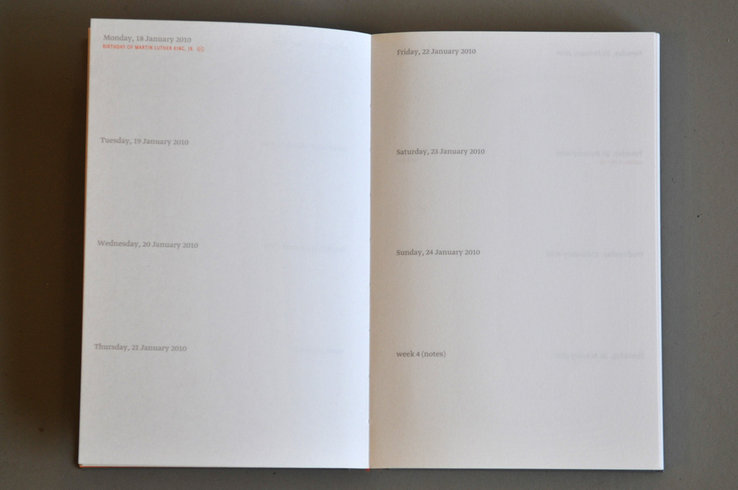
Do you start the year by setting up a new notebook or planner? What’s your method? Dustin at Stepcase Lifehack shares his steps for starting a new Moleskine for 2010:

Since I make a big deal about using a Moleskine (or similar notebook) as an always-with-you productivity tool, I thought I’d share exactly how I set mine up. It’s not super-complicated, but it might give an idea of how a simple pad of paper can hold together all the strains of an insanely complex life.

My strategy is simple: Make it as easy as possible to pull the thing out, use it, and put it away. No messing around to find the right section, no page numbers, nothing fancy. A few tabs, judicious use of the bookmark and elastic strap, and a good fine-tipped pen. And that’s it.

Read more about the specifics at Getting Ready for 2010: My Moleskine Setup – Stepcase Lifehack.

New Yorker Book Blogger Finds the Perfect Notebook

Thanks to a tip from a reader, I found this nice little post by Macy Halford, at the New Yorker’s publishing blog, The Book Bench:

Not too tall, not too short, not too fat, not too thin, not too flimsy or with too stiff a spine. And most of all, not with lines too far apart.

These are the criteria that must be met by a notebook if it is to be called mine (my mother always said, “Never settle when it comes to a notebook”), and if you are anything like me, you are constantly on the lookout, constantly wondering when you stroll into a bookshop whether Mr. Moleskine will finally have come up with something just right, something you. Because even though the legendary notebook of Hemingway is undeniably handsome, and even though the line has expanded to include those delicate, brown-paper-bound cahiers (my favorites), I always end up disappointed. A few scribbles and I find myself asking, Is this all there is?

Truth be told, I’ve been searching so long that I’d just about given up hope. I thought I was doomed to a life of half-completed notebooks, nearly the same as half-completed thoughts. And then one day last week, while wandering the wilds of the Upper East Side, I ventured into Shakespeare and Co., and there it was, just sitting there: the perfect notebook.

Which brand was it that earned the “perfect” accolade? Whitelines (buy), in particular their A5 spiral-bound graph notebook.

Read more at White on White: The Book Bench : The New Yorker.

Notebook Addict of the Week: Laura Meyer

This week’s Addict is a self-described “traveling folk rocker” who mentions picking up some pebbles along the way. She also picked up some notebooks!

These were found while helping her mother prepare for a move:

The most time-consuming part of packing was organizing all of my notebooks, CDs, and cassettes from over the years – the volume of this stuff is just overwhelming.

Read more (and see her other interesting collections) at Swept Away (April 1, 2009) « Laura Meyer.

Review: Monologue and Dialogue Notebooks by Grandluxe

Here’s a couple of nice notebooks made in Singapore: the Monologue and Dialogue notebooks by Grandluxe. I first heard of the brand when I stumbled across this post, and was quite intrigued. Though they aren’t sold in the United States, the company was kind enough to send me some free samples for review.

The Monologue notebook is something that at first would be thought of by most people as a “Moleskine clone.” But on closer inspection, it turns out that it’s more similar to another major notebook brand.

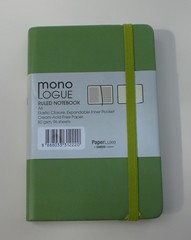
Here’s the front, with the typical elastic closure and paper band wrapping around:
grandluxe1

The cover is smooth and slightly soft, and you can see the imprint of the elastic. The Monologue branding is stamped at the bottom of the back cover. It’s hard to see in photos, but the cover material has a subtle leather-texture look, printed in tiny dots of darker and lighter tones. To the touch, it is completely smooth.
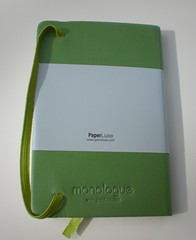
grandluxe6

The notebook is slightly larger than a pocket size Piccadilly notebook, shown below for comparison. The Monologue covers are slightly thicker and stick out a bit more from the pages.
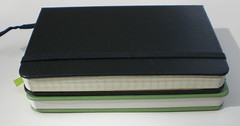
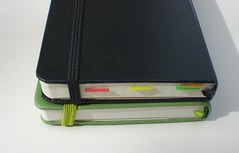
grandluxe8

grandluxe9

The inside front cover is totally blank, no predetermined space for writing your name.
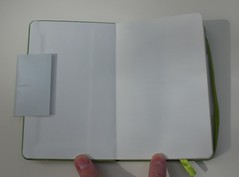
grandluxe2

Inside the back cover, the usual expanding pocket, with cloth sides.
grandluxe5

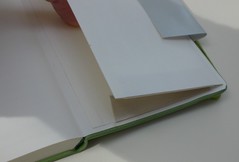
The notebook is a bit stiff at first, but it does lie quite flat:
grandluxe4

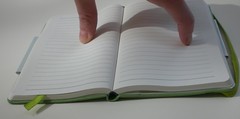
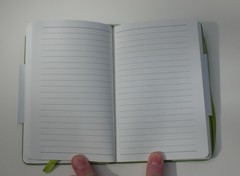
The lined pages have a fairly broad margin at each side:
grandluxe3

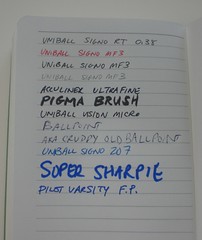
How’s the paper? Nice and smooth, but there is a bit of show-through with many of my usual pens, and my Pilot Varsity fountain pen seemed to feather a wee bit. The paper weight is 80gsm.
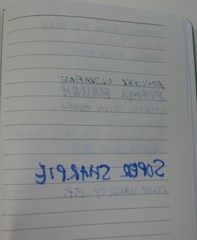
grandluxe10

grandluxe11

So, did this notebook remind you of anything? How about the Rhodia Webnotebook? They are uncannily similar in the size and exterior appearance, and even the page layout is the same but for the lack of the Rhodia logo in the corner. When you actually put them side by side, you notice other differences: the Rhodia has colored endpapers and a logo stamped on the front, and is slightly thicker, due to its 90gsm paper. But the 80gsm Webnotebook has pretty much the same dimensions as the Monologue notebook– and pretty similar paper, it seemed to me. Below are some comparison shots to the 90gsm Webnotebook:
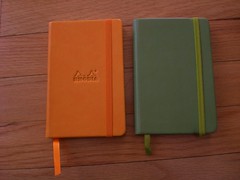
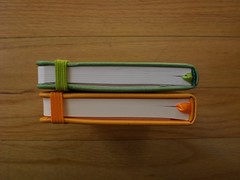
monologue2

monologue5

monologue4

monologue3

From what I’ve been able to determine from other blog reviews, the Monologue is less than half the price of a Moleskine, so I’d expect that it is also quite a bit cheaper than a Rhodia Webnotebook in the Asian markets where it is available. (Grandluxe’s suggested retail price is US$7.10.) The paper isn’t as nice as the 90 gsm Rhodia paper, but it’s pretty comparable to the 80gsm earlier Webnotebook– I don’t think I’d be able to tell the difference, but I can’t vouch for what heavy duty fountain pen users might experience.

Grandluxe also sent me samples of their Dialogue brand. With their horizontal elastic, these might remind you of Ciak’s notebooks, or Piccadilly’s Primo Journals.
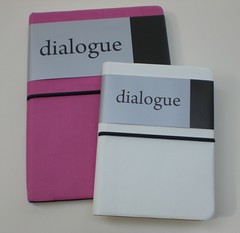
grandluxe12

Both the small Dialogue notebook and the Monologue notebook say on their labels that they are A6 size, but their measurements are actually quite different! Below is the Dialogue vs. the pocket size Piccadilly notebook. It measures about 4 3/8 x 5 7/8″. The photo below also shows how round the spine of the Dialogue is– it sticks out quite a bit to accomodate the elastic
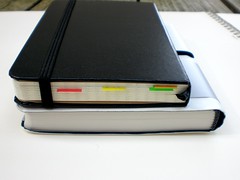
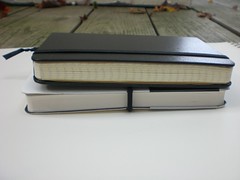
grandluxeb2

grandluxeb1

The elastic is rounded, and fits into a small groove in the side of the cover.
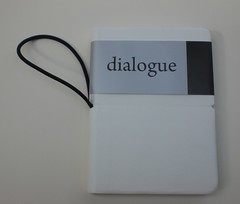
grandluxe13

grandluxe14

The Dialogue notebook is pretty springy, and doesn’t easily open flat.
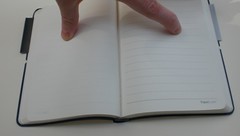
grandluxe17

The cover itself is thin and quite flexible.
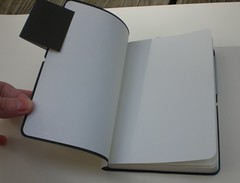
grandluxe15

The line spacing and margins are wider than the Monologue notebook, and there’s a small PaperLuxe logo at the bottom right corner of the lined pages. The front of each page is lined, and the back is unlined, which I rather like– two paper styles in one!
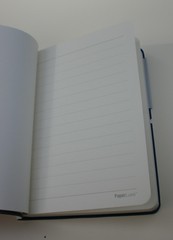
grandluxe16

This seems to have the same 80 gsm paper as the Monologue notebook, and performed similarly with pens.
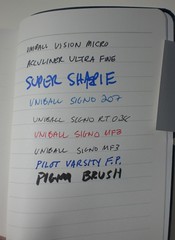
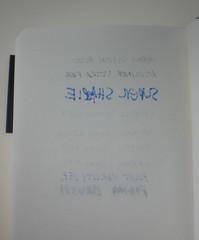
grandluxe18

grandluxe19

I personally am not crazy about sideways elastics so this isn’t a notebook I’d consider for everyday use, but it seems like a good value for the suggested retail price, which is US$6.80.

United States readers might have a hard time buying these notebooks, but the Monologue and Dialogue brands are sold in 30 countries, including:

  • Singapore
  • Malaysia
  • Japan
  • Australia
  • Indonesia
  • Brunei
  • Romania
  • Thailand
  • Dubai
  • Hong Kong
  • Taiwan
  • Philippines
  • The Netherlands
  • China

Some of the major retailers stocking them include Magrudy’s, Tokyu Hands, Eslite, Metro Books, Paragon Departmental Stores, Loft, Times Bookstore, Chater House, One-Hua Ho Department Store, Urban Write, Harris Bookstores, Kinokuniya, and Takashimaya Department Store.

If you aren’t traveling any time soon and don’t mind paying for international shipping, you can also try ordering from Grandluxe’s webstore. Other colors, sizes and styles are available.

A Stash of Journals Discovered, from “A History of Ghosts”

The story below is the kind of thing I wish would happen to me… it’s from a book called A History of Ghosts: The True Story of Seances, Mediums, Ghosts, and Ghostbusters, which, amusingly enough, turns out to be written by the father of Dan Ackroyd:
Judy and I pried open the rusted metal clasp with a screwdriver. We had expected to find either junk or emptiness. Instead, we found history.

Inside were a photo album of black-and-white prints attached with triangular corner mounts and yellowed newspapers from decades back, saved for articles germane to the family. There was a scrapbook of recipes, and our father’s sheepskin from Queen’s University, Applied Science 1913, and a bundle of notebooks of the type that children used in school. They were bound together with kitchen twine.

We untied the bundle and began to read page after page of penciled handwriting. Not good handwriting. Very hard to read. With no anticipation of doing so, we had come across Grandpa’s journals (83 of them, to be precise), written in his own hand from 1905 through 1931 and containing thoughts, observations, and conjectures that he clearly had hoped might someday be shared with others.

Within the now fragile pages were handwritten copies of letters to his family and friends and to the editors of local newspapers. The majority of the words he recorded are actual accounts of séances, most of which took place in the small farmhouse on the north shore of Loughborough Lake, near the village of Sydenham, Ontario. Other passages are his musings over what it’s all about. The notes and letters aid my remembrances of the taciturn elderly gentleman who lived in that farmhouse, where I spent many gloriously happy days and nights.

(Emphasis mine.)

How cool is that? My grandmother saved all kinds of weird things and it was a huge job to clean out her house after she died, but she didn’t leave any journals. She always told lots of great stories, and had an interesting life, so I wish she had written more things down. But then I think about my own journals and how embarrassing it would be for someone to read them– in a way I think it would be cool for some future descendants of mine to find something really old that would tell them about the life of someone in the past… but I haven’t done anything as interesting as going to lots of séances!

via ‘A History of Ghosts’ explores paranormal past – TODAY Halloween Guide.

Miquelrius Design Boardbound Notebooks

Here’s some cool-looking Miquelrius  notebooks that I’ve never seen in a store: Design Boardbound Notebooks. The label on the front makes them kind of resemble the Vickerey Old Style School Quaderno journals that I reviewed a few months back. A commenter noted that those no longer seem to be sold at Vickerey, so perhaps these could be a substitute! Please leave a comment if you’ve seen these for sale anywhere other than via Miquelrius’ online store.

Keep a Dream Journal

I recently came across this interesting interview. with a therapist who talks a lot about dream analysis. Here’s my favorite part:

“Dream recall improves if you write them down in the morning. I have been keeping track of my dreams for 25 years and have filled dozens of notebooks.”

I have an old 2001 Moleskine Daily Planner that I’ve been using to jot down dreams for several years now– it’s fun to read back through it and rediscover some really bizarre old dreams that I don’t even remember now. Do you keep a dream journal?

Writersblok Bamboo Paper Notebooks

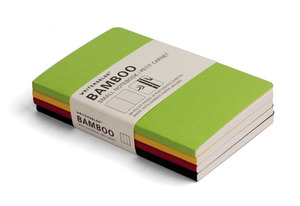
I reviewed Kikkerland’s Writersblok notebooks a while back, and now it seems their product line is expanding with these “Bamboo” notebooks, sold at RevDesign.  I didn’t love the paper in the old notebooks, so maybe this new 80 gsm bamboo paper would be an improvement. They also seem to have a different binding with more of a square spine similar to a Moleskine Volant, rather than the old staple bound format. Has anyone out there tried these? Please let us know what you think!

The 4-pack no longer seems to be listed on the website, but they have 2-packs available.

Triform Police Notebooks

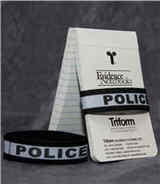
I’m always kind of fascinated by notebooks that are produced for very specific purposes. Here’s a great example:
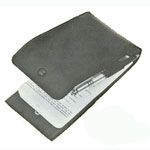
policeband-160x184home_evid
These are among the products made by a company called Triform, apparently for Canadian police officers and security guards. Why do they need these specific notebooks? Do individual officers have to purchase these themselves? Why? Wouldn’t you think the government would just buy them in bulk? Do other companies make them or is Triform the exclusive supplier? I don’t know the answers to any of these questions, but I’m tempted to call their 800 number and ask!

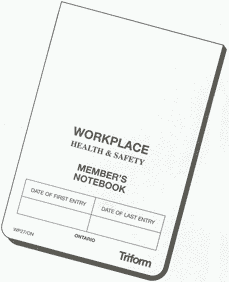
They also make a few other specialty notebooks, including “Workplace Health and Safety Member’s Notebook,” which contains sections for all this interesting stuff:

  1. Personal Title Page
  2. Work Refusal Flowchart
  3. Workplace Safety & Insurance Board Accident Reporting Poster details
  4. JHSC Meeting Dates
  5. Critical Injuries
  6. Note-taking Hints & Report Writing
  7. Investigation Hints & Effictive Investigations
  8. Workplace Inspections General Physical Conditions
  9. OHSA Definitions
  10. Metric Conversion (Height & Weight)
  11. Contacts: Names, Addresses, Telephone, Fax, Pager, Cellular, E-mail Numbers
  12. First Aid

workplace_book

Haven’t you always wanted a notebook with a “work refusal flowchart” in it? Now you can have one, for $4.75 (Canadian dollars).

Notebooks, journals, sketchbooks, diaries: in search of the perfect page…