
The blog Sushi for Lunch is having a contest. Answer the question “What Do You Do to Stay Organized” and you are entered to win a 2009 softcover Moleskine Weekly Planner + Notebook. Enter here before December 1, 2008.
Lunchtime at the Stationery Store
I’m fortunate to work in a neighborhood with some great shopping– or perhaps it’s unfortunate, as the temptation to overspend can be dangerous! Here in New York’s Flatiron/Chelsea district I have at least 3 good stationery/art supply shops within a short walk: Paper Access, Sam Flax, and A. I. Friedman.
Today I spent part of my lunch hour browsing at Paper Access. They must have just recently gotten in a lot of their fall merchandise, as I noticed a lot of new things I hadn’t seen on my last visit.
They had the Eco Jot notebooks I posted about recently, which actually come in two sizes, approx 6×8″ and 4×6″ if I’m remembering correctly. They also had Goldline notebooks made by Tollit and Harvey, who manufacture the Guildhall notebooks. Paper Access seemed to be down to only one last Guildhall in the pocket size– perhaps Black Cover wiped them out! I prefer the Goldline notebooks anyway, as they have unlined paper, though I’m not crazy about their pastel suede covers.
I also spotted a whole shelf of Cavallini notebooks in wonderfully colorful retro designs– I’ve been a fan of these since the early 1990s– their cover designs are fabulous, even though I’ve never loved the size and the ones I’ve owned didn’t have the greatest paper.
Paper Access now also stocks the HandBook journals, which they didn’t a few months ago. And of course they have the full line of Moleskines, and plenty of Rhodia, Miquelrius and Clairefontaine.
I do love this store, and I could easily have spent a ton of money– and there’s the rub: Paper Access is really expensive! They are now charging $12.95 for pocket-size Moleskines, and the HandBook journals were $10.95 for the pocket size– each at least a dollar or two more than they cost at A.I. Friedman just a block away. But browsing is free, and I have a backlog of empty notebooks to use right now anyway!
Is Your Significant Other Jealous of Your Notebooks?
I have to admit mine often says things like
You’re always fondling that thing!
Do you sleep with that notebook when I’m not here?
You love your little notebooks more than you love me!
Sad but true…
Oh Boy Notebooks
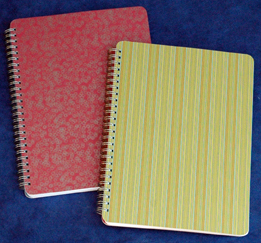
Here’s a brand of notebooks I’d never heard of: Oh Boy Notebooks. And oh, boy, do they look nice! I love the colors and subtle patterns and the rounded corners, and they seem to have some loyal fans. They are available at Jenni Bick Bookbinding, which also stocks quite a few other brands of journals and stationery products.
In Case You Weren’t Sure…
… you can read this Wikipedia entry about what a notebook is:
A notebook (also notepad, writing pad, drawing pad, legal pad, etc.) is a book, usually of paper, of which various uses can be made, including writing, drawing, and scrapbooking.
It goes on from there, and even includes a helpful illustration entitled “Notes in a notebook.”
Four Notebooks Reviewed Part 2
In the first part of this review, I discussed the outward appearance of four similar pocket sketchbooks, the Moleskine, the Pen & Ink Journal, the HandBook, and the Derwent Journal. Now I’ll look at the insides. Rather than bore you with repeated photos of almost identical things, I’ll just point out a few details that make each notebook distinctive.
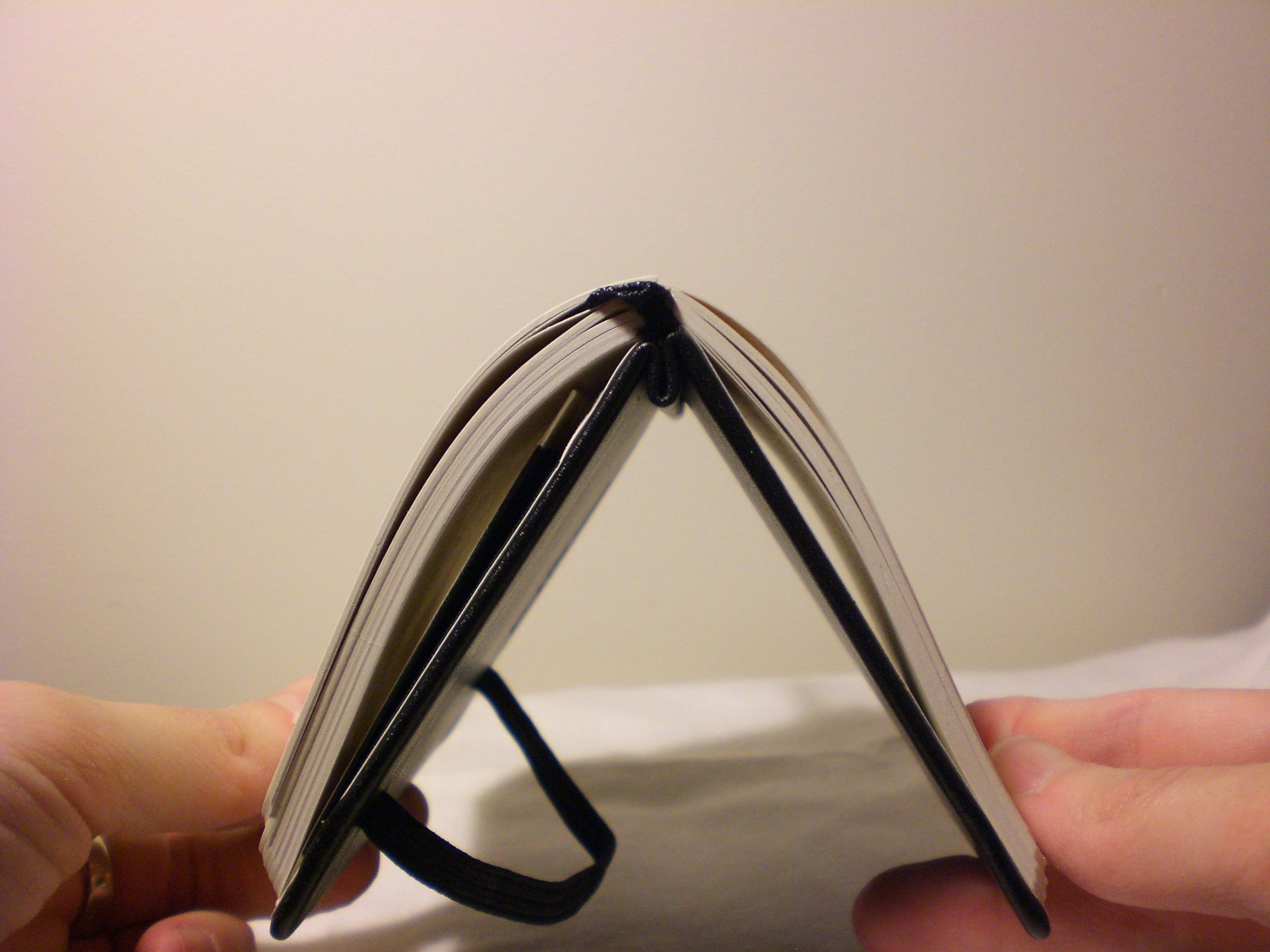
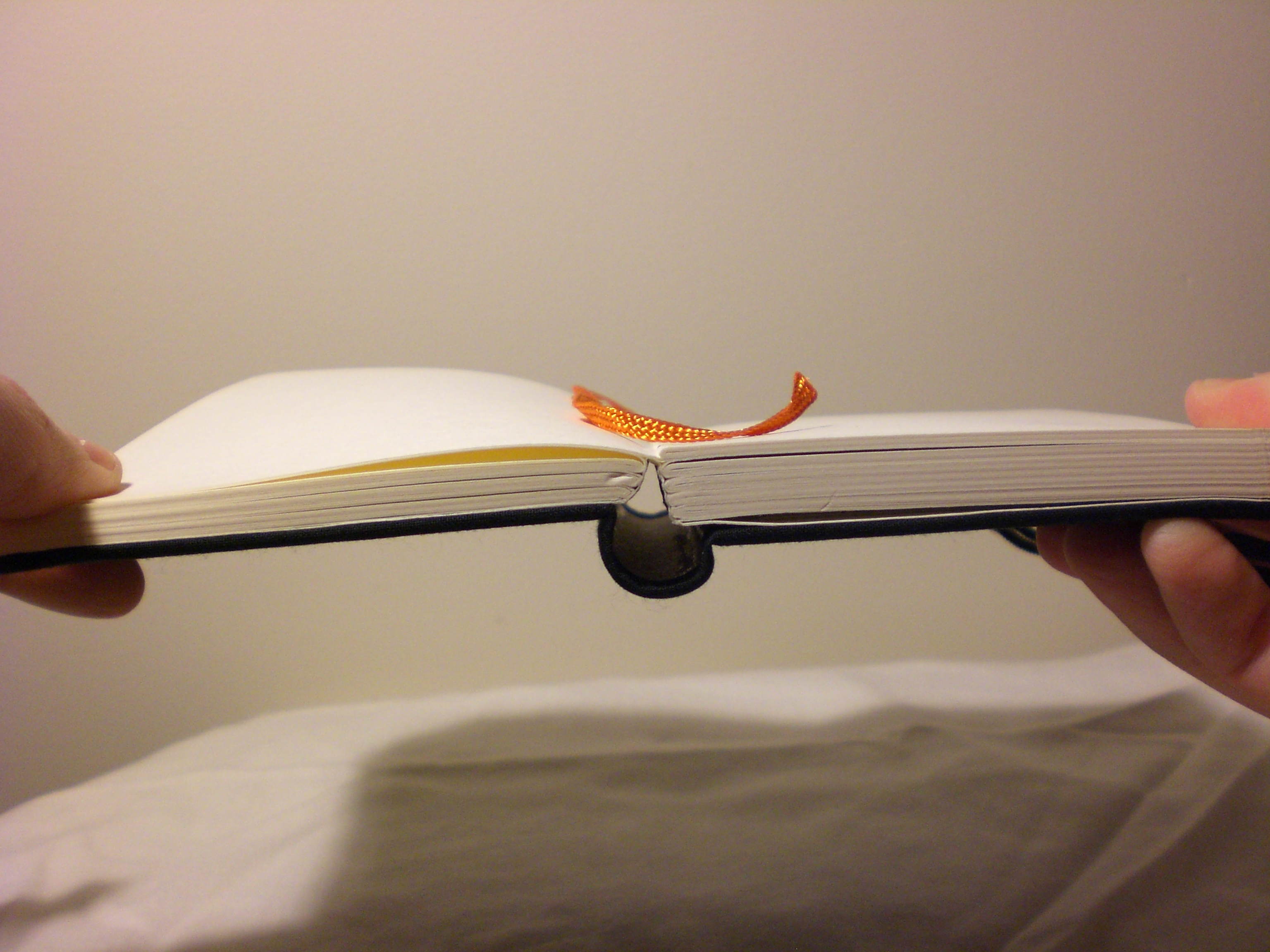
The Pen & Ink sketchbook can be opened quite far, though unfortunately I did split the last signature from the binding a little by doing this– oops! None of the other notebooks would open this far:
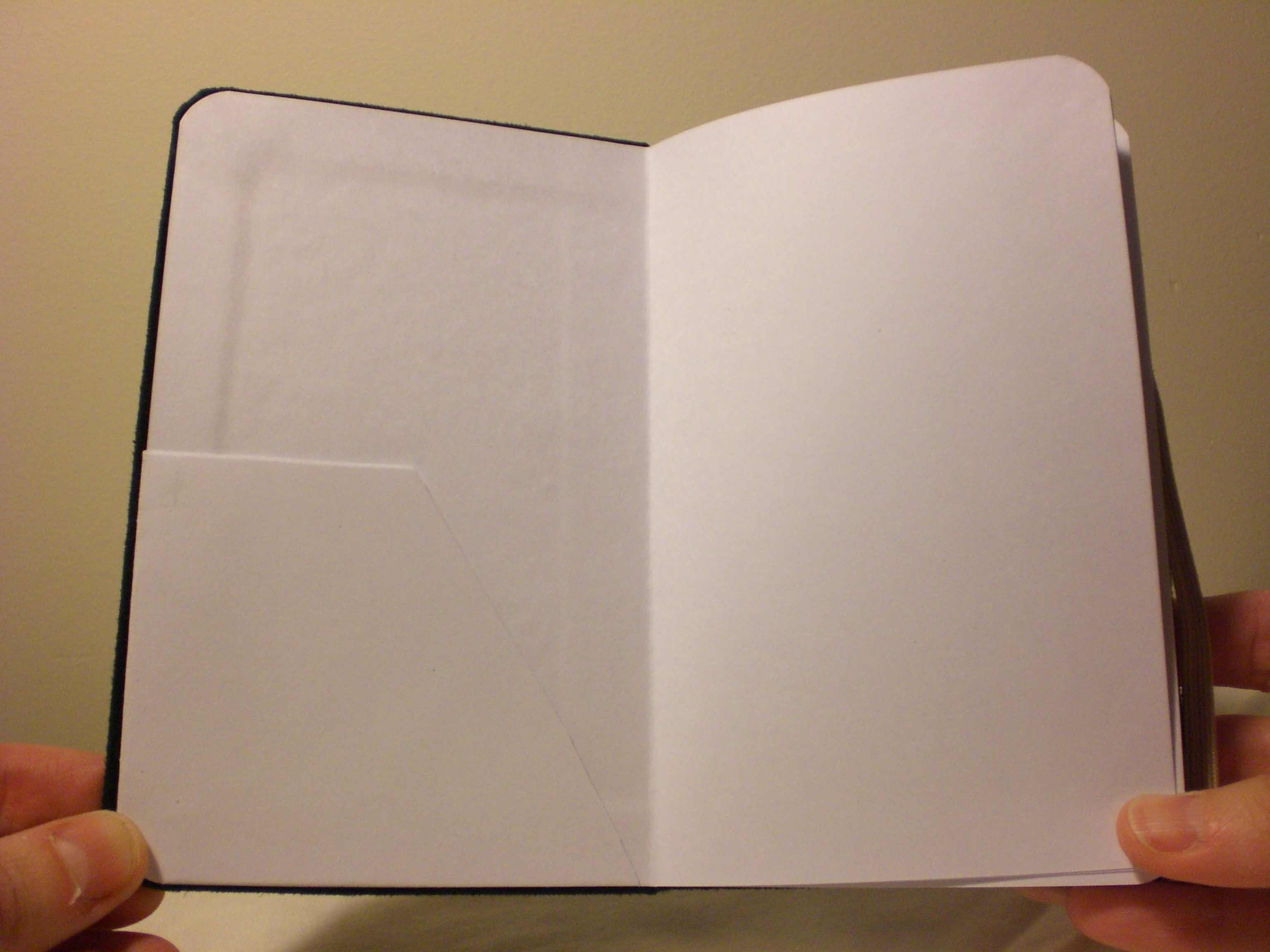
The inside front cover of the Derwent is totally plain, and offers a nice extra pocket where you could stash a few receipts or business cards.
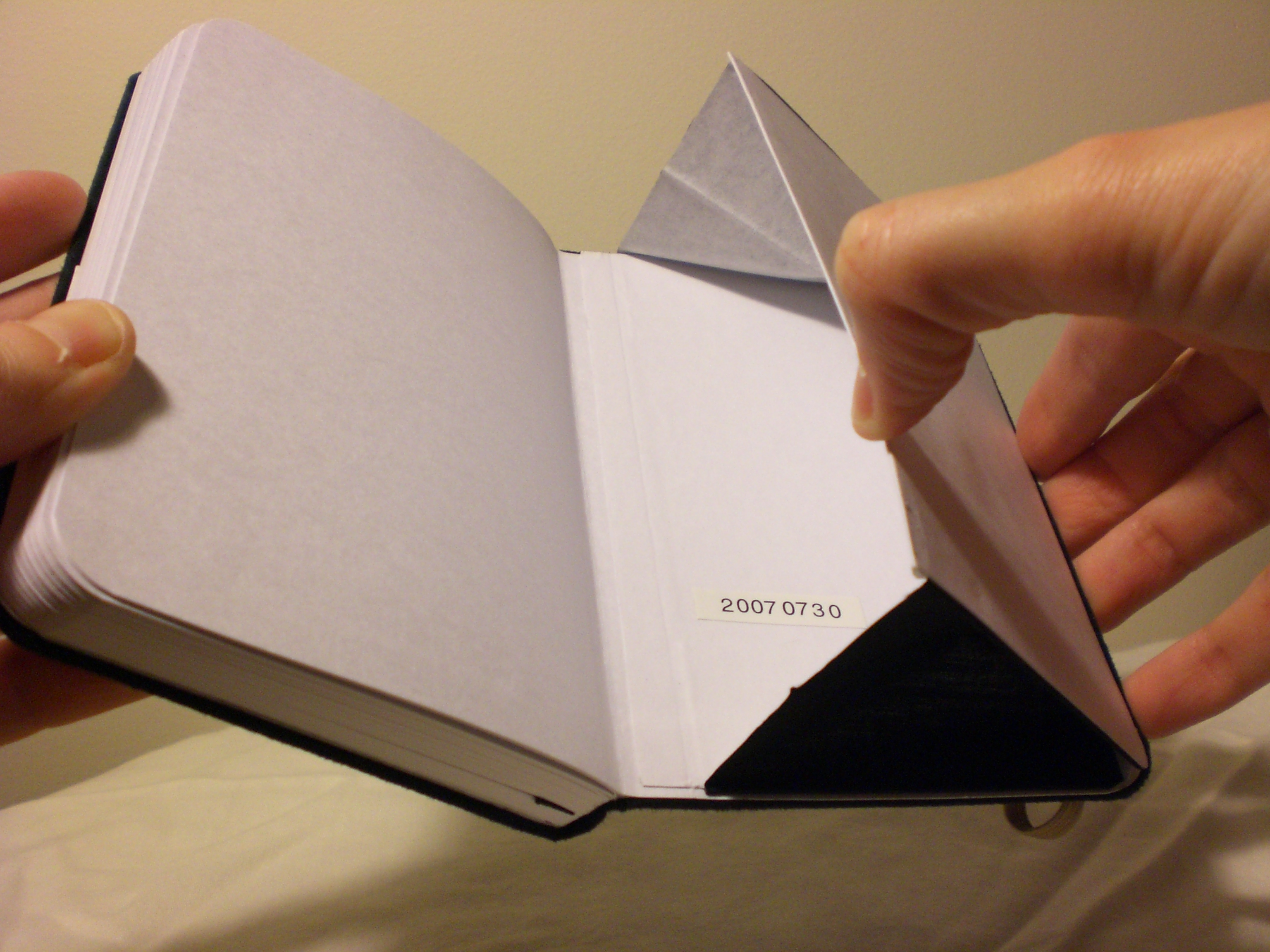
The Derwent has a very wide-opening back pocket, inside of which there is a sticker, seemingly indicating the date the notebook was made. (Maybe it will go bad if I don’t use it by a certain date…)
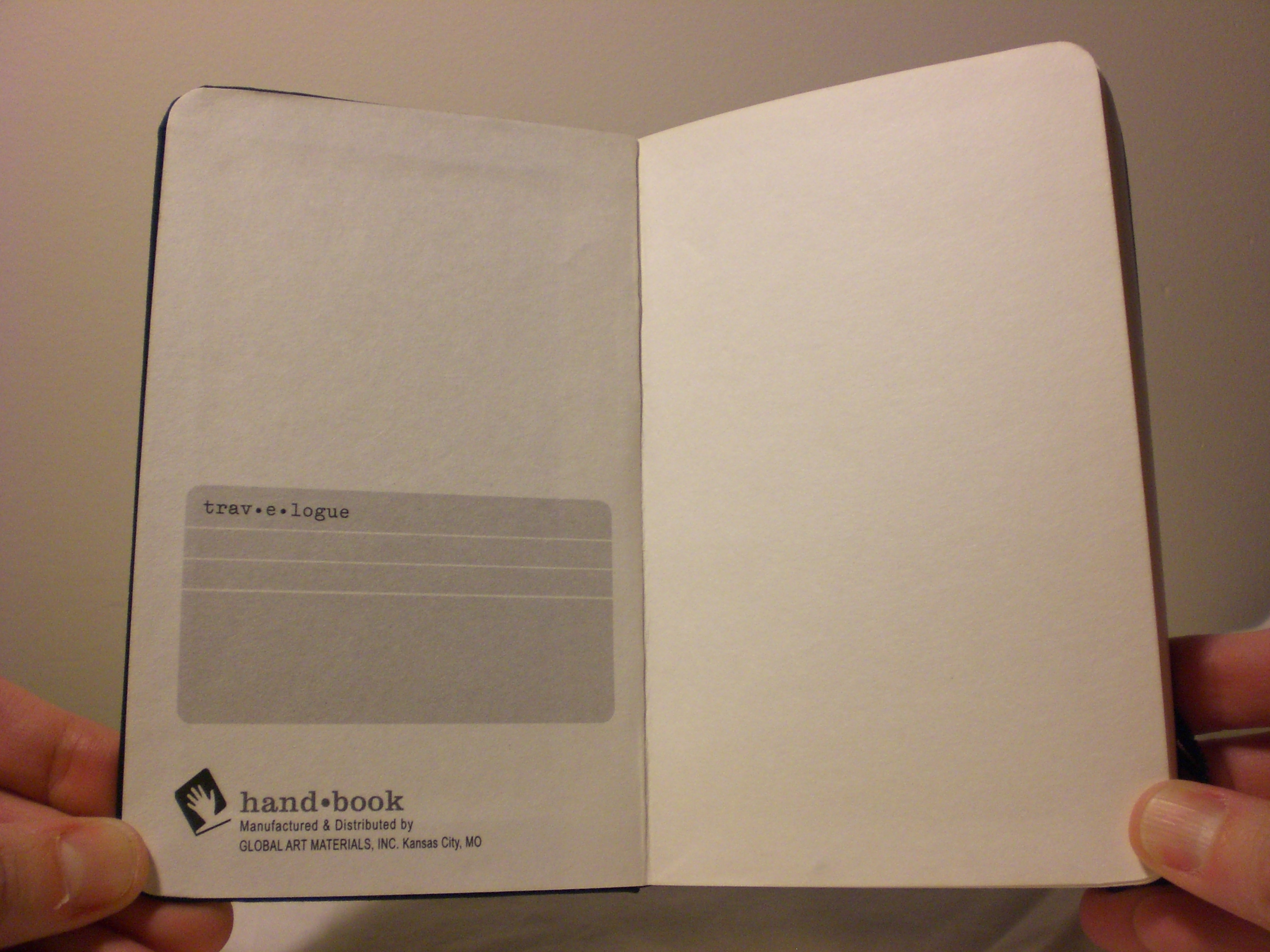
Here’s the inside front cover of the HandBook journal: a shaded box where you can write your info if desired, and the address of the manufacturer. Unlike other notebooks, they intend you to write your details on the inside front cover, not the facing page.
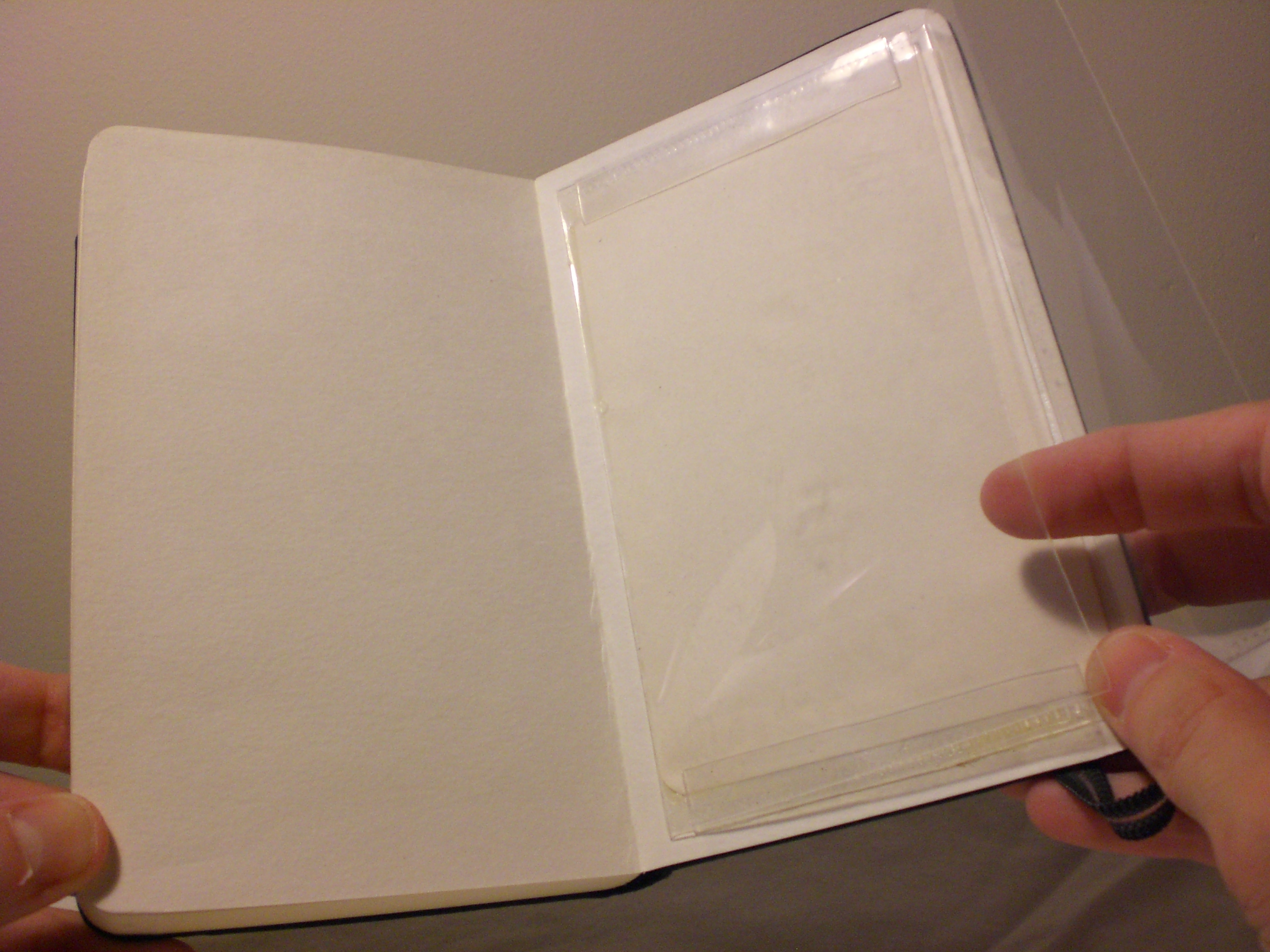
The HandBook journal can be opened quite wide, but the way the spine sticks out doesn’t exactly qualify it as “lay flat.” Unlike most other notebooks, the pocket in the back is made of clear plastic, with a flap on the opening, which faces the outside. This is quite nice for stashing things you might actually want to look at: in the HandBook I used on my safari trip, I saved a beautiful leaf as well as some ticket stubs in the pocket.
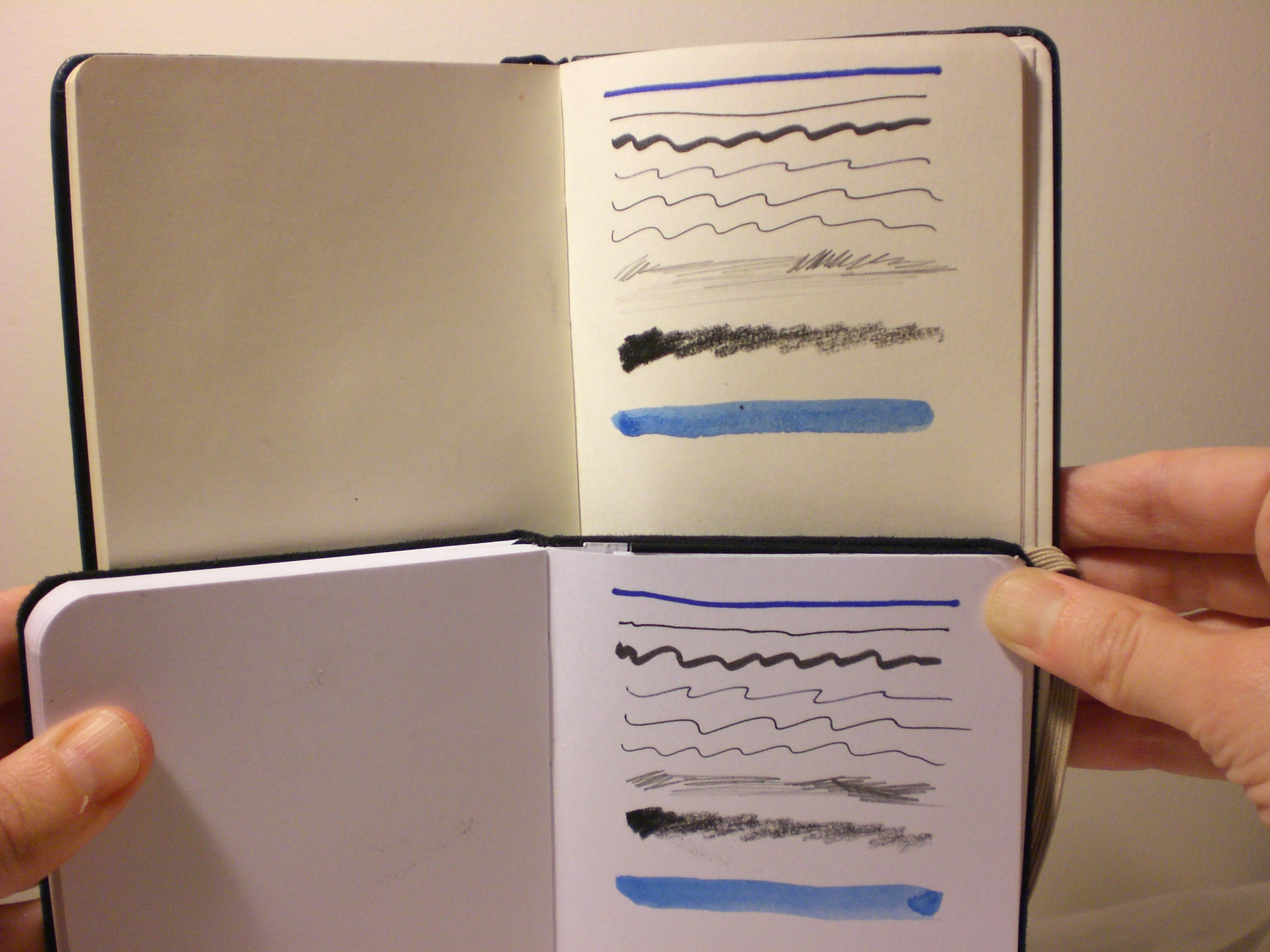
The shots below give you an idea of the paper color of each notebook as well as showing how some different pens, pencils and watercolor performed. The Pen & Ink and Moleskine notebooks have creamier looking paper. The HandBook paper is a somewhat cooler white, while the Derwent is a VERY cool white– it’s almost unpleasant, kind of like the difference between some of those compact fluorescent bulbs and regular incandescent light!
Most of these papers are too smooth for soft charcoal, except the somewhat rougher HandBook. All work well with rollerball pens– even the HandBook went fairly smoothly. All took watercolor nicely too– this surprised me a bit as in past Moleskines I sometimes found that watercolor could bead up a bit. Unfortunately I don’t have a good macro lens, so you won’t quite be able to see that none of the rollerball inks got feathery in any of these notebooks except the Uniball Vision Micro, which performed slightly better in the Moleskine & Pen & Ink journals than in the others.
Pens used, top to bottom:
- Super Sharpie
- Uniball Vision Micro
- Pigma Brush Pen
- Ballpoint
- Uniball Signo 207 Micro
- Uniball Signo RT 0.38
- 2H pencil
- Soft charcoal pencil
- Watercolor paint
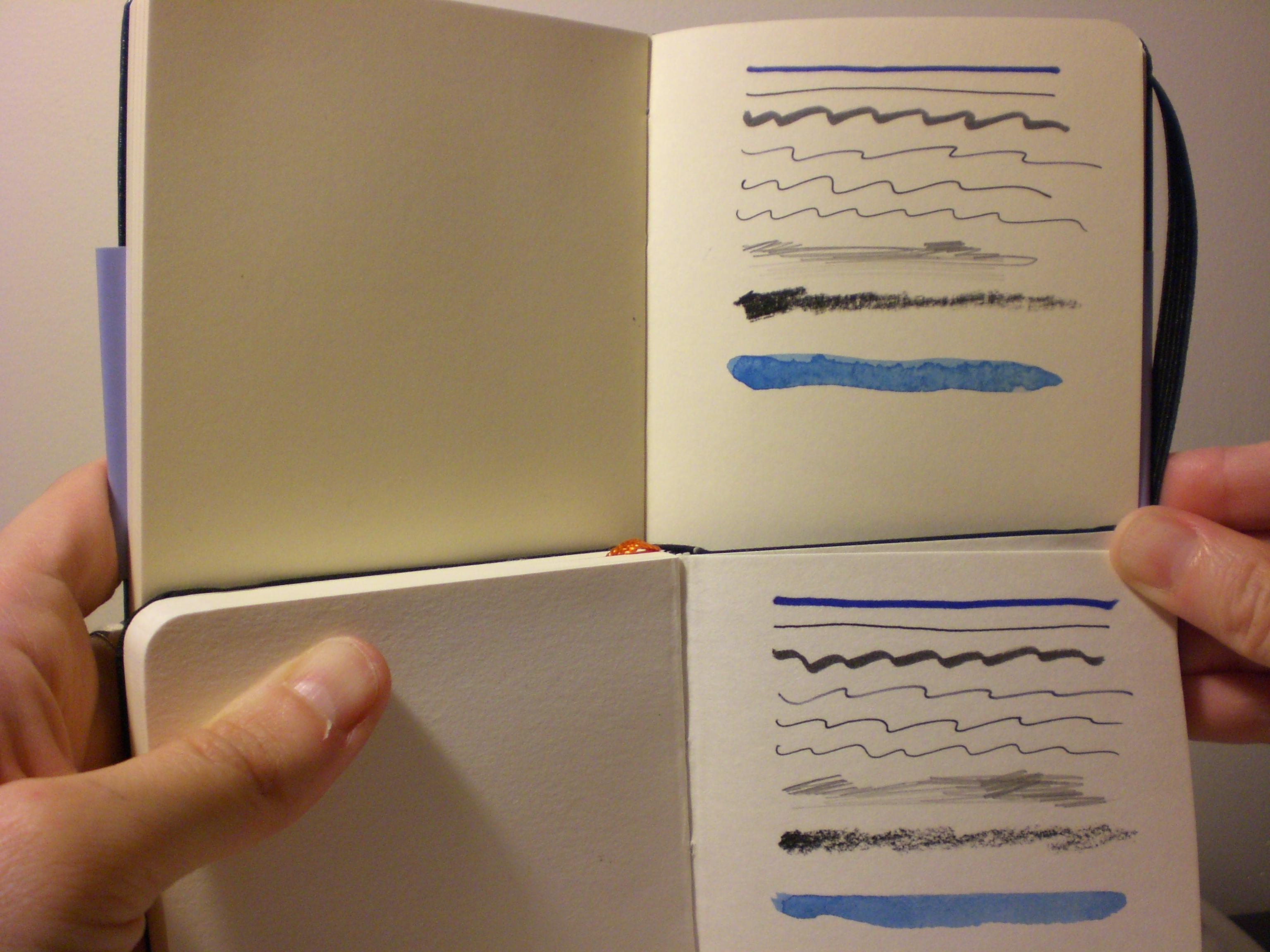
Since all of these notebooks have thicker paper than a standard Moleskine, they tend not to let inks show through too much. The Derwent (upper right) scored best in this respect:
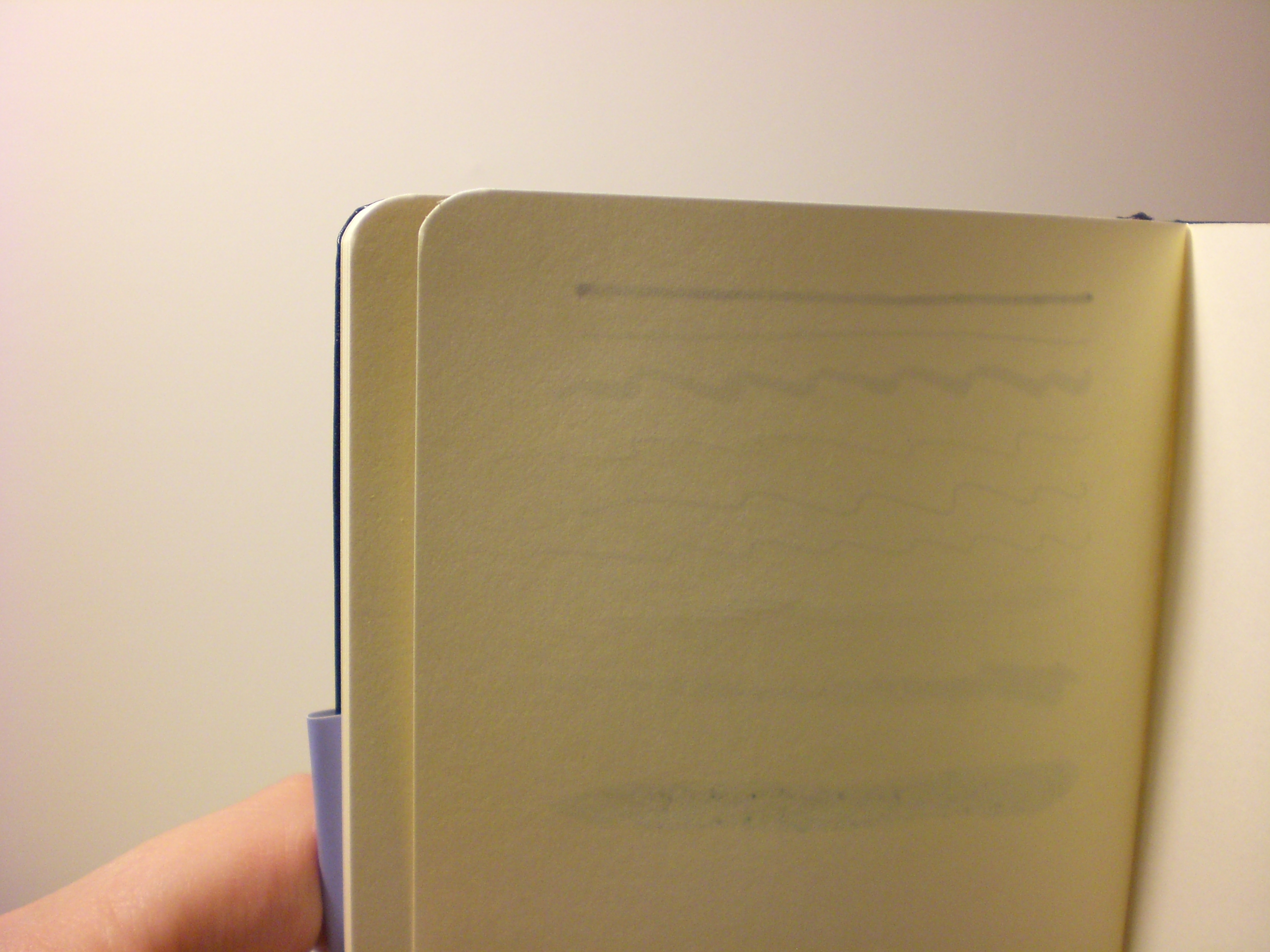
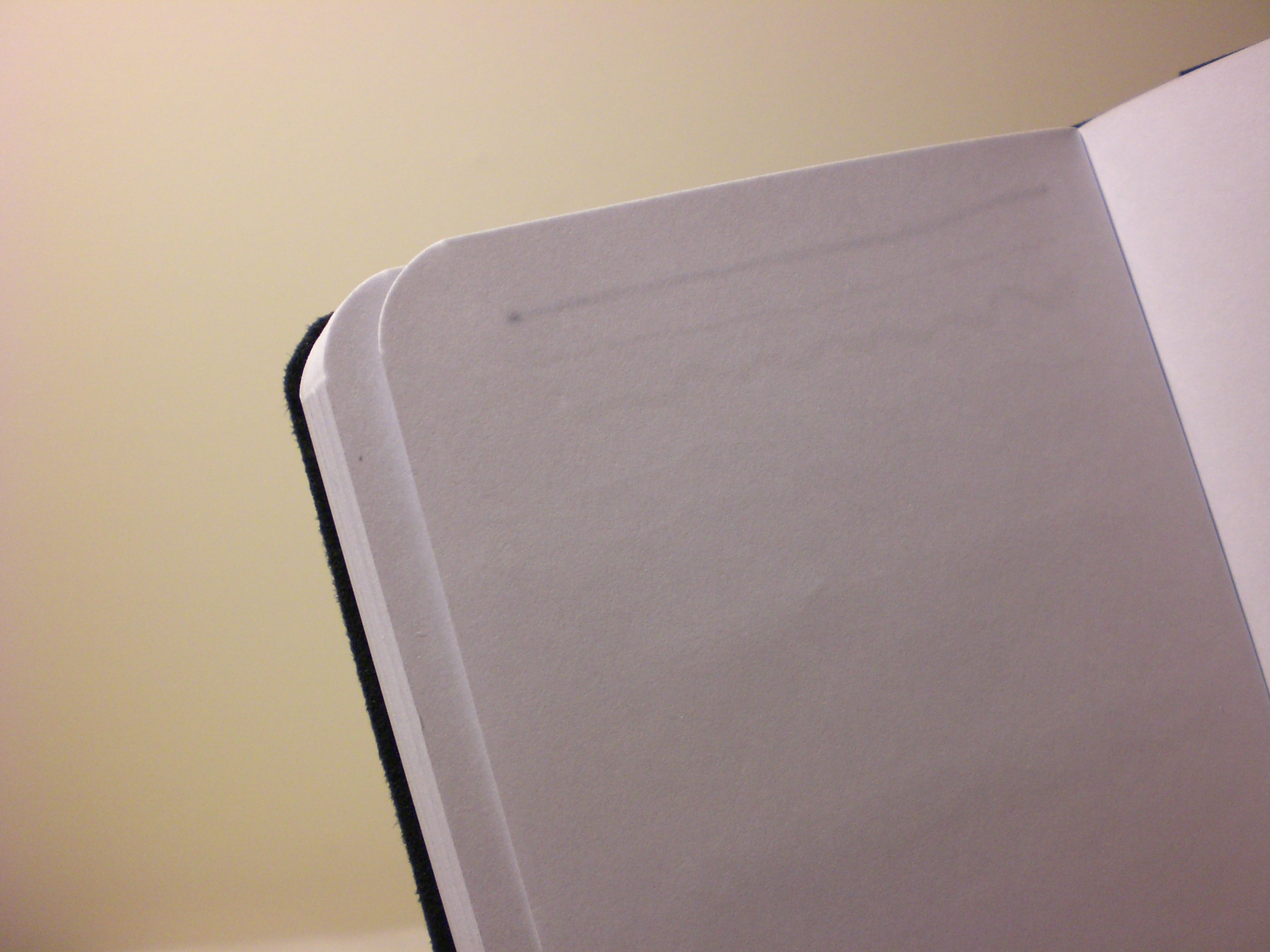


The lighting isn’t exactly equivalent in each photo (I try to be scientific, but I’m not Consumer Reports here, folks!). However, when the pages are held flat with no backlighting, the Derwent shows nothing at all on the other side except for the Sharpie.
So which notebook wins on its interior factors? Again, it all comes down to personal preference. The Derwent has the nice little extra pocket and its back pocket is easier to get into with its wide opening. It also has very smooth paper that won’t show bleed-through from most pens. But if you’re used to the color of Moleskine paper, you might find the Derwent’s deathly pallor a bit unnerving.
The HandBook will please artists who like to use pencil due to its slightly more textured paper, and the clear plastic pocket can be handy.
The Pen & Ink journal and the Moleskine are almost identical on the inside. The only real difference is that the Pen & Ink’s inside front cover is totally plain– no lines for info or a reward amount, no company address, no nothing.
Stay tuned for one final installment in this multi-part review, where I’ll cover bang for the buck, where to buy, and wrap up the pros and cons.
Notebooks for Teens
Do your kids covet your notebooks? This blogger’s daughter does!
My darling 15-year old daughter … sent me a text asking if she could have one of my “little black notebooks.â€
I found this very amusing. I can remember being about 8 years old, maybe, and poking around in my dad’s desk where he kept some small notebooks. I saw one that I really wanted, but I couldn’t ask him for one like it since that would reveal that I’d been snooping in his desk, which was forbidden!
But the blogger quoted above goes on to point out that a blank notebook can be a great educational tool:
I spend a fair amount of time with teenagers and have found … they can be random thinkers, desiring to fit with others while stretching to show their own identity. Structure can be limiting and limiting means disuse. So what’s the solution?
A plain Moleskine (or inexpensive equivalent) is a great start. They have the freedom to customize the books however they like. They are not bound by forms and templates and can capture what they need to know and how they need to know it. I’m sure there are many who feel without structure the students will be lost and miss valuable information. Ah, but do they have to?
By teaching our students the value of just capturing information rather than getting hung up on the formatting and structure, we curtail the “Hunh? I don’t remember that.†When they ask, “When’s the test again?†you can respond, “Check your book. You did write it down didn’t you?†Some may argue it is coddling the students…I disagree. Far too many professionals in the “real world†can’t handle basic information management and consistent capture is the key starting place for this skill.
I agree– I think keeping a notebook is a great habit to encourage at a young age.
Patti Smith Uses Moleskines

From an article called The Life and Deaths of Patti Smith, in the Guardian:
Smith’s room is dark. She opens the curtains a little, pulls her boots off and lies on the bed, head propped up on three pillows. Around the room are piles of novels and biographies, Moleskine notebooks in different sizes, her beloved old Polaroid camera.
Workbook Duos by EcoJot
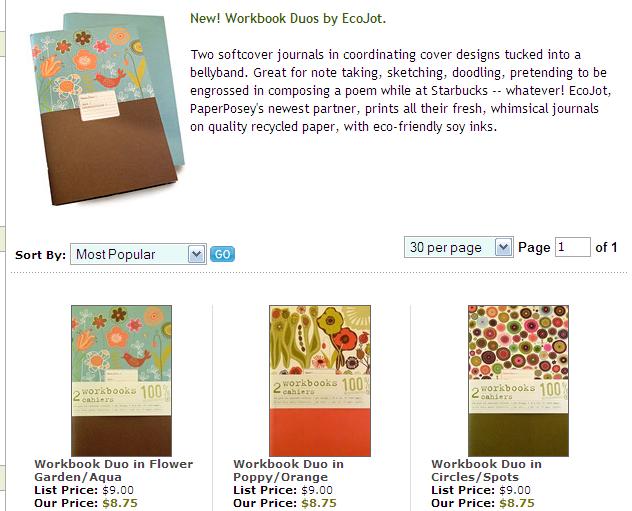
Here’s some attractive notebooks, printed on recycled paper with soy inks: Workbook Duos, by EcoJot.
They look like they are packaged similarly to Moleskine cahiers, but this is another one of those frustratingly uninformative websites: what is the size of these notebooks? It doesn’t seem to say anywhere, and you have to dig into each individual design to find out that the paper is lined, and that there are 64 pages. Still, I really like the designs.
Are Notebooks Good Gifts?
This quote rang a bell with me:
But see, I don’t even like journals. For a few years, I would often get journals and blank notebooks from friend and family — cause what do you get a girl who writes a lot? Blank paper. But I would never actually ‘finish’ those journals. I have about 8 quarter or half-filled journals at the moment. I never knew what to write in them. I still don’t know what to write in them. [LINK]
I could almost have said that myself. I’ve been given several journals over the years– some of them were wonderful. I did know what to write in them and I used them up completely. But others were those overy “gifty” journals that you don’t know what to do with. You think they might serve some purpose, but it never quite works out because they just don’t have that THING, whatever it is that makes a notebook click for you. It’s very hard to know what anyone else’s THING is, therefore notebooks can be very tricky as gifts. It’s too bad, because in theory they should be great gifts– relatively inexpensive, practical, something that everyone uses at least once in a while… but boy, are they easy to get wrong.
Do you give notebooks as gifts? Have you received notebooks as gifts, and if so, were they ones that you actually liked and used?