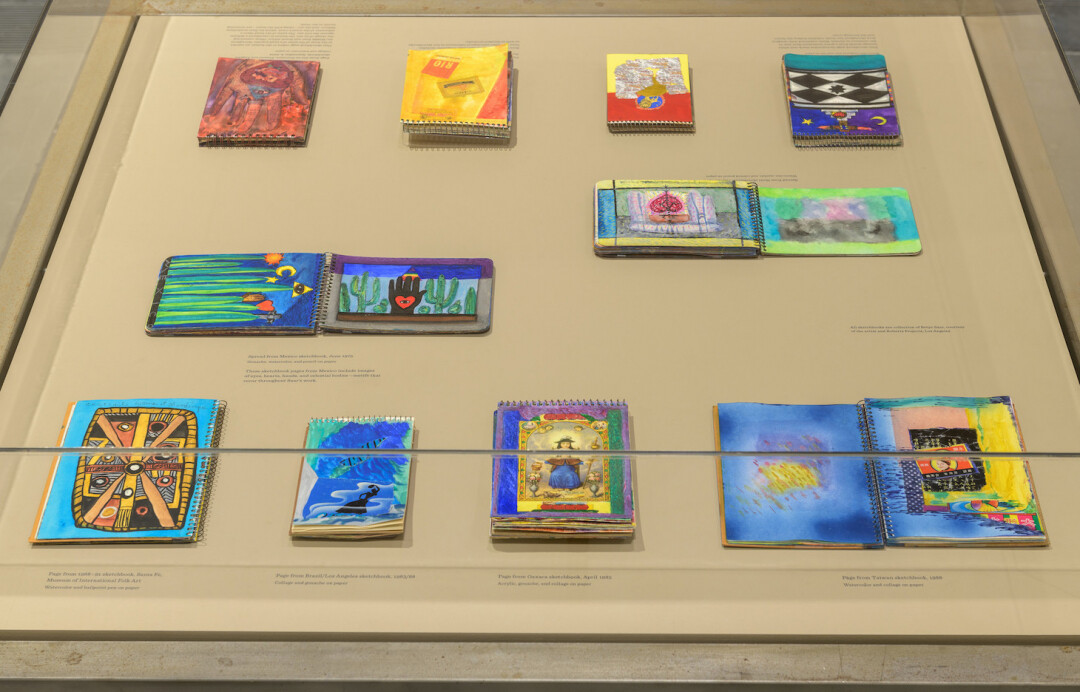
I recently posted about artist Betye Saar’s sketchbooks. The article linked below from Hyperallergic is a great exploration of her work, with lots of sketchbook images.
The sketchbooks reveal how Saar’s practice has evolved over time, and how time itself is a major thread in her work.
I thought I’d share a couple pictures of this year’s Nolty Gold vs. the new one that just arrived for 2020. It’s always fun to look at the current year’s beaten up, well-loved diary next to a brand new shiny one!
My 2020 Nolty Gold feels even more luscious than the previous one– the 2019 diary’s leather had an odd bristly feel at first (which eventually wore off) but this one is buttery smooth. The leather on the 2019 actually held up quite well– there are some scratches, and wear on the corners, but it still looks great, just a bit lived-in.
The gilt page edges almost show more wear than the leather– there are a lot of scrapes, and they’ve dulled somewhat overall.
The cover overhang on the 2020 Nolty seems slightly bigger than last year’s, giving the notebook a slightly larger height. That could be because the soft leather has bent a bit, but since it is only on the height and not the width, I think it’s actually just made a little differently.
The 2020 Nolty Gold comes with an address book insert and two supplemental lined notebooks, just like last year’s. I’m planning to just transfer over 2019’s address book for now, since I mainly use it for ongoing lists. I haven’t used the lined inserts much at all, so again I will transfer the 2019 one in use, and just start stockpiling extra ones.
The Nolty Gold Efficiency Notebook is still my favorite diary/planner. I wish it wasn’t so hard to get in the USA, but I will probably continue to pay way too much to get one shipped from Japan every year!
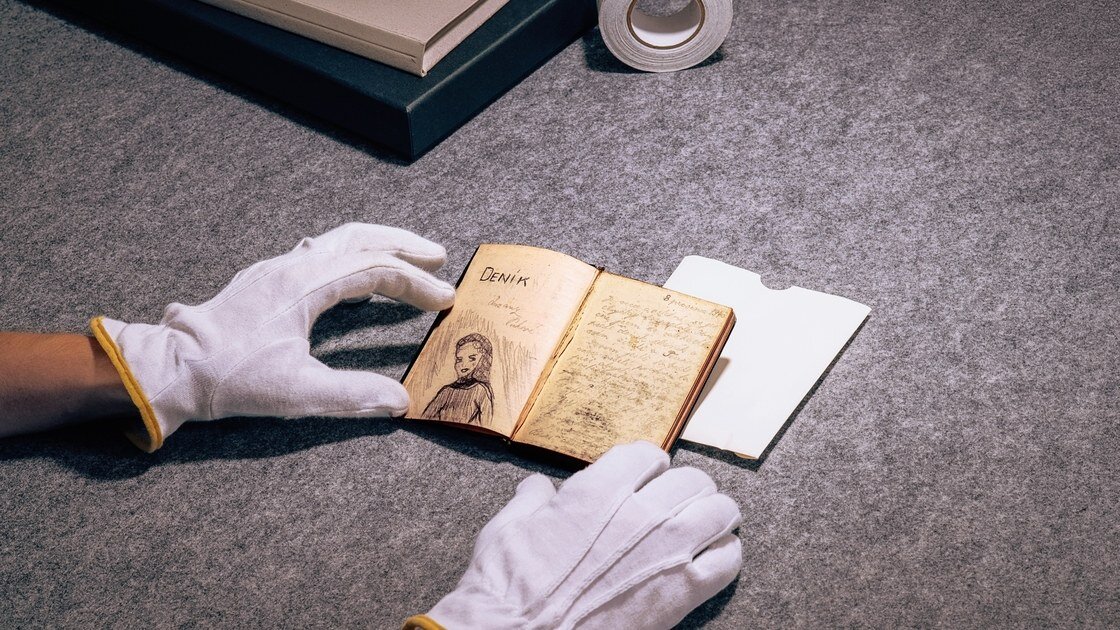
A very powerful article from the September 16, 2019 New Yorker magazine: My Terezin Diary, by Zuzana Justman. It’s a miracle that the diary and its author both survived the atrocities of the Nazi concentration camps.
The author’s childhood diary, which she kept while she was imprisoned at TerezÃn with her family, photographed at the Jewish Museum in Prague. Photograph by Thomas Albdorf for The New Yorker
I kept the diary from December 8, 1943, until March 4, 1944—the first winter of the two years I was imprisoned with my parents, Viktor Pick and Marie Picková, and my brother, Bobby, in the Czech concentration camp. (The camp was also known as Theresienstadt.) In addition to eight entries, it contains a few drawings, a poem about snow, and a story dealing with TerezÃn morality. Right after the war, I added a list of my girlfriends, marking the names of those who did not survive with a minus sign. When I first returned to the diary, many years ago, I found it difficult to read. Picking up the small book, three inches by four inches, with its cover of frayed green leather and its entries in tiny writing, I was not ready to be reminded of that terrible first winter in TerezÃn. I did not have much patience with my childish pronouncements (“Now I see, though, that it is possible to find happiness in work and in other thingsâ€) and my determined attempts to look at the bright side (“It will get better with timeâ€). I put the diary away, and then for a long time I could not remember where I had hidden it. It was only a few years ago that I finally discovered it, on a high shelf of my closet, and, to my surprise, I saw it in a new light.
Life (or L!fe) notebooks are another Japanese notebook favorite with a classic design. I don’t know much about them but apparently the company has been around since the 1940s. I had seen them a lot but never actually bought one until a few months ago when I found this adorable little wire-bound notebook:
Most of the Life notebooks I’ve seen have a taped spine– the wire binding seems more unusual. The 127 x 80mm size is adorable. It’s about 5mm thick and the rings are quite small so it’s a great format for slipping into a pocket. And at only $4.85 at JetPens, how could I not buy one?
Below you can see how slim and small it is vs. a pocket size Moleskine:
I chose the red cover with 5mm graph paper inside– that is what the word “Section” refers to on the cover, though I’ve never noticed that term being used for squared notebooks elsewhere. (Lined and plain pages are also available with different color covers.) I love the cover design with the Life name stamped in gold and the elegant border design. It seems timeless, somehow (except for the barcode). All four corners of the pages and cover are rounded. The front cover is a light cardstock, while the back cover is a heavier grey cardboard that provides more rigidity.
The paper has a creamy color with fine grey grid lines so it’s easy on the eyes. There is a tiny L!fe logo in the corner of each page– I could live without it for sure, but it’s not bothersome. The paper is super smooth and works beautifully with pretty much any pen including fountain pens. Show-through is a bit better than with some other Japanese notebooks I’ve reviewed, and bleed-through is very minor, only with my wettest, most penetrating pens.
What’s not to love about this notebook? If you want a cute little wirebound pocket notebook, I’m sure the Life Noble Note will make you happy!
Isn’t that just the best headline ever? It kills me that this story didn’t include a photo of the actual notebooks!
It is a story that is, literally, as old as the hills, yet its history can be traced in just eight small notebooks.
The accounts ledgers of Victorian bookkeepers in the upper Dales, meticulously written in fountain pen and handed down through the generations, are windows on a lost world of dairy farming… of “blue milk†cheese by the hundredweight and milk by the churn.
They will go on show next week, alongside the recorded memories of retired dairymen and women, in a celebration of the food staples that made Wensleydale famous.
It was a cardboard box that originally contained aniseed balls – 20 a penny, the label said – that had given up the ledgers.
Inside were itemised accounts from 1822 to 1850, with a gap of two years from April 1828. They had been kept by James Willis, who farmed at Yorescott, a house that no longer exists, just to the west of Yorebridge and north of Bainbridge.
Within the pages of copperplate writing were contained the minutiae of everyday life in a Dales dairy.
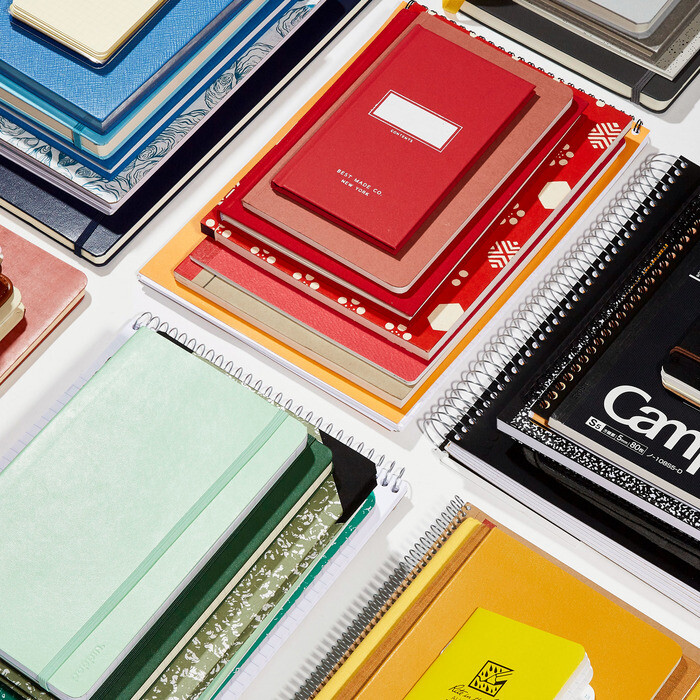
A few weeks ago, New York Magazine’s “Strategist” column ran an article ranking the 100 best notebooks. I bookmarked it but it took me a while to go back and absorb all the info. Having now read through the whole thing, let’s just say I have some issues with it!
The best spiral-bound, leather, lined, blank, and gridded notebooks, as judged by the writers and editors who tested them.
Like most of these kinds of lists, it’s mainly intended to get you to click on their affiliate links to Amazon and other retailers, so you have to take it with a grain of salt. But they do begin by listing all their criteria for evaluation and citing a whole panel of experts they consulted in collecting all their candidates. (The experts include writers, artists, retailers and bullet journalers, but no bloggers from the notebook/pen community, as far as I could see.)
These are the criteria they scored each notebook on:
Design: Is there enough room to write? Do the aesthetics and ergonomics of the open notebook encourage you to use it? Do the lines/dots/grid feel impactful in a good way or overly designed and distracting? Or are they, in fact, perfectly muted?
Page Quality: Is the paper smooth enough for writing? Is it thin or thick? Does the weight of the page make it feel luxurious or flimsy? Is the texture soft and smooth or coarse and scratchy? Is the paper recycled/recycled-feeling? Colored or unbleached or bleached bright white? Does the ink bleed through?
Overall Feel: Does the notebook feel substantial or flimsy? Is it a good weight and size? How portable is it? Does it pack easily into certain bags? Will it hold up against wear and tear? Are there too many/too few pages? Or is it just right?
The Cover: What design elements stand out?Is it hardcover or softcover? Is it nice to look at or jarring? Is it minimal, classic, and clean or just boring? Design-y in a cool way? Or is it overdone or even a little immature-looking? Does it come off as expensive or cheap?
A lot of this is pretty subjective– the “Design” and “Cover” categories seem to overlap. And “Overall Feel” seems very weighted towards size. I don’t think a notebook can be ranked better or worse based on its size– it all depends on what size the user wants and needs, so for some people a 5×8″ notebook is perfect, while for others it’s too big, or too small. I would have liked to see them include “Value” as a criterion, but they make hardly any mention of price vs. size, quality and features.
I could talk about how their rankings differ from what mine would be, but that’s not really the point. My biggest beef is that they didn’t really dig all that deep for a wide variety of brands. I was kind of excited to see a list of 100 different notebooks– I should make one myself, but it really is a ton of work to pull together! The Strategist list misses quite a few widely available brands, perhaps because they couldn’t find a way to affiliate-link them. They then pad out the list with repeats of several brands, which leads to some really absurd rankings. For instance:
These are all basically the same exact notebook in different sizes, page styles and orientations. (Moleskine Volants and two sizes of Moleskine Cahiers are also on the list.) A few other brands have similar instances where they are giving different rankings to various formats of the same notebook.
These are their top 3 notebooks:
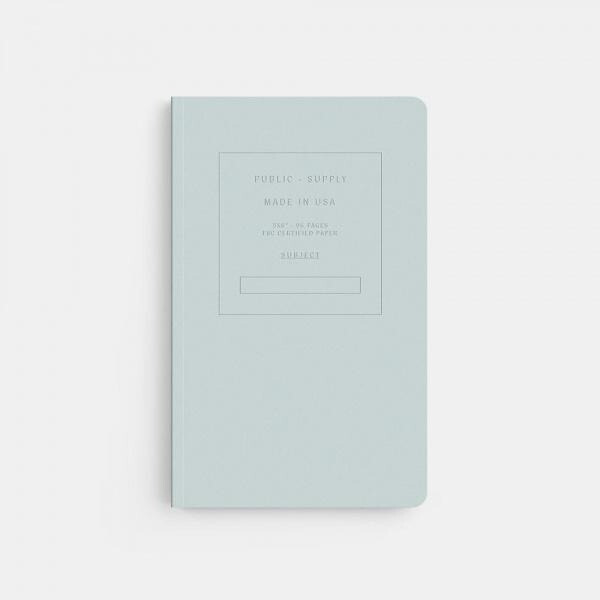
Public Supply Notebook
I’ve seen the Public Supply notebooks around, but haven’t reviewed one yet. I like the cover design a lot, but I think I shied away because they were a bit expensive and had a glued binding that didn’t open flat. Maybe I’m remembering that wrong, or else they’ve changed their construction, as it looks like they now have stitched spines. I will reserve any judgment about whether or not this should be #1 until I’ve reviewed one myself.
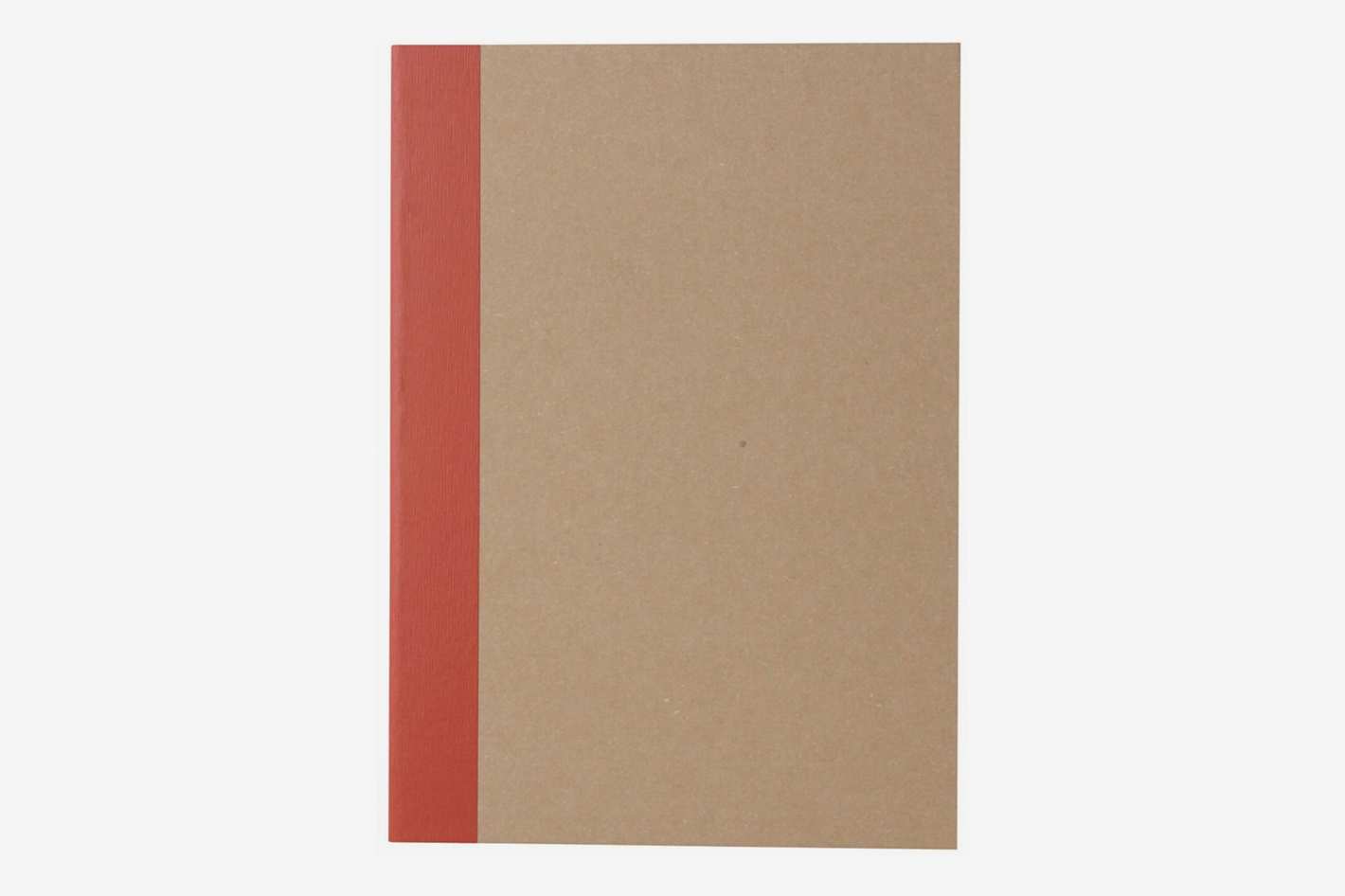
Muji Notebook
I haven’t done a full review of a Muji notebook either, but I always fondle them when I go into a Muji store. They’re very inexpensive, and nice-looking. The paper feels creamy and smooth, and from what I’ve read online, seems to be good with fountain pens, though I have not tested that myself.
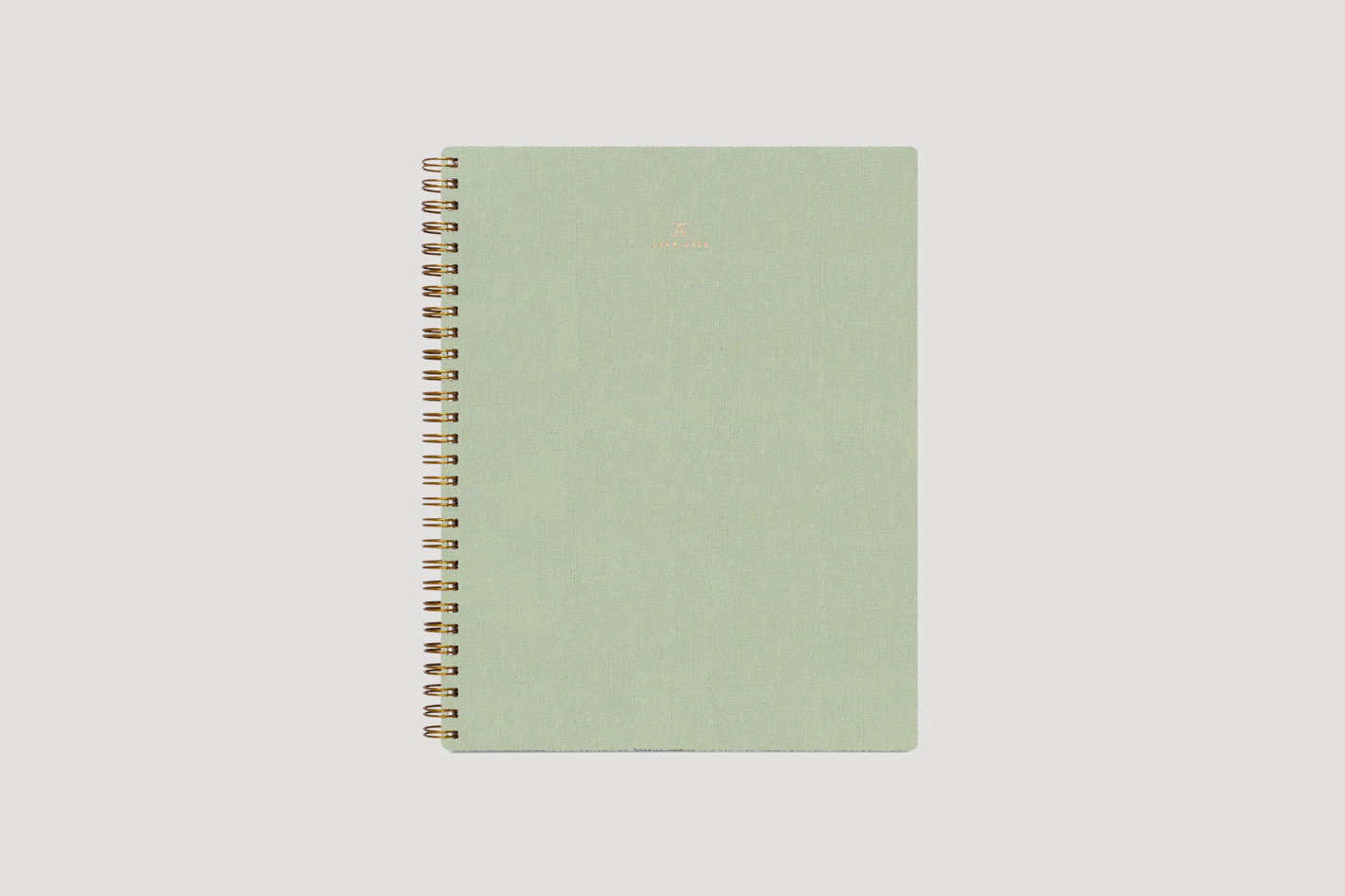
Appointed Dot Grid Notebook
I reviewed an Appointed notebook a few years ago. Afterwards, I used it day to day at my job. I liked the design a lot, and the paper was great for fine point gel ink pens, though I found that fountain pens feathered a bit. I found it a bit on the pricey side, but not totally out of line for a USA-made product. (Looking at their website now, it only mentions the covers being made in the USA.)
A nice glimpse of a sketchbook belonging to a 2019 high school graduate from Oregon, who is heading to art school next.
Melody Mendez won McKay High School’s award for the top artist in the Class of 2019. She created a web comic, No Where Here, set in a fantasy world and has been drawing since she was five.
I love this collection of notebooks, which have been used to record hundreds or even thousands of haiku. (The original post at Notebookers.jp is in Japanese, so I am relying on Google translate.) I don’t know much about Japanese writing and only know the most basic structure of haiku, but short poems with this kind of syllabic structure seem to fit very nicely on notebook pages like this!
Several months ago, I treated myself to a couple of slim little Japanese notebooks from JetPens. The Monokaki notebook was one of them. It is made by the Masuya company, a manufacturer of writing papers since 1882.
The Monokaki notebook is the perfect size for any pocket at 3 5/16″ x 5 1/2″ x 1/4″. It comes in a clear plastic envelope, with a small translucent bellyband that has some brand info, mostly in Japanese. The cover of the notebook is a light, flexible card stock and has an interesting monochromatic look with just the brand name and a beautiful border design. (It looks abstract at first, but then you realize it shows a fountain pen, ink bottle, pencil, lamp and fishbowl!) A center motif is repeated on the back cover. The exterior card stock is light enough that it would probably be best to use some sort of add-on cover if you’re going to be carrying the Monokaki notebook around a lot.
Monokaki notebook compared to pocket size Moleskine
Monokaki notebook compared to pocket Moleskine
Inside, you have black endpapers which are partially glued to the cover. There are 8 sewn signatures of 16 pages each, but they are glued tightly into the binding, so it doesn’t open quite flat, and once you’ve pressed it open, the cover doesn’t totally close on its own.
The paper inside has a 7mm grid, with a border all around the edge so you don’t see any lines on the outside edges of the notebook. The paper weight isn’t specified (at least not in English) but it feels quite light and fine and smooth. Heavy wet pens will bleed through, and one of my wider fountain pens bled slightly and feathered, but the other fountain pens I tested worked nicely. There is show-through, as you’d expect with a paper of this weight, and as is common with many other Japanese notebooks such as those from Design.Y and Nolty.
All in all, this is a lovely little notebook if you want a (mostly) fountain pen friendly jotter that is light and pocketable, though the durability of the cover is a concern. I paid $7.75 for it at JetPens, which seemed a bit high for such a small notebook, but when I remind myself that it has 128 pages of good quality paper, it seems more reasonable. An A6 (approximately 4 x 6″) version is also available with ruled or blank pages, priced at $10.
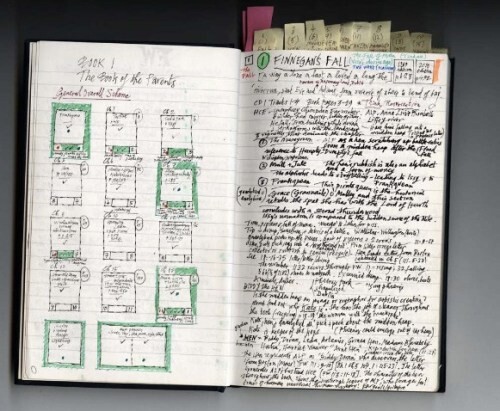
I must have missed this Brainpickings article when it was originally published in 2014, but I’m glad I discovered it via Pinterest! Artist John Vernon Lord created amazing illustrations to accompany James Joyce‘s Finnegans Wake in a collectible edition published by the Folio Society (now out of stock, alas). The illustrations are stunning, but of course I find the notebook pages documenting his creative process even more beautiful!