From the original article at the Field Book Project website:
Field notes are well known to be essential, primary material that provide details about collections and expeditions that aren’t found in published material or specimen labels. Field notes can also contain diary entries, poems, and sketches which give insight into the lives of the researchers themselves. In our last post, we briefly highlighted some of the candy and drink preferences of some of the researchers in our collections.
One of these researchers is August F. Foerste. In his Specimen notebook, Ohio, 1887-1888, with no explanation, we find a list of several different candy recipes, including chocolate creams, lemon drops, and Neapolitan creams. Brings up quite a few questions. Who gave him the recipes? Was this the only paper he had available to write them down? Did he try to make them? … What we can determine is that they were written down in 1888 when Foerste was completing his master’s degree at Harvard University.
Read more at: Field Book Project
Collection highlights, news, interviews, and other treasures uncovered by the Field Book Project. The Field Book Project is an initiative to increase accessibility to field book content that documents natural history. Through ongoing partnerships within and beyond the Smithsonian Institution, the Project is making field books easier to find and available in a digital format for current research, as well as inspiring new ways of utilizing these rich information resources.
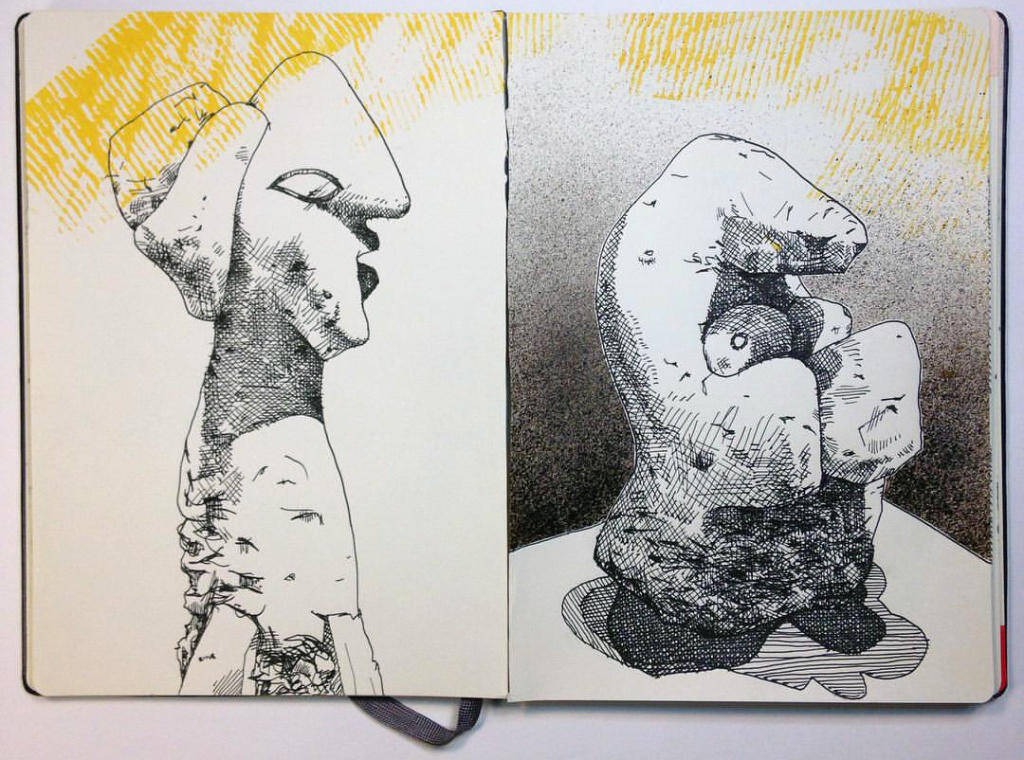
…or perhaps this post’s title should be “Sketching Skulpture,” because my inspiration comes from a blog post at Sketchbook Skool.
The sketch below by Jonathan Twingley really caught my eye– such a cool mix of color, texture and light and dark shading with fine cross-hatching. It was done on location at MoMA, as part of a project of sketching all the Picasso sculptures on exhibit there.
Sketch by Jonathan Twingley
Sketching on location is a great way to bring fresh inspiration to your sketchbook. And doing it with a friend is a great way to keep from chickening out. It can be a little intimidating to sketch in public—particularly when you’re sketching something by a great master. Don’t go for a perfect rendering; that’s what cameras are for. When you sketch what you see, sketch it as you see it. Art is about interpretation. Is the art you’re sketching a perfect rendering of a person, a house, a field? No, it’s the artist’s emotion and perception on the page.
For some reason, I have almost always avoided sketching sculptures. If you’re sketching a realistic sculpture of a human figure, the problem is that it usually looks like you tried to draw a real human model and ended up with a stiff and lifeless representation, no matter how accurately you captured the pose and proportions. But seeing the sketches above has inspired me to try drawing some abstract sculptures the next time I have a chance. That way I can focus more on shapes and shadows and texture, and less on trying to draw an accurate figure.
I’m always looking for inspiration for my own drawings— lately I’ve been drawing from photos but I think sketching objects or people in three-dimensional real life is better practice. I just started a new sketchbook, so now I can’t wait for my next chance to see some sculpture!
I recently reviewed the excellent pocket notebook from Pebble Stationery. Now they are back with a new Kickstarter project for a larger A5 size notebook, in the same design with Tomoe River paper, which I’m sure will be a popular item!
The campaign runs for just 2 weeks, from June 25th to July 9th. Deliveries of notebooks are expected to be completed in August. They have limited the number of notebooks available to make sure there are no issues getting enough paper, so if you are interested, make sure you get your order in ASAP. Retail pricing on the notebooks will be $12.99 USD.
Pebble Stationery shared an early prototype of the new A5 notebook with me. I was pleased to see that they kept all the great design details of the pocket notebooks– same cover, endpapers, stitching and paper. And they have added numbering to the pages. The page count is 120, up from the 80 pages in the pocket notebook.
As with their prior notebook project, for each notebook sold, Pebble Stationery makes a donation of a pencil for a school child. This time, the beneficiary will be an orphanage called the Ibn Hayan Association, in Fez, Morocco.
You can see the full details on the Pebble Stationery A5 Notebook Kickstarter campaign here.
In this remarkable gathering of private journals, log books, letters and diaries, we follow the voyages of intrepid sailors, from the frozen polar wastes to South Seas paradise islands, as they set down their immediate impressions of all they saw. They capture their experiences while at sea, giving us a precious view of the oceans and the creatures that live in them as they were when they were scarcely known and right up to the present day. In a series of biographical portraits, we meet officers and ordinary sailors, cooks and whalers, surgeons and artists, explorers and adventurers. A handful of contemporary mariners provide their thoughts on how art remains integral to their voyaging lives.
Often still bearing the traces of their nautical past, the intriguing and enchanting sketches and drawings in this book brilliantly capture the spirit of the oceans and the magic of the sea.
This week’s addict is Katerina Sakkas, an artist and writer from Sydney, Australia. She’s been using Daler Rowney sketchbooks for 20 years, filling them with drawings and ideas:
Simple and sturdy with their canvas-textured hard covers and heavy-weight, off-white paper, Daler Rowney’s Ebony journals have served me faithfully for 20 years, as a place to document the process of art-making; to research, experiment and workshop ideas.
Sometimes messy, sometimes elaborate, they hold an eclectic mixture of different media and textures, combining practice drawings and paintings, image designs, reference pics and (more recently) mock-ups of comics.
You can see more of her sketchbooks/journals in this post from her website, where she also shares images of her incredible paintings. There is lots more to see on her Instagram feed too (@kat_sakkas), where she posted this photo of more journals:
In addition to Daler Rowney, her collection includes Paperblanks, Leuchtturm, Rhodia, Clairefontaine and Moleskine notebooks.
Thanks for sharing your addiction, Katerina! It is always great to hear from fellow notebook addicts!
Like Field Notes, the various limited edition and branded partnership designs of Kokuyo Sketch Books have become very collectible. People customize them with decorations, add elastic closures, and put them in protective covers. Here are a few of the many variations I’ve spotted on Instagram:
If you want to see more, search the tag #野帳 for “field notes,” and #測é‡é‡Žå¸³ for “survey note book”
Back to the notebook itself in its basic form, the Kokuyo Sketch Book is 3.75 x 6.5″, and about a quarter inch thick. This makes it a great size for a jacket pocket, if not for the back pocket of jeans. The slimness of it is very appealing. The green cover has a slight fabric-like texture, and the gold stamped “Sketch Book” title gives it a very retro look. It is a hard cover– not as thick a cardboard as a Moleskine cover, but it still doesn’t have much flex to it, and seems quite sturdy. You can bend it back on itself without the spine breaking. The corners are sharply squared off, with a fair amount of cover overhang. Those who are longtime followers of this site know I’m always griping about wide cover overhang on notebooks, (purely for my own aesthetic preferences and unrelated to function) but I’ve realized that my objection to it really depends on the proportions of the notebook– the thinner the notebook, the less it bothers me, and on this notebook the overhang doesn’t bother me at all.
The Kokuyo Sketch Book not only opens flat, but it will lie flat by itself. Inside the notebook, the endpapers are plain white other than a barcode inside the back cover. Then you have 80 pages of squared paper. The light blue grid lines are spaced at 3mm, which is noticeably smaller than you’ll find in most notebooks, which are 5mm. The only other notebook I can think of with an even tinier grid is the Kleid 2face Notebook, also from Japan.
The paper weight is not specified but it feels smooth and relatively light. Some wetter pens bleed through quite a bit, and show-through is about average. I would call this notebook semi-fountain pen friendly. There was almost no feathering, but there were small spots of bleeding with most fountain pens, more noticeably with wetter pens. If you use finer nibs and drier inks, you will probably be fine.
I bought this notebook for $5.00 at Yoseka Stationery in Queens, NYC. I haven’t seen them for sale in too many other places, but I believe Goods for the Study carries them. I thought I had seen them at Kinokuniya a while ago, but they haven’t had them the last few times I’ve visited. Online, you can get a 10-pack on Amazon for only $19.99. The Level Book is available as a single copy, only $4.82 with free shipping. JetPens doesn’t carry them, strangely. At Baum-Kuchen and Nomado Store, you can get a snazzy Superior Labour-branded version.
I really love the Kokuro Sketch Book– the classic styling and the practical durability make it a winner. And the slim 80 page format makes you want to line 100 of them up on a shelf. But I am trying to figure out how I’d use it. My only problem with it is the size– I like it, but I am so wedded to my favorite 3.5 x 5.5″ size, it’s hard to use anything else in my daily carry. If Kokuyo made a smaller 3.5 x 5.5 ” version of the sokuryo yacho, I would find it irresistible!
Here’s an odd one: a sketchbook by the notorious British gangster Reggie Kray.
The Kray twins were serving a life sentence in prison when they heard about James Fallon, a young boy living in South Africa who had been paralyzed as a result of being hit by a car and only survived thanks to a seven-hour operation. The imprisoned Kray brothers ended up becoming pen pals with Fallon and helping to raise money for his care. Among the correspondence they exchanged in the 18th months before his death was this sketchbook:
The archive includes six signed crayon drawings by Reggie of a sailor, a cowboy, a boxer, a landscape, a boat at sea and a boxing match. Affixed inside the sketchbook are two Christmas cards. An inscription on a page at the front dated December 3 1989 reads: “The most courageous boy in the world – James Fallon. God bless. Affection. Your friend. Reg Kray xxxxx.â€
I just loved this spread from the Moleskine sketchbook of Finnish artist Paivi Eerola, posted on her website Peony and Parakeet:
Here’s some of her thoughts on art journaling:
For me, art journals are little more than just sketchbooks. I like to call them “idea books†as I often process my ideas further when I am working on the page. I don’t always make one page on the same go, but work with it several times, adding more ideas as the page progresses. However, I have quite low expectations on how my pages will look. They are not pieces of art but more like collections of ideas to me. … My art journals are not chronological diaries but random visual notes that I process to full images. I can make a quick sketch of a rose one day and then continue the page with painting on the other day. When I am working with a new art class, I use art journals to record my visual ideas and practice the techniques. I also see creating art journal pages a route to bigger paintings. When I paint on canvas, I use the ideas that I have come up with when making the pages. Every artist should also be an art journaler!
This week’s addict shared a photo of his collection with me via Twitter several years ago and yet it somehow languished in my to-do list until now! (At least I think so… after 10-plus years of blogging, I can’t even remember all the Notebook Addicts I’ve posted about!)
Here’s Stephen’s collection as of 2015.
I bet he has a lot more by now! Maybe he’ll update us via Twitter again: @hdbbstephen
Notebooks, journals, sketchbooks, diaries: in search of the perfect page…