Josephine Wolff’s Perfect Notebook: Fantasticpaper

I love finding out about notebook brands I’ve never heard of, this time via a fun article from Buzzfeed, by Josephine Wolff. She first talks quite a bit about her notebooking habits:

As far back as I can remember, I have been an obsessive keeper and collector of notebooks, devoted to filling them with lists and notes and doodles — but I have never been good at keeping an actual journal. I first remember trying when I was 10 years old, but somewhere around day three or four of yet another entry beginning “I went to school and then I came home…” I would inevitably throw in the towel and decide that diaries were meant for people with more glamorous and exciting lives than mine.

My inability to keep a journal has not in any way hindered my notebook consumption over the years…

I totally identified with that! For most of my childhood, I was always craving a new notebook but never that good about actually writing much in them because my life didn’t seem that interesting! Wolff continues, talking about various notebooks she used over the years, until:

In March 2015, my mother discovered Fantasticpaper notebooks, manufactured by the German company Authentics, in a department store in Berlin. She brought me back two gray Fantasticpapers and I fell in love.
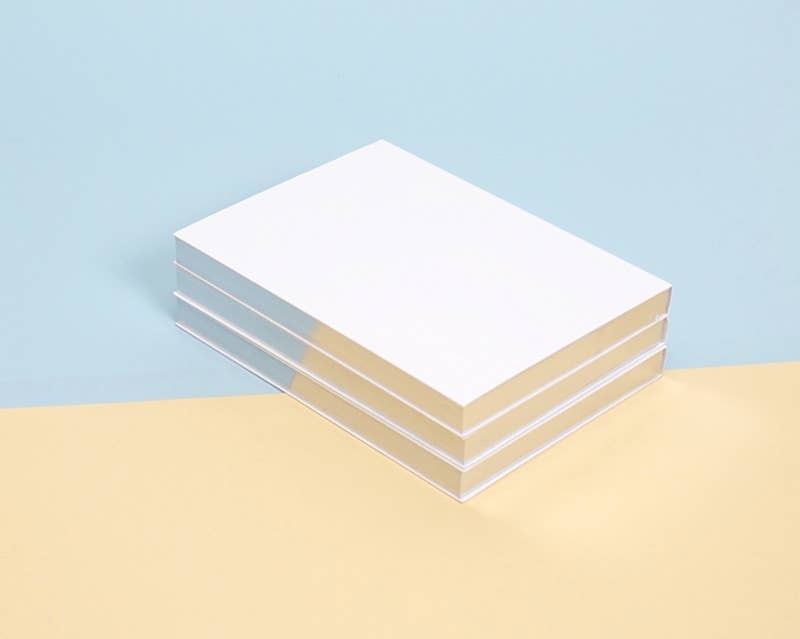
Wolff goes on to describe why she loves the Fantasticpaper notebooks, which she ended up buying in bulk from a store in Belgium:

They have a sewn binding that lays perfectly flat when open, paper so thick that absolutely no ink bleeds through the page, a durable cardboard cover that doesn’t peel after months of intensive use, and a modern geometric industrial design aesthetic that is pretty without being too precious. It is as if the designers heard every complaint I’d ever made about a notebook — curling covers, too-bright grid lines, too-large graph paper squares, thin paper, unsatisfactory binding — and designed this notebook just to meet my particular specifications.
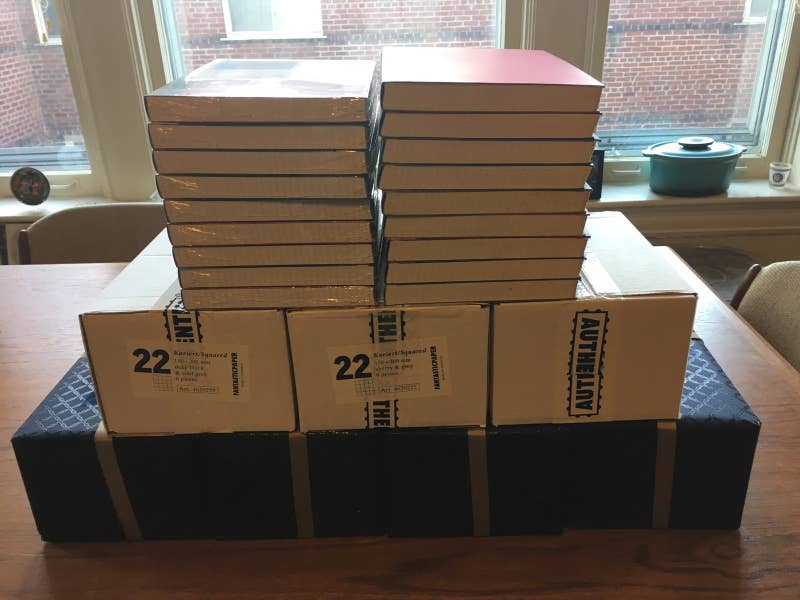
Looks like she’ll be set for a while! (Maybe this should be a Notebook Addict of the Week post!)

The Fantasticpaper notebooks do look rather nice– they come in some nice color combinations, in A5, A6 and XL sizes, with lined, squared or plain paper. The company’s website takes you to this online shop, where they start at â‚¬7.99 for the A6 size. But I’m not sure if they ship outside of Europe. Something to add to my list of notebooks to try someday!

Be sure to read the full article, which is full of wonderful insights about keeping notebooks: How Finding The Perfect Notebook Made Me Less Anxious About The Future. Wolff feels happy about her new-found notebook writing habits, and secure because she’s stockpiled enough Fantasticpaper notebooks to last her a decade. But I’ll admit that had me worrying on her behalf: “only a decade?”

Review: “The Perfect Sketchbook”

I purchased The Perfect Sketchbook as part of a Kickstarter in 2015. It was in my “to be reviewed” pile for quite a while, and I even did some pen tests but then it somehow fell off my radar. I recently came across it in my to be reviewed box and realized I’d never written a post about it. I might have set it aside realizing stock was sold out and no longer available from that first run of pocket sketchbooks.

The creator, Erwin Lian Cherngzhi, and his manufacturing partner, Bynd Artisan, later did a second version in a larger B5 size, with a different high quality paper. And now it’s good timing to be getting back to this, as he is working on a third version with a new manufacturing partner, Etchr Lab.

It is quite audacious to market something as “The Perfect Sketchbook.” People’s preferences can differ, so it’s hard for one sketchbook to be perfect for all users. But Erwin put a lot of thought into creating something that would be perfect for him, and quite a lot of other people too!

The Perfect Sketchbook Exterior

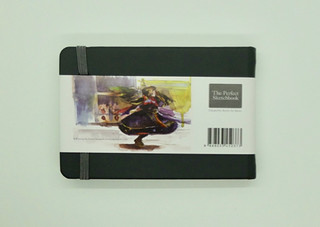
The outside of this Sketchbook is pretty typical: 9 x 14cm landscape format, hardcover, with an elastic closure. A removable paper band has the product specs and brand info, as well as some lovely examples of Erwin’s own art. The cover material is more leather-like than many other competitors. The brand is stamped onto the front cover– it’s subtle but I’d prefer it to be on the back. I like the grey color with matching ribbon marker and elastic band in a slightly lighter shade of grey. The sketchbook has a chunky, sturdy feel with a rounded spine and slightly thicker cover boards than some other similar notebooks. There is a fairly large cover overhang.

perfect sketchbook review - 1
The Perfect Sketchbook front cover
perfect sketchbook review - 2
The Perfect Sketchbook back cover
perfect sketchbook review - 3
Perfect Sketchbook (top) compared to Moleskine Watercolor Sketchbook (below)
perfect sketchbook review - 4
Perfect Sketchbook (top) compared to Moleskine Watercolor Sketchbook (below)
perfect sketchbook review - 5
Perfect Sketchbook (below) compared to Moleskine Watercolor Sketchbook (top)
perfect sketchbook review - 6
Perfect Sketchbook (below) compared to Moleskine Watercolor Sketchbook (top)
perfect sketchbook review - 11
The Perfect Sketchbook cover overhang detail
perfect sketchbook review - 10
The Perfect Sketchbook spine

The Perfect Sketchbook Interior

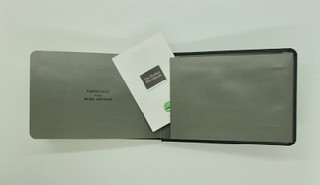
When you open the sketchbook, the grey theme continues to the endpapers. There is a brand logo and space to write your name. The endpapers are a somewhat glossy coated paper, so some pens will bead up and smear easily. The flipside of the endpapers have a value chart in shades of grey. This can be used to assess the lights and darks in what you’re sketching. I have never used such a tool myself but I can see it being helpful and I’m looking forward to trying it. Erwin has suggestions for how to use it in the Kickstarter campaign page. There is a back pocket with a little booklet of fun facts about the Kickstarter campaign.

perfect sketchbook review - 7
The Perfect Sketchbook inside front cover
perfect sketchbook review - 9
The Perfect Sketchbook inside back cover
perfect sketchbook review - 8
The Perfect Sketchbook value chart endpapers
How to use the Perfect Sketchbook value chart

The Perfect Sketchbook Pen, Pencil and Watercolor Tests

The stitched signatures of heavy watercolor paper open totally flat. The paper has an off-white color and a toothy feel. It gives a nice texture for charcoal pencils and holds up to heavy watercolor washes without buckling. Erwin’s Kickstarter page also goes into quite a lot of detail about the characteristics of the paper.

perfect sketchbook review - 12
Perfect Sketchbook paper (top) compared to Moleskine Watercolor Sketchbook (below)

A nice bonus about this Sketchbook is that it came with some small swatches of the paper (extra bits left behind during the manufacturing process) so I was able to use these for testing. The rougher texture of this paper is not a good match for most fine pens– it just feels a bit harsh, but they can certainly be used. You can throw pretty much anything at this paper. Nothing bleeds through. (There are some smudges of pencil on the back of the swatches from how they were stored on top of each other.) I don’t have a lot of technical knowledge about watercolor painting, so I will just say that this paper seems great to me, without trying to judge it on a professional artist’s criteria.

perfect sketchbook review pen test - 1
The Perfect Sketchbook paper swatch tests front
perfect sketchbook review pen test - 2
The Perfect Sketchbook paper swatch tests back

Conclusion

So is this Sketchbook truly perfect? The paper is perfect for what it’s perfect for, which is drawing and painting. The tagline on the notebook says “Created by Artists, for Artists,” and I believe artists will be happy with it. If you want something where you can incorporate writing, you might prefer a sketchbook with smoother paper. I have my little quibble with the cover overhang, but on the whole, I think the quality of the construction is excellent.

I pledged $20 as an early bird backer. $20 isn’t cheap for a pocket sketchbook, but for something of this quality, it’s not totally out of line vs. the competition. The closest thing I’ve tried is probably a Stillman & Birn Delta or Beta series– their pocket size version runs around $10 on Amazon, but it’s a softcover with fewer features, so it’s not an apples to apples comparison. I also reviewed three watercolor sketchbooks a few years ago. Of those, the Pentalic is probably the closest to the Perfect Sketchbook, and you can get it for about $13 on Amazon.

But the Perfect Sketchbook was only available at the $20 price for early birds. Other backers paid $25. The cover of the sketchbook notes a price of $30 USD, though I don’t think copies were ever sold at retail. This should really be considered a semi-custom-made sketchbook, collectively produced by artists who want these exact features and will pay extra to have them. I really like my Perfect Sketchbook and am glad I have one. But for me, it’s like driving a Lamborghini instead of a BMW, or cooking on a Wolf range instead of a Samsung, or listening to McIntosh speakers instead of Bose: a higher-than-high-end experience that I can’t quite appreciate enough for it to be worth the extra money. Nevertheless, I look forward to seeing what Erwin does next, in case it’s perfect for me!

Sterling Hundley’s Sketchbook

A gorgeous, dense sketchbook spread by artist Sterling Hundley, drawn with Blackwing pencil, in what appears to be a Moleskine. This is the kind of sketchbook page I can get lost in.

Sketchbook by Sterling Hundley

The observational sketchbooks of Sterling Hundley. With a focus on time as a central theme, these journals are filled with “compression portraits”, which seek to reveal a portrait of time.

These sketchbook drawings are part of a book Hundley is publishing after a successful Kickstarter campaign. The book is due in April 2019, and can be pre-ordered for $26 plus shipping here even if you missed the Kickstarter.

See lots more: Sterling Hundley – Sketchbook: Compression portraits from Sterling Hundley

A Notebook from the C.O. Bigelow Apothecary

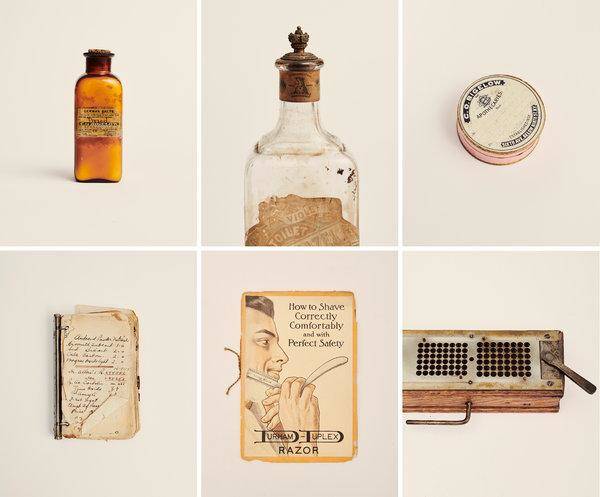
Neat article about the original Bigelow pharmacy store in NYC. They have a collection of artifacts which includes old notebooks of recipes for medicines!

Established in 1838 by Dr. Galen Hunter, the store was originally called the Village Apothecary Shoppe. In 1880, Clarence Otis Bigelow purchased it and renamed it after himself, moving it 22 years later, two doors down, to Sixth Avenue and Ninth Street, where it stands today.

Mr. Ginsberg’s grandfather and his brother-in-law bought the drugstore in 1939. Over the last 180 years, the Ginsberg family has amassed more than 10,000 pharmaceutical and beauty items, including original prescription and recipe books from the 1800s; tablet rollers; old photographs; and mid-20th-century cosmetics packaging.

Over the last 180 years, the Ginsberg family has amassed more than 10,000 pharmaceutical and beauty items.

Read more: The Secrets Inside the C.O. Bigelow Apothecary (Est. 1838) – The New York Times

Notebook Addict of the Week: From the Pen Cup

This week’s addict is Mary, the blogger at From the Pen Cup. Her website features lots of pen and notebook goodness, including these photos:

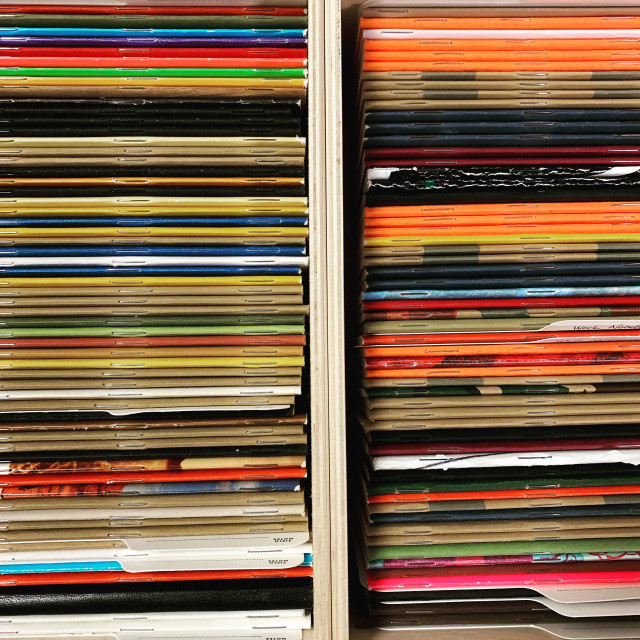
I started my third Field Notes Storage box this week. That’s a picture of a portion of the first two boxes, crammed with as many completed pocket notebooks as I could jam in there. I keep a “personal” and “work” notebook running all the time, and enjoy using not just Field Notes, but also Nock Co., Story Supply, Write Notepad & Co., and Log & Jotter notebooks.

Every time I see those nice wooden Field Notes crates, I am wildly envious! I might have to buy one to store my various small softcover notebooks even though most of them are brands other than Field Notes. Mary’s leather notebook cover looks very nice too.

Source: My Life In Notebooks | From the Pen Cup

The Barrister’s Notebook

What is a barrister’s notebook? That is what I found myself wondering when I recently read a PD James mystery set in the colorfully traditional world of the London criminal court system. (See Crown Court, Old Bailey and Inns of Court for more background.) I noticed a mention of a certain type of blue notebook used by barristers to keep records about their cases. Notebooks in traditional formats that are specific to certain professions always fascinate me, so I had to learn more!

As an introduction, here’s a passage from a memoir of a law student who participated in a special program that allowed her to spend a year working with and learning from a barrister:

At 4 Pump Court, I also participated in a few hearings and meetings with Tony Temple QC, a former head of Chambers and tenacious advocate. His first words of advice to me before
departing for an arbitration at which I was to merely observe, was to go and get my own “blue book” from the stationary cupboard. A “blue book” is a unique feature of barristers, consisting of lined or blank sheets bound in a stiff, light blue cover. It resembled a North American child’s school notebook, yet no barrister worth his or her salt was ever seen without one. He turned to me and said: “Lisa, even if you are not important at a hearing, you should always look as though you are”. The blue book remained at my side for the rest of my year.

From “It is a Long Way to Middle Temple or How I spent my year in London” By Lisa Tomas, Fox Scholar 2002-3

Further online research led to these images of notebooks referred to either as barrister’s notebooks or counsel’s notebooks:

barrister's notebook
Barrister’s notebooks from Legal and General Shop, Ireland
barrister's notebook or counsel's notebook
Counsel’s notebook from Octopus Office Products, UK

The barrister’s notebooks above all seem to be A4 sized, staple bound with 96 pages. They are usually sold in packs of 5 or 10, with a per-book cost of a couple of dollars or less, though the Irish red/white/blue ones seem to be €4 each. As Lisa Tomas notes, they are very similar to the exercise books I remember using in school, which you can still buy in various incarnations, though those were usually smaller at 7 x 8.5″. I also noticed a hardcover barrister’s notebook which is actually made by the LogBookStore division of Book Factory, whose pocket size field notebooks I reviewed years ago:

hardcover barrister's notebook
Barrister’s notebook from LogBookStore

The LogBookStore page offers quite a few options for different page layouts. Since they are US-based, I couldn’t help wondering if lawyers in the US also use these, or if they sell them all overseas.

I could see the staple-bound barrister’s notebooks like these being quite handy for people who like to keep a separate notebook for each project. The A4 size is good for when you want to tuck in meeting handouts (even if it’s not an exact match for those of us used to US paper size standards). And those Irish ones in particular have a very cool retro look! I’m going to be in Dublin in a few weeks and may have to look for office supply shops near the courthouses…

Beechmore Books Notebook Review and Giveaway

I had not heard of Beechmore Books notebooks until the company contacted me to offer a sample. The creator, Sam Horbye, named the company after the street he grew up on in London, and says:

I created Beechmore Books because I wanted a notebook that had the elegance of a Smythson, the every-day use style of a Moleskine but with paper that was thick and avoided bleed-through (ours is 120 gsm).

That all sounded pretty good to me! And I will say right up front that he delivers on this promise, at a price you would not expect.

Beechmore Books Notebook Exterior and Packaging

The Beechmore Books notebook arrives in a shrinkwrapped protective box. It’s not a super fancy box, but it does make it a little more gifty. When I removed the notebook from the packaging, I thought, oh, it’s leather! Upon closer inspection, I realized that. like most notebooks these days, the cover is actually a faux leather, but the texture and rich brown color are very nice, more realistic than most.

beechmore books notebook journal

This is an A5 size, approximately 5.75 x 8.25″, and .75″ thick. There is a removable paper band with the brand name. The logo is also crisply stamped on the back cover. The construction of this notebook is great– symmetrical edges, nothing out of square, everything tight and neat. There is some cover overhang but it’s well-proportioned and the corners are rounded just right. It definitely gives the first impression of a higher quality notebook.

beechmore books notebook journal
beechmore books notebook edge view
beechmore books notebook journal stamped logo

Beechmore Books Notebook Interior

Inside the notebook, there is a postcard with a Ray Bradbury quote and contact information. The brand logo appears again on the inside front cover, but otherwise the endpapers are totally plain. Mine had a few specs of ink– I’m not sure if I did that myself without noticing, or if something smeared during the manufacturing process– the specs seem to align with the line spacing on the pages. If it is a manufacturing defect, it is a very minor one, and the only one I could detect in this notebook.

beechmore books notebook journal inside front cover
beechmore books notebook inside front cover
You may not even be able to see the specks

There is a ribbon marker that matches the cover and the back has an expanding pocket. The notebook opens flat, and inside you find 160 pages of 120 GSM creamy paper with wide-spaced (8mm) lines, with slightly larger spaces at the top and bottom.

beechmore books notebook opens flat lined pages
beechmore books notebook back pocket

Beechmore Books Pen Tests

The paper quality is superb. When I first touched it, I thought, ooh, smooth and thick. When I first wrote a few notes on it with a gel ink pen, it felt great. And when I started testing all my fountain pens, I thought “hallelujah!” For the most part, it passed my tests with flying colors. Fountain pens did not bleed through at all, with the slight exception of a vintage Waterman with a flexible nib where I was applying a fair amount of pressure. (Also, that nib is a bit crooked and scratchy, so it may tear at the paper fibers a bit more than most.) My only other quibbles were that the Bleu Nuit ink seemed to feather slightly, and Apache Sunset had a somewhat blotchy look. Otherwise, only my wettest markers bled, and show-through was minimal. It is one of the most fountain pen friendly notebooks I have reviewed.

beechmore books notebook fountain pen tests
Pen tests front of page
beechmore books fountain pen tests
Pen tests back of page

Conclusion

This is a GREAT notebook. I don’t usually use lined journals in this size myself, but if it was pocket size and dotted or plain or squared paper, it would be my next daily carry. Beechmore notebooks were recently sold out in most formats, so I guess they are off to a great start, and I hope their product line will expand to include a pocket size version. As of this writing, all Beechmore notebooks are back in stock at Amazon in both dotted and lined versions, in black and brown faux leather, and also in a cork covered version.

As for the price, first let’s note the competition: A classic Moleskine of this size has a list price of $19.95 and terrible paper. An A5 Rhodia Webnotebook is usually $19.95 and up, with good paper but a less elegant exterior. A Smythson notebook has a real leather cover and thin fountain pen friendly paper, but prices start at $75 for a small pocket size notebook. The Beechmore Books A5 notebook is $15.95 on Amazon, a great value for a notebook of this size and quality. (If you are in the UK, you can order directly from Beechmore’s website at £12 per notebook, which includes free shipping.)

And courtesy of the folks at Beechmore, you can enter to win a notebook in the color and page format of your choice. Please note that the prize can only be shipped to North America, UK or the EU. One winner will be randomly selected from entries received in any of these ways:

On Twitter, tweet something containing “Beechmore Books Notebook @NotebookStories”, and follow @NotebookStories .

On Facebook, “like”  the Notebook Stories page and post something containing the words “Beechmore Books Notebook” on the Notebook Stories page.

On your blog, post something containing the words “Beechmore Books Notebook” and “Notebook Stories” and link back to this post, also leaving a comment below with the link in case the trackback doesn’t work.

On Instagram, follow @Notebook.Stories and comment on my Beechmore Books post, tagging a friend and adding a hashtag of your favorite adjective describing the Beechmore Books notebook. (Example: “@myfriendsally #fountainpenfriendly”)

The deadline for entry is Friday March 15, 2019 at 11:59PM, EST. Good luck everyone!

I received a free sample of this notebook to review but no other compensation. All opinions are my own.

Marie Kondo and Tidying Up Notebooks

Is tidying up notebooks possible for us notebook addicts? I’ve been a tidy person who folds her t-shirts precisely and stores them vertically in drawers since long before Marie Kondo‘s “The Life-Changing Magic of Tidying Up” hit the bestseller lists. Because I’ve lived in some very tiny New York apartments, I’ve always been pretty good about clearing out clutter, even if I am a bit of a hoarder when it comes to CDs, books, and of course notebooks.

This was a messy moment in my notebook storage history!

Now that Marie Kondo has her own TV show, everyone seems to be talking about her rules for tidying, and she’s had to clarify some of her advice. At one point, it was rumored that she had said you shouldn’t have more than 30 books and the internet pretty much erupted with people saying “oh hell no!” Kondo has since clarified that she doesn’t suggest any particular numerical limit, as long as your books all “spark joy.”

I haven’t read Kondo’s book, but I did watch a couple of episodes of her TV series. They made me realize that I’ve already been living another aspect of her method without even knowing it. When you go through her program of tidying up, you’re supposed to touch all your things, and decide whether you feel that spark of joy from them. You’re also supposed to thank them for their service. You keep the ones that spark joy, and get rid of the rest.

I already do this with my notebooks all the time. I am always sorting through my notebooks. Sometimes I’m putting away ones I’ve just reviewed and I use it as a chance to make room in one of my storage boxes. I find myself handling the various piles of notebooks, turning notebooks over in my hands, sorting them, appreciating their various qualities, and organizing them by size and type. I don’t actually thank them for serving me, but I contemplate them with appreciation, and most of them do spark joy.

Just a few of my spare Moleskines.

Sometimes I come across ones that don’t spark joy and I set them aside to give away or donate. I have a huge collection of notebooks and sometimes I feel like it’s a bit much, but on the whole, I keep it under control and organized and relatively neat. I don’t let my notebooks become a source of stress rather than pleasure. Tidying notebooks is part of the way I enjoy them.

Lots of old notebooks, since reorganized.

So here’s my KonMari-inspired tidying method specifically for notebooks:

Take out all your notebooks from all the various places you store them and put them all together in one room.

Pick each one up, see if it sparks joy. Your notebooks may bring up various feelings as you do this:

  • Feeling happy or sad about past events recorded in a journal
  • Feelings of anxiety about not being creative enough
  • Feeling like a certain type of notebook is “too nice” to use 
  • Thinking about why you used to use a certain type of notebook but have now switched to another

This is all good stuff to ponder, and might help you decide how you want to approach your notebook usage and buying in the future.  And it may help you realize that some of your notebooks aren’t helping you achieve your goals. If you have notebooks that don’t spark joy, thank them and set them aside for disposal. You may find that a local school teacher is thrilled to get a donation of notebooks.

For the notebooks that do spark joy, group them by whether they are used or unused. Then group them by size. For used notebooks, you might also want to organize them by date.  Try to find boxes you can store each size in efficiently. Simple cardboard shoeboxes work very nicely for pocket size notebooks. It’s better to use small boxes that won’t get too heavy. I have some clear plastic boxes that were meant to store sweaters, but they work nicely for pocket notebooks because I can easily see what’s there, and read the dates I’ve written on the edges. (It’s hard to find good plastic boxes with straight sides and the right dimensions. Mine are old and don’t seem to be sold anywhere nowadays, but these look pretty good.)

My completed journals and sketchbooks since about 2001.

You could also store notebooks on shelves like books. Regular bookshelves are too deep for pocket notebooks, but if you have old racks used for CDs or DVDs, they might work for holding smaller notebooks. Vertical storage is much better than piles, so you can see each notebook without having to dig around because every layer of notebooks hides more underneath. 

In my home right now, I have the two plastic boxes of completed notebooks and sketchbooks above, a couple of cardboard boxes of notebooks that are in my “to-be-reviewed” queue, a box of notebooks to be given away or donated, a plastic under-the-bed box with spare to-be-used notebooks, and a handful of other in-progress notebooks around my desk. I also have quite a few shoeboxes full of my lifelong notebook collection– childhood notebooks, college sketchbooks, pre-2001 journals, more spare notebooks and other goodies I’ve written about on this site. These are all in a storage unit and I look forward to regaining access to them someday soon!

I’d love to hear from readers about how you organize and store your notebooks, especially if you’ve tried Marie Kondo’s tidying plan! Even if every notebook you touch sparks joy, the KonMari method is probably a good way to get rid of other stuff so you’ll have room for more notebooks!

Sketchbook Art in NYC

There was an exhibition of sketchbook art in Long Island City, NY recently. I had hoped to see it in person but the opening weekend there was supposed to be a big snowstorm so I was avoiding travel into the city. Then when I tried to go the next weekend, there was some sort of snafu and no one was there to let us in… it’s a shame, as I really would have loved to see these gorgeous sketchbooks up close!

Diana Corvelle
Nicolas V. Sanchez

About the show, which ran from January 19 to February 8, 2019:

Artist Dina Brodsky … has kept a sketchbook since she was 18 years old. What was first a collection of “scattered thoughts and scribbles” has transitioned into thoughtful spreads that combine detailed drawings with handwritten text.

In addition to being an artist, Brodsky is also a curator-in-residence at Sugarlift in Long Island City, New York. There, she’s organized an exhibition called Sketchbook Vol 1. The show offers visitors a rare chance to flip through the books of fine artists to see the place where their ideas come to life. The inner working of the creative process is demystified as these art objects highlight how these people think and how they experience the world around them.

Read more: 14 Creatives Offer a Rare Chance to See Their Beautiful Art Sketchbooks

Notebook Addict of the Week: Mary

This week’s notebook addict sent the photos and comments below about her beautiful and colorful notebooks:

I can’t exist without writing, painting and making art in my notebooks. I live in the Texas panhandle area. There just isn’t much to do here at all except watch sunsets and moonrise and hear the coyotes howl and of course write and paint.

I frequent coffee shops to write in one of my many notebooks and I take about 7 different ones in this open bag purse, one for poetry, one for my daily life record, one for painting, one for my coffee shop stories, etc. I can’t be without them cause you never know what needs to be recorded.

A daily carry of seven notebooks, in their own dedicated bag! That is a real commitment to notebooking! Thank you for sharing your notebook addiction, Mary!

Notebooks, journals, sketchbooks, diaries: in search of the perfect page…