A 1920s Notebook That Hits “the Emotional Jackpot”

At her blog Whispering Winds, Marian Korth has a lovely story about the notebook above:

“As I was thinking about what to write in my blog this week, I picked up my mom’s little black book again. This is the little hardcover “Memorandum Book” that Stella Lillesand, my mom’s Sunday School teacher, had given her in 1921, when Mom was 13 years old. Mom had used this book to write down Bible verses as she memorized them starting on October 2, 1921 and ending on August 5, 1923.

Her first entry was “Let the words of my mouth and the meditation of my heart be acceptable in thy sight, O Lord, my strength and my redeemer.” (Psalm 19:14) Her last entry was “But thanks be to God which giveth us the victory through our Lord.” (I Corinthians 15:57)

I decided to look up any verse she might have memorized the last week in January, this week almost 100 years ago. On January 29, 1922 she wrote, “A friend loveth at all times.” (Proverbs 17:17) When I read that, I thought I’d hit the emotional jackpot. My best friend, Mim, and I have celebrated the week between January 24 and February 1 for the last 27 years.”


Read more at : The Emotional Jackpot | Whispering Winds

Andrew Croswell’s 19th Century Notebooks

I love stumbling on interesting antique notebooks like this!

“Andrew Croswell (1778-1858) was a student at Harvard University in the late 1790s. He later studied medicine in Plymouth, MA, and practiced there and in Fayette and Mercer, ME. In the collections [at the Massachusetts Historical Society] we hold two notebooks that were kept by Croswell. The first is a mathematical notebook which contains definitions and problems in geometry, trigonometry, and surveying. The second is a physician’s notebook that contains notes on the treatment of diseases and injuries, as well as the use of some medicines.

The second notebook, relating to various diseases and treatments, is text-heavy in its content. Croswell – who had very nice, neat, and even handwriting – copied observations from published medical texts, especially the work of Dr. Benjamin Rush.”

See lots more beautiful pages at: Massachusetts Historical Society: the Beehive

Notebook Addict of the Week: William

This is one of my favorite notebook addict submissions, because these notebooks are truly full of stories!

“My name is William, last November marked 20 years for me as a ships agent. Indirectly my notebook habit began in the US Army. A very instrumental part of infantry basic training is you are required to keep a pen and one of those green government issued memorandum pocket notebooks with you at all times. After the Army in 1995 I began working in shipping as a ships agent in the Port of Baltimore. At the time, we had these great bound pocket notebooks in the supply closet. Before smart phones, PDA’s, emails, and heck a 56K digital rolodex which cost $89 back then and was considered cutting edge, there were notebooks. During the course of my duties as a boarding agent, I was required to keep track of an array of numbers, times, dates, ships water drafts, bunker oil, water and cargo quantities, and coordinate with a never ending trail of issues that required jotting down phone numbers and details on the go. Common to those in this field, either ships mates, or cargo surveyors, a pocket notebook to keep up with all the details of the job is fairly standard issue. Time is money in shipping and each and every figure has a dollar figure significance to the report or document it will ultimately be transposed into. In some cases, a wrong time, or missing time, could ultimately cost someone 1000’s of dollars if recorded wrong by the ships agent.
IMG_3299

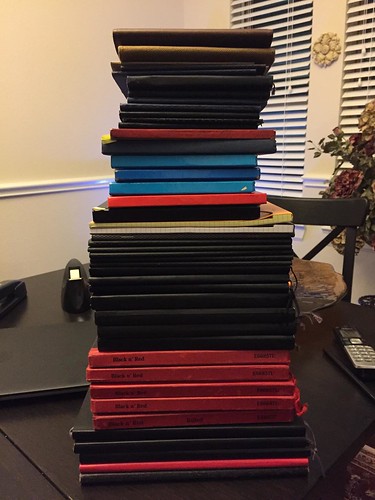
Somewhere in my parents attic is the first 5 years of pocket notebooks I used then. Around late 1999 I began working with a new fleet of Norwegian vessels, I really liked the European notebooks the vessels officers used and would occasionally barter some new ones away for a magazine or a quick shopping trip in trade. As I moved up in the ranks, with more administrative duties building, I moved to larger notebooks, first composition, then Red & Blacks, next Moleskines, and currently Leuchtturm is preferred, but have added in a new mix of Clairfontaine and Rhodia pads. Aside from the possibly missing boarding notebooks of the earlier years, I have yet to throw even one of them away.
IMG_3311

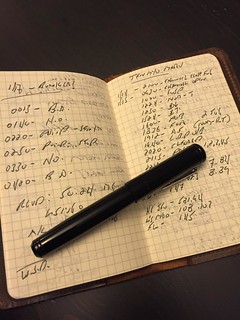
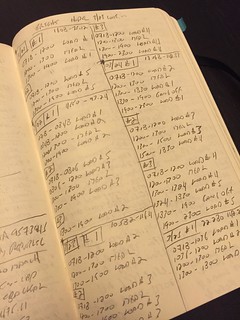
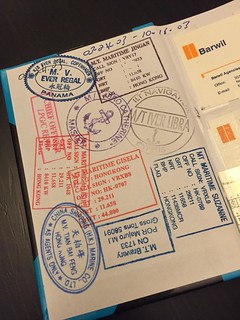
My boarding notebooks hold a wide record of ships passing in the night, ETA’s to far off places, phone numbers of overseas contacts, biographical details of sailors, stowage plans, and cargo quantities of large shipments of oils, grains, coals, and ores. Once and a while, even a ships official stamp was placed as a souvenir of the time onboard.
IMG_3306

Some unique memories in these books, boarding the M/v “Tampa” on her return trip after rescuing 100’s of refugees off Christmas Island which resulted in an international standoff between the Norwegian and Australian governments. Emergency contacts collected after the passing Hurricane Katrina wiped out New Orleans communications. Arrival details of the “Scotia Prince” which was chartered by FEMA to house emergency service workers in the devastated St. Bernard’s Parish. They contain details of 100’s of ocean going vessels sailing to and from ports far around the world. Hopefully my wife is not reading,  they may even include a few phone numbers of wild nights gone by. These notebooks were always in my pocket as it’s a 24 hour job and your always on call, they were in smoky ships offices with taking times from Pakistani officers, engine rooms, bar rooms, restaurant tables, dropped in the mud, carried in the rain, up ships ladders, even written in while sitting on the toilet.
IMG_3303

These days I regretfully don’t board a ship very often, I am now vice president of the company and we grew from 2 offices, to 18 offices and now attend about 4000 port calls a year. But when training new young agents, I always explain to them, despite all the technology, wireless devices and cloud based systems available to today, no better organizational tool exists then a pocket notebook and I make sure a quality supply of them remains in our supply room for them today, just as there was 20 years ago for me. Today my notebook as a mix of to-do lists, daily planning, conference call notes brainstorms, employee reviews, and meeting notes from here in Houston, to NYC and far as away as Geneva.
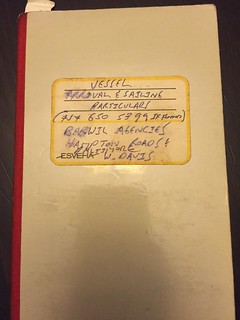
IMG_3302-1

Being left handed, I always required some sort of bound notebook and my handwriting style is that of a doctor. First with mechanical pencils, now a new love of fountain pens, ultimately it was proved my notebook habit was best served by better quality paper. I am not a “in the lines” type mind and prefer blank or gridded pages. Despite best efforts to keep in a particular direction, depending on the stress level of the day, the pages contain a wide away of chicken scratch, rough calculations, lists of times, phone numbers, neat and structured meeting notes, or rapid shorthand and even some timeless scribbles from my kids who love to grab them and leave their own mark on my day.
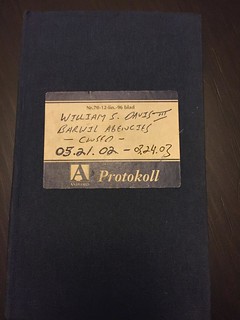
IMG_3301

I do however still keep a pocket notebook with me at all times, be it the waxed canvas cover with Field Notes for weekends, or the leather cover and Moleskine combo I use on those few occasions when get to board ships, or the pocket Leuchtturm that I use when traveling to keep addresses and arrangements quick at hand. Despite being a HUGE Evernote addict, the paper notebook is first and foremost, often pages of which are scanned into Evernote for easier archival access –vs- the old box in the garage where they ultimately get placed to rest.
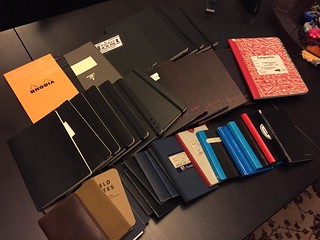
IMG_3297

The world is an increasingly fast paced driven by electronics, apps and phones get smarter. The ability to organize and collaborate get easier, or does it ? Nothing replaces the mind-clearing peace, or retains the moments of the day exactly like placing pen and pencil to paper.”

A big thank you to William for sharing both his notebook addiction and his adventures in the maritime world!

Smythson Notebooks by Vahram Muratyan

A new collection of colorful Smythson notebooks:

“When Smythson approached the graphic artist Vahram Muratyan to design a set of notebooks — carte blanche — Muratyan ran with that freedom. “It occurred to me that I could take those words — those French phrases that we use in English — and place them above the different glasses, or characters,” the graphic artist says. “Carte blanche” didn’t ultimately make the cut, but there’s “je ne sais quoi,” “crème de la crème” and “touché” (and three more) etched onto fuchsia, orange and yellow covers. “


Source: A Playful, French Take on a Classic Notebook – The New York Times

Lauren Redniss and Her Sketchbooks

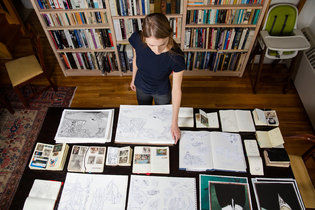
I love this image of the author/illustrator Lauren Redniss with some of the notebooks, sketchbooks and scrapbooks she used in the making of her book Thunder & Lightning: Weather Past, Present, Future.

“Ms. Redniss, who teaches at Parsons School of Design, walked a reporter through her bookmaking process, picking up materials laid out on an ornately carved table. She began by binding a blank book of approximately the same dimensions as the eventual published project, then pasting in bits of text and drawings taken from sketchbooks or made from photographs, playing with different arrangements.

She also drew from a personal archive of images clipped from newspapers and magazines and pasted into notebooks that she has kept for years.”

I wish I could flip through some of those sketchbooks, but I guess I’ll have to settle for the book:

Read more at: For the Author Lauren Redniss, No Such Thing as Bad Weather – The New York Times

Notebook Addict of the Week: Eryck Webb

This week’s addict is an illustrator graphic designer who has been keeping sketchbooks for years. Some of these go back to his college days. More recently, he fills about one sketchbook a year, and likes to decorate the covers. They look fantastic, inside and out!

Read more at: 2015 Sketchbook: Latest In A Long Tradition | Eryck Webb Graphics

Learn to Write Cursive

I am lucky to have grown up in an era when learning cursive was mandatory. In first grade, I was in an open classroom where we were combined with second graders for some activities, but the older half of the class went off on their own to learn cursive. I have a very vivid memory of watching some of their lessons– enough to make me write my own little lines of loops, thinking it looked fun! When I was a little older, certain school projects were required to be written in cursive. And even today, I can’t help thinking that certain correspondence, such as a condolence card, should really be written in cursive, though in reality , I just write in my neatest print on a blank card or piece of stationery.

Nowadays, not all kids are being taught cursive and many people are worried that handwriting is a dying art. Kids almost seem to learn to type before they can print letters with a pencil or pen. And even print handwriting skills may be on the wane– when people are more accustomed to typing or tapping an on-screen keyboard, their handwriting may deteriorate into chicken scratch.

I think my own handwriting has become hasty and messy, despite my ongoing devotion to writing in notebooks. I can print very neat block letters when I want to, but my usual quick scrawl is pretty sloppy. As for my cursive, I am so out of practice, I find it always looks very childish when I try! Even in the ’70s when I was a kid, cursive wasn’t taught with the rigor that it used to be– you had to learn it but they didn’t force you to be totally perfect, at least not in my school. (If I’d gone to Catholic school, it might have been different!) I never mastered it to the degree I wanted to, and always looked with envy at things written by my mother and grandmother in their elegant, clear cursive. Now that was “penmanship!”

If you’d like to teach yourself or someone else the lost art of cursive, here’s a method to check out: Cursive Logic. They offer a workbook that breaks down the common shapes of cursive letters and how they are connected. It has practice pages and dry-erase pages for repeat use.

As you can see from the writing samples below, I could use a little refresher course myself…

handwriting sample

Planner Formats

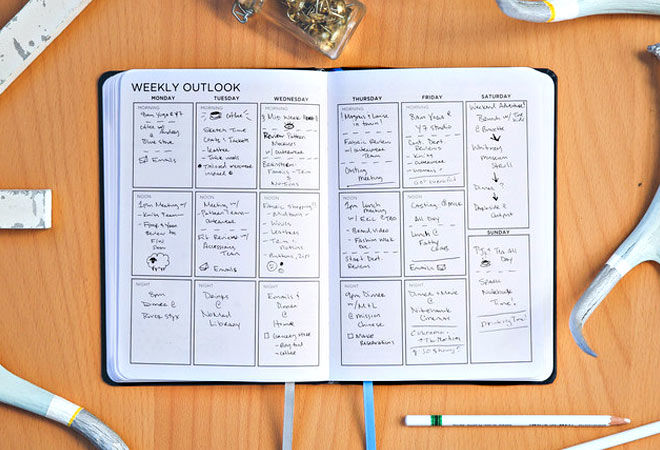
How do you feel about planner notebooks with highly formatted pages? I love seeing images of how people use them, as the pages sometimes look wonderfully dense and textured with text and colors and highlighting. But when it comes to using them myself, I’m a bit reluctant. I make lots of lists on paper, but when it comes to keeping track of appointments and projects, I tend to use digital tools instead. I love to use pens on paper, but for some purposes I have to admit I don’t find it efficient. The image below with blocks of time laid out with different color highlighters is very appealing, but in my day to day life, I know I’d get frustrated by having no way to erase them when meetings were rescheduled! I do like the way these planners prompt you to slot your to-do list items into blocks of time– I think it’s a key part of being organized, as you have to allow yourself time to actually do things!

The planners below– the Spark Notebook, the Basics Notebook and the Passion Planner were featured at Cool Material along with some other ideas for notebooks to get you organized. The Spark Notebook has a pretty minimalist layout for its weekly view. The Basics Notebook adds more hourly time slots and other page layouts to prompt various kinds of planning and logging. The Passion Planner seems to be the most elaborate of all, with hourly, daily, weekly monthly and annual planning and space for you to reflect on goals, gratitude and steps for improvement.

None of these seems like quite the right fit for me… but they’ve given me ideas about what kinds of layouts I might wish for in my own planner, customized to my own life… perhaps a subject for a future post! I’d love to hear more about what planner systems readers are using– please chime in with a comment!


See more at: 7 Notebooks That Will Help You Get Organized in 2016 | Cool Material

Notebook Addict of the Week: Jake Seliger

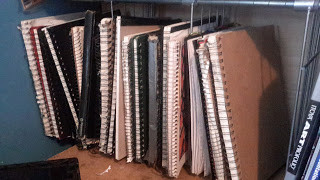
Jake Seliger is a novelist, (see his novels here) and blogs at The Story’s Story, where he has a variety of posts about using notebooks and reviewing various brands, some of which I’ve linked to before. I think this photo of his notebook stack qualifies for addiction!


Some of Jake’s very valuable reminders about the benefits of notebooks:

“A notebook is the written equivalent of a face-to-face meeting. It has no distractions, no pop-up icons, and no software upgrades. For a notebook, fewer features are better and fewer options are more. If you take a notebook out of your pocket to record an idea, you won’t see nude photos of your significant other. You’re going to see the page where you left off. Maybe you’ll see another idea that reminds you of the one you’re working on, and you’ll combine the two in a novel way. If you want to flip back to an earlier page, it’s easy.

The lack of editability is a feature, not a bug, and the notebook is an enigma of stopped time. Similar writing in a computer can function this way but doesn’t for me: the text is too open and too malleable. Which is wonderful in its own way, and that way opens many new possibilities. But those possibilities are different from the notebook’s. It’s become a cliche to argue that the technologies we use affect the thoughts we have and the way we express those thoughts, but despite being cliche the basic power of that observation remains. I have complete confidence that, unless I misplace them, I’ll still be able to read my notebooks in 20 years, regardless of changes in technology.”

Read more at: Why little black books instead of phones and computers « The Story’s Story

Notebooks, journals, sketchbooks, diaries: in search of the perfect page…