Roy Lichtenstein is best known for his Pop Art comic book style works, so I was quite surprised to come across this page from one of his sketchbooks, which is now in the collection of the Whitney Museum.
The Roy Lichtenstein Study Collection, Jointly owned by the Whitney Museum of American Art and the Morgan Library & Museum, Gift of the Roy Lichtenstein Foundation
Not comic-y at all, these seem to be studies of perhaps architectural moldings and patterns. I was hoping to find other images from this sketchbook, so I flipped through all of the Lichtenstein works the Whitney has in their online archive. I didn’t see any other pages like this, but there were a lot of photos of architectural elements, and other drawings that were quite different from Lichtenstein’s most famous work. It was quite interesting, even if I didn’t get the full sketchbook flip-through I’d hoped for!
Are you staying home? Are you writing a lot? Drawing? Filling notebooks to fill your time? Recording what life is like during this historic pandemic?
These are such strange times. I’ve stopped carrying a bag or any notebooks with me when I do my weekly grocery run so I’ll have less stuff to worry about disinfecting when I get home. (And yes, I know getting germs on my notebooks is a petty concern in the larger scheme of things.) It is scary living in the NY area these days, where so many people are sick and dying. I give thanks every day to all the supermarket workers, healthcare workers, delivery people and other employees who have to expose themselves to the public, as they are really the ones at risk. I feel very lucky to be able to mostly stay home, where I do try to do some journaling and sketching when I’m not too distracted by all the news.
The New York Times published a great article about how people are documenting this time in journals, diaries and sketchbooks: The Quarantine Diaries
As the coronavirus continues to spread and confine people largely to their homes, many are filling pages with their experiences of living through a pandemic. Their diaries are told in words and pictures: pantry inventories, window views, questions about the future, concerns about the present.
Taken together, the pages tell the story of an anxious, claustrophobic world on pause…
When future historians look to write the story of life during coronavirus, these first-person accounts may prove useful.
“Diaries and correspondences are a gold standard,†said Jane Kamensky, a professor of American History at Harvard University and the faculty director of the Schlesinger Library at the Radcliffe Institute. “They’re among the best evidence we have of people’s inner worlds.â€
I’d love to do a post on how some of this site’s readers are notebooking their way through the COVID-19 crisis. If anyone would like to share their own notebook or sketchbook pages or stories, please email me at nifty [at] notebookstories [dot] com.
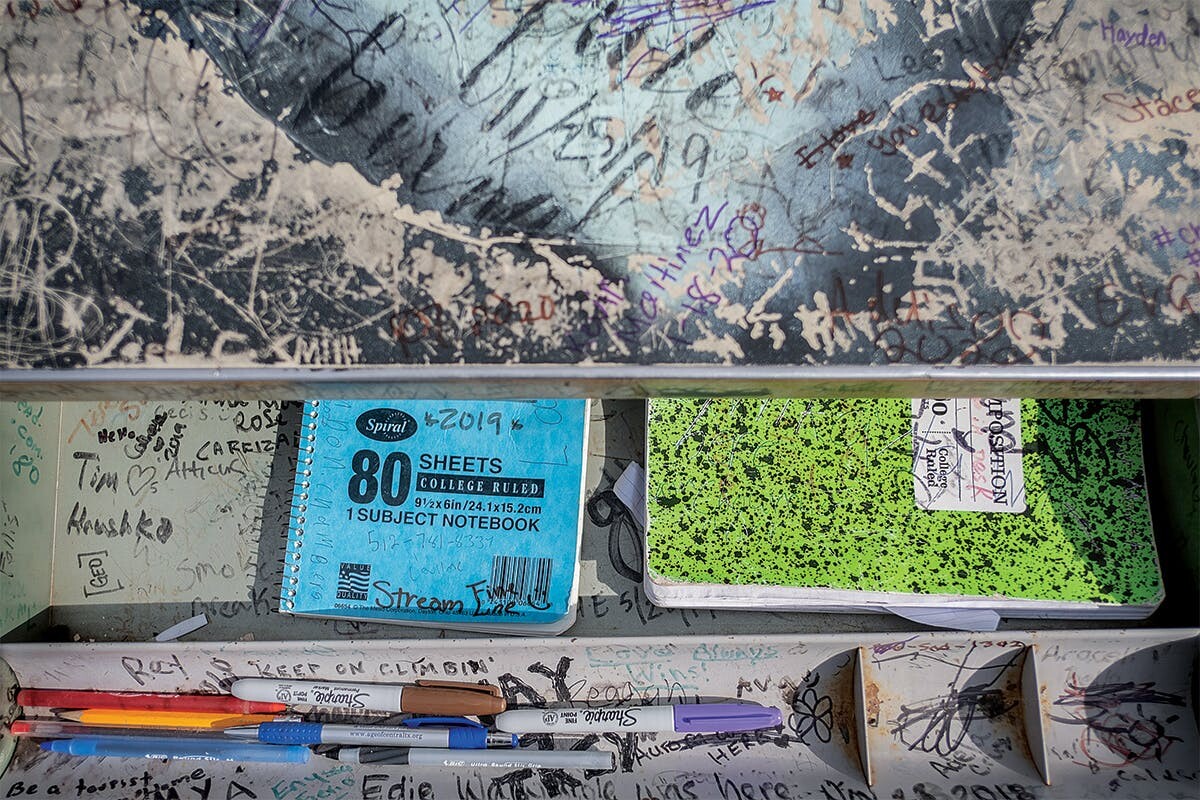
How would you like to sit at this desk and do some writing in a notebook?
That desk is on Hancock Hill, in Alpine, Texas. It’s been there for 40 years. At first, the guy whose idea it was to put the desk there just stashed a notebook in the drawer so he could record his running times. Sometimes he’d add some other thoughts. Then other people who came across the desk started leaving their own notes:
The first notebook ran out of blank pages. Then a second one and a third. “Whenever they’d get filled up, we’d take them away and put a new one in there,†Kitchen says. “It really surprised me, the things that were written—pretty moving stuff. This was all before the internet. We weren’t socially connected like we are now. But people were making a connection to nature and to each other in those notebooks. It became something pretty special.â€
Sul Ross’s Archives of the Big Bend is now the keeper of the journals, which are still picked up and replaced periodically. Most of the writers are anonymous, though the notebooks’ content is remarkably consistent: lots of “BFFs forever†statements, inside jokes, prosaic advice, mentions of drunkenness, rough drawings. Over time, the “We were here†category of comments has become more common than longer, more thoughtful entries. Still, people really spill their guts.
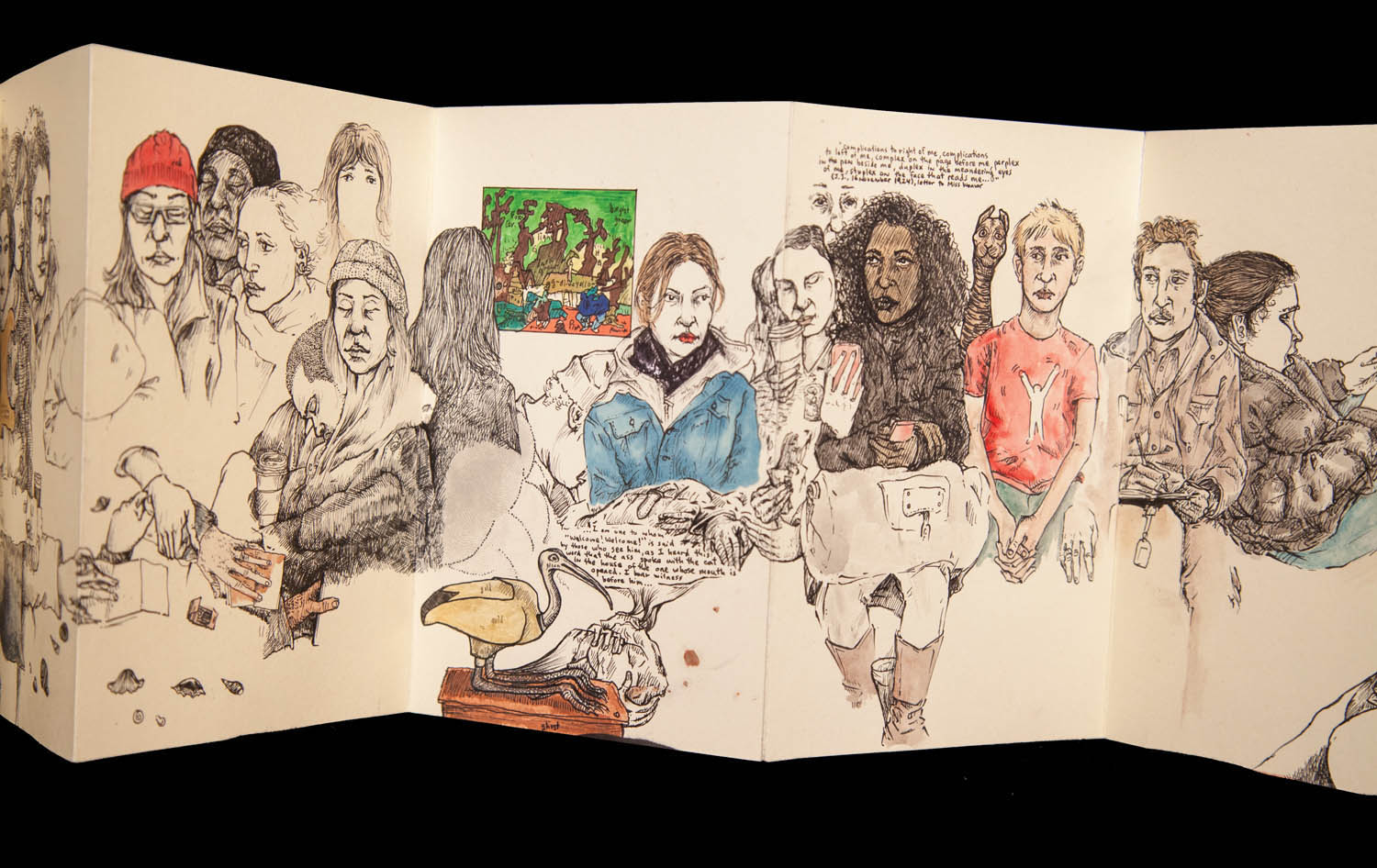
I have a couple of Moleskine’s Japanese Albums, but I’ve never actually used one. The elongated spread of pages always seems daunting to me, but I love to see the way other artists take advantage of this format. American illustrator Chris Russell is one of the best I’ve seen. Large narrative paintings by seventeenth century Buddhist monks in China were the inspiration for his amazing multi-year project documenting a very different landscape: his morning commute.
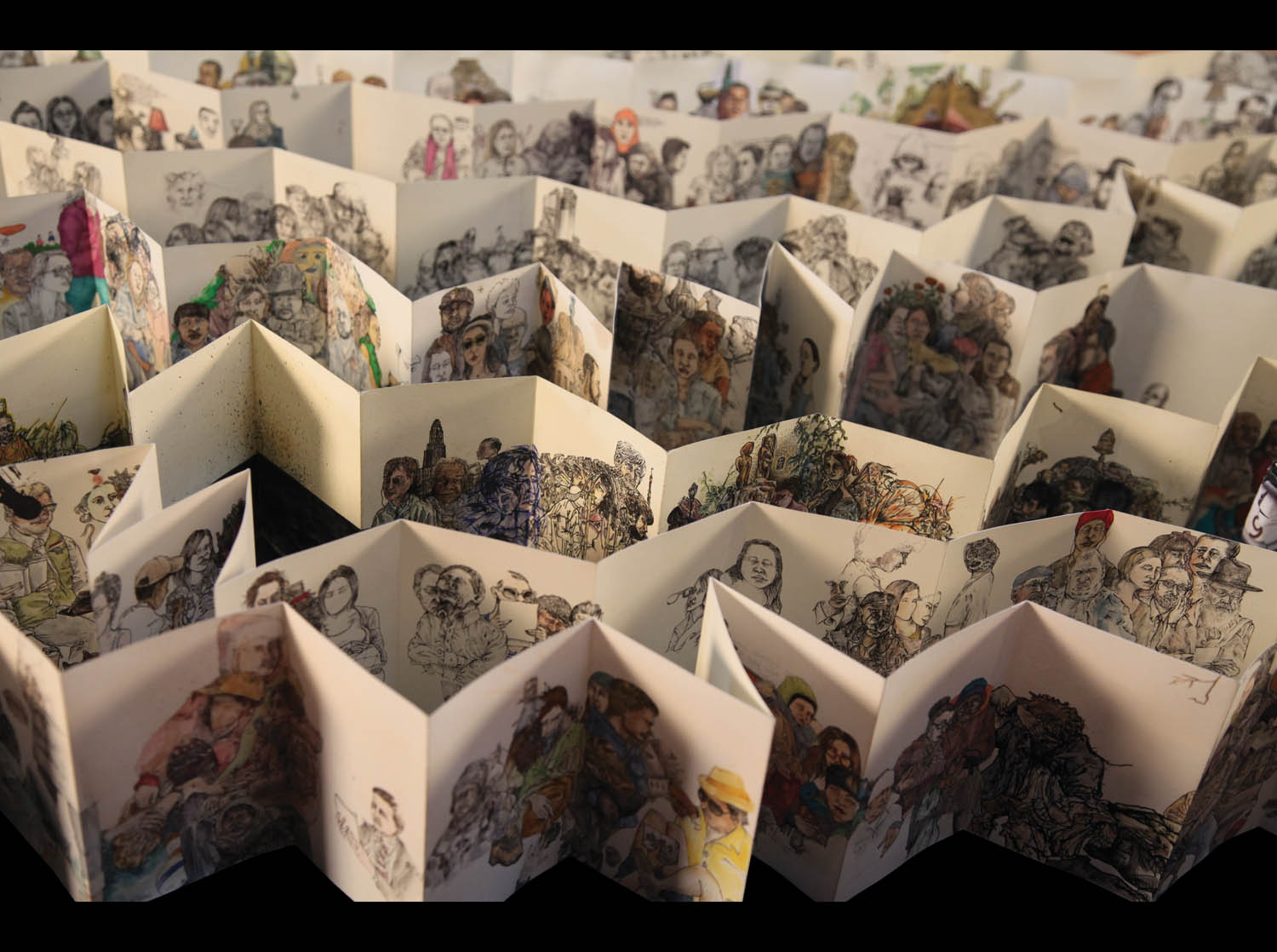
[Russell’s] project of the last nine years [is] a series of figurative ink drawings that unfold across pocket-sized accordion notebooks, each measuring five and a half inches tall and more than one hundred and eight inches long when fully extended. He now has nine such notebooks, which merge into a seamless stream of interlocking images when placed end to end. Once, Russell found a particularly long hallway and laid out all the notebooks across the floor. The work in progress stretched over eighty-one feet. “It was a little overwhelming,†he says.
Russell refers to his work as an “endless landscape†in a nod to the late Ming / early Qing compositions, particularly the masterful, elegiac work of Shitao, Kuncan, and Xiao Yuncong. When you relax your gaze, Russell’s images take on the flowing topographical patterns of the paintings they’re modeled after: clusters of form that rise into peaks between swathes of blank space suggesting clouds or sky or rising mist. On closer look, Russell’s drawings resolve into intimately detailed portraits of the strangers who sit opposite him during his daily commute across New York City. They evoke not only the form but the feeling of the Chinese landscape paintings, that melancholic sensibility. “Portraiture is inherently melancholic,†he says. “It’s about trying to hold onto something that you know is gone already, or that you know is about to be gone.â€
Please read the whole article at VQR, there is lots more great background about Russell’s inspirations and methods: The Humanity Notebooks
This week’s addict shared these photos of her journals:
Wow. I love all the intense patterns and color, which I think looks even better because of the standard shape and size of all the journals. Jacqueline is using a Dyan Reaveley Creative Dyalog standard TN cover that she painted, and made her own inserts featuring art from past journals. (I wasn’t familiar with Dyan Reaveley, but after looking her up, I realized I’d seen her Dylusions products in various art supply stores.)
Thanks for sharing your art and your notebook addiction, Jacqueline!
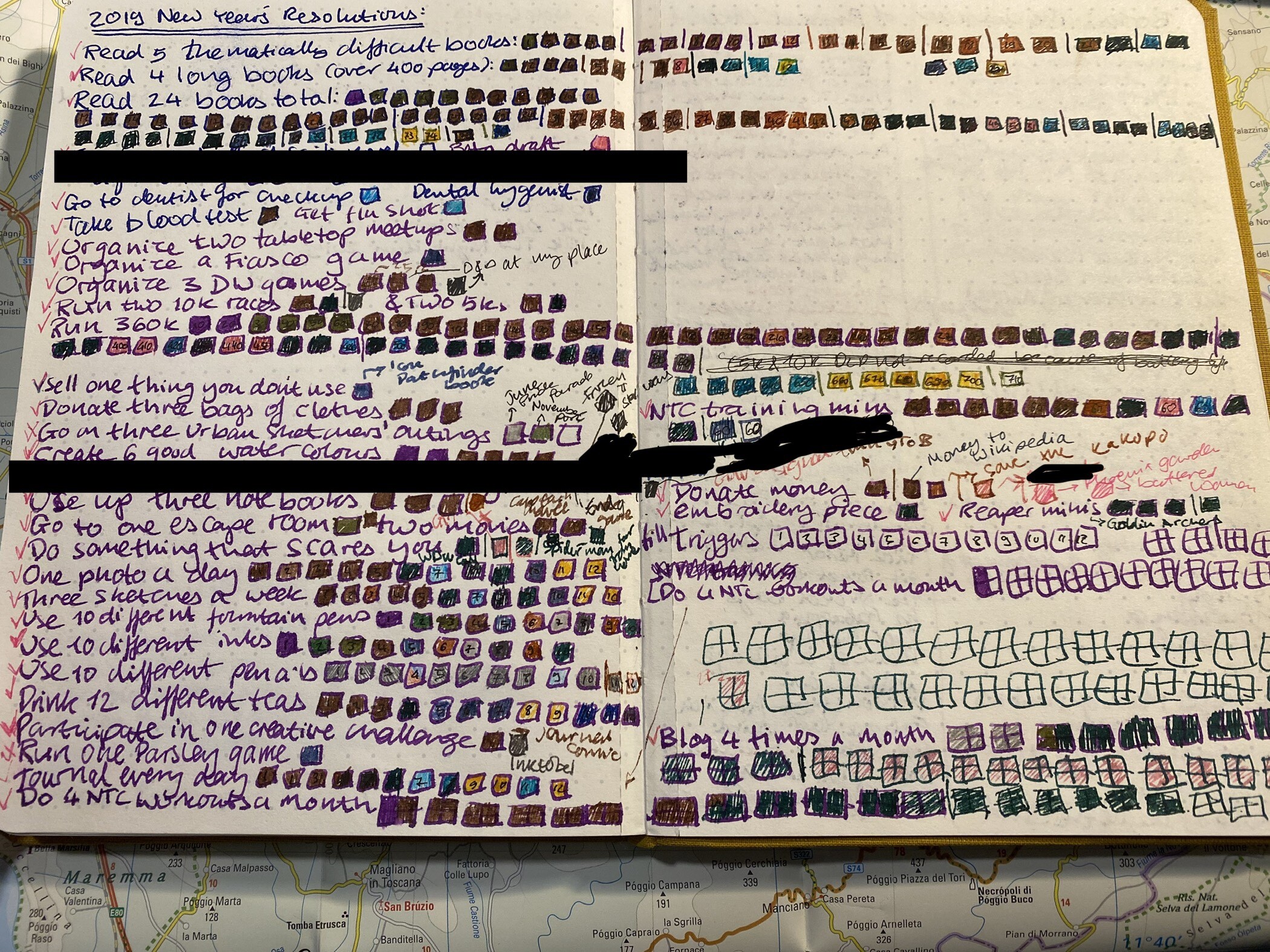
I loved this post from the “Writing at Large” blog, about tracking goals and resolutions in a notebook. The dense lists and checked-off boxes are very satisfying.
My “resolutions†are, however, S.M.A.R.T. goals: specific, measurable, attainable, relevant and time-bound. I manage them using the least used notebook that I had lying around (a Baron Fig Confidant), and whichever pen I have at hand. They aren’t made for instagram, rather I use my plain ugly handwriting, and what marking are on the page are there because they’re useful. Over the past five years I’ve attained about 90% of what I set out to achieve, with even an annus horribilis like 2018 not putting me too much off track. My goals are tiered, much like Kickstarter stretch goals, with most goals having a fairly easily attainable first tier, just in case life decides to kick me in a tender place.
Here’s another shoebox full of notebooks from my collection. This one has most of my Filofaxes and other refillable looseleaf notebooks.
First, here’s the Filofaxes. I used 4 of these on a regular basis during the mid to late 1990s. (See Pocket Filofax, Early 1990s for details on the burgundy one.) These older ones all say “Made in England,” and a couple of them note that they are made of calf or kid leather. The burgundy one and the black one at top left are the old 4-ring style, but they don’t have a style name stamped on them. The other two black ones have 6 rings, and are the pocket “Chelsea” style. The one in the box is a 2009 Guildford Extra Slim that I couldn’t resist buying because the slim, small ring Filofaxes without the snap closure seemed rare at that point and for some reason I just wanted another one. (Do I need a reason? ) But the leather is much more flabby, just nowhere near as nice as the old models. It doesn’t say where it’s made, but I’m guessing it wasn’t England. (The only current Filofax model in the pocket slim size is the Lockwood, which has a MSRP of $102, but can be found on Amazon for $49 in Navy and $77 in a discontinued taupe/black.)
Pocket FilofaxesPocket Filofaxes2009 pocket Guildford Extra Slim Filofax
Then we have 5 assorted vinyl covered looseleafs from the 1980s and early 1990s. I bought these at various five and ten, stationery and office supply stores. The orange one marked “Astronomy” is the oldest. I guess I thought coloring it silver with a metallic marker made it look more space-y, but the cover itself was originally all orange. (There are a few additional photos of it in this post: Random Notebooks from My Collection) The one with the textured cover in the upper left of the photo dates to junior high and high school in the early 1980s. It was made by Top Scholar in Hong Kong. There used to be stiff cardboard inside the covers but I sliced the vinyl open and removed it because I wanted it to feel more flexible, more like the leather Filofaxes that I wouldn’t be able to afford until later in life! It has a lot of snarky notes about my classmates that I find really embarrassing now. Good thing I marked it “PRIVATE KEEP OUT!” The other 3 notebooks in the bottom row are pretty generic and weren’t used as much, though I think I tried to utilize one of them at my job for a while. (see Notebooks in My Office, which also featured one of the leather passport holders below, with a Clairefontaine notebook inside.) (You can still get basic pocket size looseleaf binders like this, from Mead and other brands, and they’re cheap. I have some listed in my Amazon “Refillable Notebooks” list for as low as $7 each.)
Here’s a few other leather and faux-leather notebooks, all of which would have been bought in the early 1990s. A couple of them are passport holders that I bought to use as notebook covers. The nicest one was from Coach (upper right in photo), which fit a certain Clairefontaine notebook perfectly if you trimmed the cover to be a little smaller than the pages. The second nicest passport cover was from Banana Republic, bottom left. In this one, I inserted a ring binder system mounted on plastic that I removed from some other notebook– probably a Filofax, as it has 4 rings, not 6. (This has me wondering if I really sliced apart an actual Filofax, back when they were pretty expensive! I doubt it…) I filled it with Filofax inserts and it ended up being one of my favorite “Filofax” notebooks of all. Bottom right is another passport holder, made of not very nice leather. I don’t remember where I got it and I don’t think I ever even put a notebook in it. Maybe it was actually a notebook cover that had that 4-ring binder in it originally…
I never used the little Bree looseleaf (middle bottom row) but it’s a cute slim size. All the paper has that weird grey squares design on one side, and is blank on the other. There’s also a Dayrunner cover (top left) that I think originally had a calendar and address book inside. But I moved the calendar to a kind of cheesy faux-leather cover from the Limited (top middle). And somehow, for some reason, I rebound some lined notebook paper in with the address book. It looks pretty terrible but I must have put a lot of effort into figuring out which spiral notebooks had holes that would align, and then bending the wire-o binding open and shut. Someday I’ll have to do a post called “Stupid Notebook Tricks.”
Assorted leather/ faux leather refillable notebooksBree leather binder notebook, made in GermanyDayrunner address book modified with lined notebook pagesDayrunner calendar inside faux-leather cover from The Limited
Then we have two little Japanese looseleaf binders by Maruman (one included in this review: Japanese Notebooks from Kinokuniya). The one with the clear plastic cover is a great size, but the cover is kind of stiff. The rings in both of these binders open via an unusual sideways hinge mechanism. I don’t know why JetPens doesn’t stock these, but you can find some versions in different sizes on Amazon.
There’s also a Moleskine Color-a-Month diary, the Kolo Essex Travel Book (available on Amazon) and a really odd notebook from my childhood. A neighbor gave it to me because I coveted it and probably kept dropping hints about how much I wanted it to be mine. I can only imagine what a pest I must have been to any adult who happened to own a cool notebook! But it was a weird size, so I trimmed down the cover and then covered the ugly green vinyl with paper. I’ve never seen refill paper that would fit rings like this. I used it a little when I was 13 years old, and starting to babysit. Probably my favorite thing about babysitting was having something new to write about in my notebooks. And more pocket money to buy notebooks.
Japanese looseleaf notebooksMaruman Mini File Admix ring binder notebookWeird 1970s notebook binder, size modified
This shoebox represents most of the refillable notebooks that I own, except for a few more recent acquisitions that will probably end up in this box eventually if I’m not using them actively. I loved using my Filofaxes back when I only kept my calendar and addresses on paper. Even when I switched to using a Palm Pilot, I still used a Filofax as a notebook and wallet, but then when Moleskines came along, I completely stopped using looseleaf notebooks. I keep wanting to bring some kind of leather looseleaf notebook back into my daily carry but haven’t quite figured out how to do it yet. But I’ll have lots to choose from when that day comes!
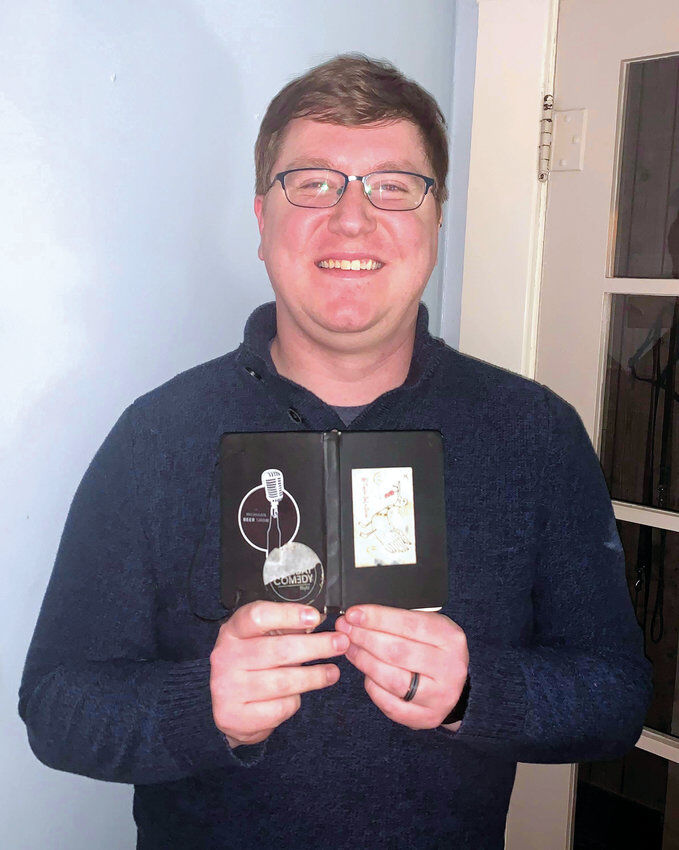
Dan Currie is a stand-up comedian based in Lansing, MI. One of his favorite things is his notebook:
My favorite thing is a notebook I acquired back in 2014. Over a four-year span, I’ve had it at hundreds of shows. My friend and fellow comedian Carl Johnson booked me and a group of other comics for a tour in Canada. He bought it for himself, but was disappointed when he found it was basically graph paper on the inside as opposed to it being lined. I’d been looking for a small book to write set lists on and take on stage with me, so he gave it to me.
The creator of the Tuk Book is another self-professed notebook addict. Zach Rome has always carried a pocket notebook, but despite trying many brands, he could never find that anything truly held up to every day back-pocket carrying. So he set out to design a truly indestructible notebook that he believes is the perfect everyday carry. Let’s take a look at the sample he sent me!
The Tuk Book is made entirely out of Tyvek, which is best known as being that waterproof fabric that is wrapped around houses as a protective barrier underneath siding. When I say “entirely,” I really mean it– it’s not just the pages and the cover that are made out of Tyvek. The “ring” binding is too! This patent-pending FlexiSpine binding is quite clever. Thin strips of the back cover material pass through holes in the pages and are then glued down under the front cover. The result is a totally flexible spine that can be bent in any direction without tearing or breaking.
Like most notebooks, the Tuk Book comes with a bellyband on which is printed branding information. Once that is removed, the notebook is totally plain except for a small woodpecker logo on the inside front cover, symbolizing the company name, Woodpecker Laboratories. (At this time, they do not seem to have any other commercially available products beyond the Tuk Book.)
The version I received has a blue cover. Green, and a red patterned cover are also available. The size is about 3.75 x 5.5″. There is an elastic closure and an expanding pocket in the inside back cover.
Inside, you get 140 pages (70 sheets) of lined paper. The lines are a bit darker than you see in most notebooks, and are spaced at 5mm. The “rings” are not round– being made of paper, they fold up when the notebook is closed. This can lead to the pages sticking out in uneven clumps when the notebook is closed if you don’t straighten them out first. But the binding is loose enough that the pages turn pretty easily.
The Tyvek paper has a strange texture– kind of plastic-y, kind of fabric-y, a bit slippery. Writing on it can be tricky– not all pens are suited to this material, and the packaging warns that it is not intended to be used with pencils. I found that Sharpies worked the best. Some gel ink pens were ok, but ballpoints could be skippy (I don’t have many ballpoint pens to test with). Many pens show feathering, and there were spots of bleed-through. I tried a couple of pencils out of curiosity and found that a hard lead is useless, but a softer 6B pencil actually wrote pretty well.
All that said, the aesthetics of fine handwriting and fountain pen performance aren’t really the point of the Tuk Book. It’s meant to be a utilitarian, indestructible notebook that can take a beating. So I gave it a beating! I tried to rip the paper and couldn’t. I tried to tear the binding and couldn’t. I bent the notebook every which way and all that happened was that the cover got some wrinkles in it. I even ran water on it, and although a couple of inks washed off, the notebook was otherwise fine. I was trying to think what else I could throw at it– in doing some research on Tyvek, it even seems to resist acid, alkaline and saline solutions to some extent, so I thought it might be an opportunity to take my reviews to the next level and start dipping notebooks in corrosive chemicals just to see what happens. Alas, I don’t have the facilities… I had also considered trying to burn the Tuk Book, but it turns out that fire is one thing Tyvek is NOT resistant to.
The competition for this notebook would be waterproof notebooks like Rite in the Rain, or the Field Notes Expedition Edition, though neither of these makes the claim to be an indestructible notebook. In writing this review, I realized that I don’t seem to have ever done a proper review of a Rite in the Rain notebook, though I do own one. I remember the RitR paper being weird with a lot of pens. The Field Notes Expedition paper is also recommended to be used with only ballpoint pens or pencils, but I found that it worked really well with quite a few pens, other than having a long drying time. That paper is also very durable, but not as strong as the Tyvek in the Tuk Book. And neither RitR or Field Notes offers as durable and flexible a binding as the Tuk Book– the Field Notes survives bending quite well, but the pages can be torn out of the staple binding quite easily. To me, the best of all worlds might be a notebook that uses the Tuk Book FlexiSpine Tyvek binding with the Field Notes Expedition paper.
If you prefer to use certain writing instruments and really care about paper texture, the Tuk Book may not be right for you. But if you like to keep a notebook in your back pocket, the Tuk Book will feel very comfortable there. And if you spend a lot of time outdoors in harsh conditions, the Tuk Book will be a durable companion. It truly is an indestructible notebook.
The Tuk Book can be purchased for $14 at Uncommon Goods.
I cam across this week’s addict in the r/notebooks community on Reddit. What a lovely and well-organized desk corner, with easy access to a LOT of notebooks!
From Migo984’s comments:
I’ve been looking for a way to store my “in-use†and new notebooks and journals whilst keeping them to hand on my desk. Recently I found two little shelving units that are ideal. They fit neatly in the corner of my desk and even have room for some of my fountain pen storage trays. I added a clip-on LED light and now I’m very happy with my writing and creativity corner 😍
The bottom shelf of the right hand unit is a mixture of my Tomoe paper notebooks (Nanami, Taroko, Galen Leather, Hippo Note, Scriptura Optima & PaperForFountainPens) and my Midori MD notebooks. I tend to keep my new notebooks in their cardboard slipcases or wrappings. Once I start using a Tomoe notebook I usually put it in a slipcover (leather, fabric or PVU). They are on the bottom shelf of the left hand unit.