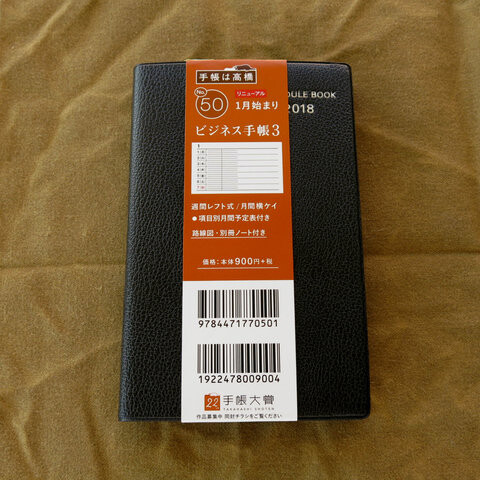
Nanami Paper‘s fountain pen friendly Tomoe River paper notebooks seem to be very popular. But I kind of wrote them off because they only seemed to sell larger A5-ish sizes rather than the pocket size I prefer. However, I recently took another look and was glad to see there are a few options that might appeal to people like me!
First is this Takahashi planner. At 150x95mm, it is not quite my perfect size of 140 x 90mm, but it’s pretty close, and it looks like it has some interesting features. I already have my other favorite fountain pen friendly Japanese diary from Nolty, but if I couldn’t get those any longer, I would consider the Takahashi.
Next is a regular notebook with gridded pages inside, the Cafe Note Pocket Edition. It has two ribbon markers, which is always a nice touch. At 92x155mm, it is still a little bit larger than my perfect size, but I can’t help being tempted!
Then there’s the Cafe Note A6 size. The dimensions in millimeters or inches aren’t specified, but they say it is A6, and to me, it looks like the size of the Hobonichi Techo, which is 105 x 150mm, which is almost exactly true A6 size. (Not all A6 notebooks really are A6 size!) This one is out of stock right now. Still not quite the right size for me, but close.
Of all of these, I’m most attracted to the Cafe Note Pocket Edition. I like the taller proportions, which will seem strange to those of you who remember me complaining that I can’t buy Leuchtturm’s pocket notebooks because they are 150 x 95mm! But for some reason, with that retro faux-leather vinyl cover, and the 3.7mm grid, and that paper, it just looks very appealing to me!
FYI, I have not tried any of these notebooks, and have no connection or sponsor relationship with this retailer. Just my own opinions and interests as a notebook shopper!
It’s been a while since I attempted any sort of notebook hack or alteration (except for removing the pen loop from a Taotree notebook), but I recently decided to do a little experiment.
I’ve always like the Moleskine City notebooks because they have a nice thickness, with more pages than the normal pocket size notebooks. They also have 3 ribbon markers. But of course much of the interior is taken up with city info and there isn’t that much space to just write or draw. And the issue with Moleskine notebooks in general, as we all know, is that the paper isn’t great if you want to use certain types of pens. Even their sketchbook paper has issues– the smooth card stock they use can be great for some kinds of drawing, but not so much for watercolors, or fountain pens.
The pocket sketchbooks that have become quite popular are those made by Stillman and Birn. Artists love these because they are available with a variety of good quality paper types, in different weights, textures and colors. Their pocket size is the 3.5 x 5.5″ format, same as Moleskine, but they only come in softcover. S&B also makes hardcover sketchbooks but they have square corners and don’t get any smaller than 4 x 6″.
So I wondered what would happen if I did a little transplant surgery, removing a Moleskine City Notebook interior and filling the cover with Stillman & Birn paper. I had managed to buy an extra Moleskine City notebook very cheaply, so it seemed worth a try!
Taking apart the Moleskine isn’t too hard– you just have to cut very carefully between the endpaper and the first signature to remove the page block. You can then remove the ribbons from the page block spine.
I popped the S&B sketchbook inside the cover and it almost fits perfectly, except that the corners are rounded to a much larger diameter than the Moleskine cover. For me, this made the whole project a non-starter. It’s bad enough to have too wide an overhang, but when it’s wider on the corners than along the sides, that is just ugly.
I also think that even if the corners matched perfectly, it would not quite work to just attach the S&B softcover inside as is. It works well in terms of its thickness–the one I’m using is an Alpha, but some of their other paper types would be too thick to fit. But I don’t think gluing the Moleskine endpapers to the cover of the S&B would make for a strong enough binding, given the stiffness of the S&B spine.
Other people have done this notebook hack by making their own sewn signatures and attached them to the Moleskine endpapers in this way, and it always made me wonder how well it held up to use. In most bookbinding, there is additional material glued to the spine (called the “mull”) that also gets attached to the cover boards underneath the endpapers. The mull is traditionally linen or some kind of loosely woven cloth, but on the Moleskine, it appears to be made of paper. From what I can see in my dissection, it isn’t glued that strongly to the spine, but it must add some reinforcement helping to keep the cover attached.
So now I am trying to figure out if there will be a next stage to this notebook hack. I could try removing the endpapers and back pocket and see if that would give me room to glue in a different, slightly thicker S&B sketchbook, gluing the outside cover of the S&B directly into the Moleskine. But that wouldn’t solve my corner problem. I could buy a larger size S&B and cut it down to match exactly, but that would be a lot of work, and would probably turn out looking all butchered on the edges. And I’d have to be sure the cutting didn’t run into the stitches that hold the signatures together. I could also try folding, cutting and sewing my own paper signatures… and while I’d really love to do my own bookbinding someday, I don’t have all the proper equipment to do it right, and this whole thing is starting to sound like an expensive pain in the ass.
At least for now, I’m going to have to admit that I just don’t have the patience to successfully carry out this particular hack. But if any readers have their own stories of similar projects, I’d love to hear them!
I recently wrote about how Moleskine’s packaging has evolved over the years. I thought it would be interesting to take a look at a similar Rhodia Webnotebook comparison. In future posts, I’ll also examine some other popular brands to see how their products have changed over time.
I first reviewed a Rhodia Webnotebook in 2009, not too long after they were introduced. Here’s the orange one I received as a sample from the company.
At some point, I also acquired a black Webnotebook with 80 GSM pages. I already had it when I reviewed the orange one, so I’m assuming I bought it in late 2008 or early 2009.
A few months ago, I purchased a current Webnotebook from JetPens when I saw that they were stocking the version with unlined 90 GSM pages, something I’d wished was an option years ago when they only offered lined pages.
How have the old Webnotebooks held up over time? Neither of the early ones was subjected to daily use–they have just been stored in boxes, so I can’t really speak to durability. The orange one seems to show some wear or fading of the color on the cover at the edges and corners, but it’s basically in great shape. What is quite shocking is the condition of the old black one– the cover material is crumbling on both sides of the spine, to the point where flakes and particles fall off every time I pick it up. Seems very strange for a notebook that has barely been opened to wear out in that way.
The original notebooks both had the vertical paper band with branding info on it. You can see that the newer one has a more typical horizontal band, just in white. It’s attractive, but I miss the iconic Rhodia orange! The other major difference in external appearance is that the recent model has a slightly larger cover and slightly smaller pages, leading to a great big cover overhang. The old black Webnotebook had the smallest overhang, and even the orange one was starting to get a little clunky looking, but this current one looks way worse. The cover also seems softer and almost rubbery.
My older black Webnotebook doesn’t note a country of origin, but the orange one said “Made in France.” The new one says “made in Étival-Clairefontaine, France,” but I think that refers just to the paper. Below that, the band says “French Design Made in Morocco.”
The 80 GSM paper in the old black notebook felt nice to write on but shows a lot of feathering and bleed-through with fountain pens. The 90 GSM paper in the old orange notebook and the current black notebook performs very well with fountain pens, and still feels wonderfully smooth to write on.
90 GSM Orange Rhodia Webnotebook from 2009:
80 GSM Rhodia Webnotebook tested in 2009:
90 GSM Rhodia Webnotebook from 2019:
I was really hoping the unlined Rhodia Webnotebook would be something I could use day to day. I love the paper but I just can’t get past that clunky cover. (And I hope it won’t end up deteriorating like the other one!)
Bottom line on the Rhodia Webnotebook comparison: a cosmetic update to the packaging, but from what I can see, Rhodia seems to have stayed very consistent in their paper quality over the past decade, and it’s great that they introduced unlined (and dotted) versions after the early years when lined was the only option. Also, in 2009 I had noted that the suggest retail price was $15 for this pocket size– that does not seem to have changed, which is nice. Unfortunately, the exterior construction is a bit different after the move to Morocco, but if the larger overhang isn’t something that bothers you, it’s still a great notebook!
Cuprohastes was one of the winners of my recent Arteza giveaway, and he included Arteza sketchbooks and watercolor books in this shot of his notebook collection!
Quite a variety here: I spy Field Notes, Moleskine, including one of the Van Gogh silk covered ones, perhaps Leuchtturm and I think Mead, as well as others I can’t identify.
Here’s another shoebox tour! This box of notebooks, one of the many that hold my collection, contains lined and dot-grid notebooks that I may find a use for someday, or at least like enough to want to keep. As with the previous shoebox tour, I first just looked at the box without taking any of the notebooks out and identified them by their spines. Then I dug in further to see if I was right!
X17 refillable notebook, Received as a sample for review
Reviewed in 2011, here. I still like the idea of using a system like this with slim staple-bound notebooks inside a cover, but haven’t quite figured out how to make it work for me.
Rationella notebook from Sweden, received as a gift from a reader
I haven’t done an in-depth review, but included it in this post. The Rationella notebook is very similar to the Bindewerk notebooks below, with a linen cover and rounded spine, but it is just a hair smaller, and has lined pages. I would love to get more Rationella notebooks, but I think it would require a trip to Germany or Scandinavia.
Clairefontaine notebook, purchased in 1990s
I don’t remember exactly where or when I bought this but it’s a relatively common notebook still today, though Clairefontaine’s cover patterns seem to have changed somewhat over the years. Here’s the current version on Amazon, which is also sold in a 5-pack at a much better unit price. I used a few pages of this notebook to write notes about a book I was reading, but then abandoned it. This type of Clairefontaine notebook with the cloth covered spine were always my favorite– this one has stitched signatures within, unlike the squared “Age Bag” Clairefontaine notebooks I bought in Paris, where the pages are glued in under the cloth spine.
4 Bindewerk Linen Journals, purchased online
I still love these so much, especially when I see them in a group like this– such pretty colors. Reviewed here. I see these here and there in shops, but not so much online. HWE Stationery carries them, but the listing is unclear as to whether they are the lined or dotted version. OrangeArt has the dotted version.
Of the notebooks in this box, the dot-grid ones are what I’m most likely to use. The Bindewerk notebooks are really a favorite of mine, and the Taotree notebooks, while a bit less refined, are an exciting find. I really like the Clairefontaine and Black n’ Red notebooks too, but wish they had plain or dotted pages. Many of the others are hard to find, and/or have lined pages, so they are more for the pleasure of collecting. Hope you’ve enjoyed this shoebox tour, there will be quite a few more to come!
I’ve got a few extra notebooks to clear out, so it’s time for another random giveaway. And this one is for those of you who don’t have blogs or social media accounts. All you have to do to enter is leave a comment on this post telling me something about your love of notebooks– what your favorite old or new notebook is, how you’re using notebooks lately, what new notebook brand you’ve been dying to try. You can even tell me what kind of notebook you’d love to win! (Make sure you put an email address in the comment form so I know how to contact you if you win. Your email address will not be used for any other purpose.)
I will pick 3 winners, each of whom will get a notebook. Or two notebooks, maybe. It will be a surprise!
Prizes can be mailed to US addresses only. (Sorry international readers, but the shipping costs really add up!) The deadline to enter is Friday December 20, 2019, at 11:59pm EST.
At some point during the years I’ve been writing this blog, I remember coming across some discussion about whether the “regular” size Moleskine notebook was the pocket size or the large size. Many people consider the large size to be the default, and I’ve seen customer reviews on Amazon where people give the pocket notebooks 1 star because they’re “too small.” For me the pocket size has always been my go-to, but I do have a couple of the large ones too. I came across them while reorganizing my collection, and stopped to take a closer look to see if there was anything I should have included in my article on The Evolution of Moleskine Notebook Packaging. I realized that these belly-bands on the early Modo e Modo stock settle the question:
For the Moleskine brand, the pocket size was the original inspiration, and the large size “evolved from” it. And from what I’ve seen in museums, the notebooks used by artists in the early 20th century were indeed closer to the 9 x 14cm pocket format, though they certainly had other sketchbooks that were larger.
If anyone had a bar bet riding on this question, I’m happy to accept a portion of your winnings!
This week we have a Rollbahn addict! I’ve never seen such a big collection of Rollbahn notebooks, including tons of limited editions. They really look great laid out like this!
You can see lots more from @Lemonbahn on Instagram.
Notebooks, journals, sketchbooks, diaries: in search of the perfect page…