I found this week’s addict on Instagram, where he displays an amazing 38 year loyalty to the Nolty diary.

(The original text is in Japanese, but has been auto-translated into English in the image above.)
See more at @motohashinobuhiro 5884

I found this week’s addict on Instagram, where he displays an amazing 38 year loyalty to the Nolty diary.
(The original text is in Japanese, but has been auto-translated into English in the image above.)
See more at @motohashinobuhiro 5884
I’m very fortunate to have friends in Paris and Amsterdam that I’ve been able to visit a few times. I went in 2014 and bought quite a few notebooks. This past year, I went again, and also included Belgium on my itinerary. I wasn’t expecting to buy as many notebooks this time, but I ended up with quite a few! Sometimes it can seem like the world has gotten smaller and shopping isn’t that different between New York and Europe, but happily, that didn’t seem to be true on this trip and I found a number of things that I could not have bought back home in the USA.
At Esquisse (a small art supply shop in Paris, probably overlooked by most tourists in favor of the nearby and much more picturesque Sennelier store), I was quite captivated by a tiny little Hahnemuhle sketchbook. It’s a sweet little size (120 x 90mm, shown below with a pocket Moleskine for comparison), and at €3.20, not terribly expensive. I haven’t tested the paper inside, but it seems like a nice weight and texture. The same shop also had the lovely little quarter-pan Daler Rowney watercolor set I’d been hankering after ever since commenter Paul mentioned it in response to this post about my favorite watercolor sets. It’s a very elegant and slim metal box that can slip into any pocket, and the paints within are high quality. At 4 7/8″L x 1 7/8″ W x 1/2″D, it is amazingly small for an 18-color set– smaller than it looks in the photo below. Did I need it? No. Should I have spent approximately $85 on it? No, but I had to have it! (At the time, it was listed on Amazon for over $90 and otherwise almost impossible to find. You can currently get this set at Jackson’s for $79.61, but shipping from the UK will probably cost you another $7-10 if you’re in the USA.)


I managed to escape from France without buying any other notebooks except this one, a lovely Oxford softcover with smooth squared pages. It reminds me of some of Clairefontaine’s notebooks, and though I’ve only tested a couple of pens so far, it seems very fountain pen friendly. I have a hardcover Oxford notebook very similar to this one– I wrote about it briefly in a recap of notebooks I bought in Portugal, but I don’t seem to have ever done a full review. This red notebook was €3.99 at a FNAC store in central Paris.


My next stop was Bruges. It was my first time in Belgium and I was excited to see if I could add any unusual home-grown brands to my collection, particularly from Aurora, a Belgian brand I’d heard about back in 2010 from a reader. I only spent one day in Bruges, and visited several bookstores and stationery stores. I did see some Aurora notebooks but they were not the linen-covered type I was most interested in. I didn’t end up buying anything in Bruges except a set of journals from Dille & Kamille (such a cute store!) that were a gift for someone at home.

Then I moved on to Amsterdam. I had made a list of office supply stores and some high-end stationery stores, and found some interesting things at each. On the basic office supply end, Gebroeders Winter seems to be a wide-spread chain, where I fell in love with this little booklet meant for tracking expenses.


I also saw a lot of diaries from the Ryam brand. This format really caught my eye as something quite unusual, but practical. It lies flat and could be placed next to a keyboard for easy desktop reference. The €3.70 price seemed very reasonable.


At another basic stationery and office supply shop (Brugman), I found this notebook by Bekking & Blitz and felt like it was a perfect Amsterdam souvenir with its pattern of canal houses on the cover. The design continues on the endpapers. Unfortunately it has lined paper, which is not my favorite, but on the plus side, it was only €5.99.


Moving on to stylish lifestyle stationery shops, I visited Like Stationery. It’s beautifully merchandized, with a colorful selection of brands from Japan and Europe, mostly things I’ve seen at places like Goods for the Study in NYC. I only wanted to buy things I knew I couldn’t get at home, so I pounced on this Astier de Villatte journal, something I’d previously only seen online. It has an elegant patterned cover, gilded edges and creamy smooth paper inside. €24.50 was a ridiculous price to pay for this notebook and I almost didn’t buy it, but my traveling companion is the bad pixie who always says “just do it. You know you want it.” Don’t travel with an enabler, people.


I also purchased this interesting stitched journal made by Shapes and Papers. I’ve never seen anything like this– a lot of the page is taken up by the colored designs (two designs which repeat throughout). The colors are printed in a way that almost seems hypnotic, so perhaps you’re meant to meditate on them and then write whatever comes to mind. The company’s website (shapesandpapers.com) is not functioning as of this writing, so I can’t tell you if that’s what they intended. At €11, this was also overpriced, but I just thought it was cool.


My final stop was Misc Store, another shop with high-end, mostly Japanese stationery and lifestyle products. At this point I was feeling like my credit card was about to spontaneously combust, but I wanted to buy a little something because the selection and merchandizing were so nice and the shopkeeper was so friendly. This tiny little Penco notebook from Japan was €2, so that fit the bill.


But then on the way to the register I also saw this lovely set of plaid cahiers from Le Typographe. The paper inside was unlined– yay. The set cost €15. Too much, really, but they’re lovely and definitely not something you see just anywhere. Sold.


Most of my trip was spent seeing amazing sights and enjoying the cultural and historical vibes, not shopping for stationery. But it was a pretty fruitful trip for notebook collecting!

One thing I have been bad about on this site is following up on my notebook reviews to see how notebooks perform and hold up after being used daily til they are complete. My “everyday carry” notebook habits are pretty consistent and skew heavily towards the older Moleskines I’ve stockpiled over the years, but I have used some other brands. All of these Moleskine alternatives are more or less the same format as a pocket Moleskine: 3.5 x 5.5″, hardcover, most with a ribbon marker and elastic closure and back pocket. Some are thinner paper appropriate for just writing, and some have heavier sketchbook paper. Some were used almost entirely for writing, some have a mix of writing and doodles and sketches, and some were sketchbooks dedicated solely to drawing and watercolors.

I really loved the Bindewerk Linen notebook when I first bought it, and didn’t love it any less when I turned the final page. This is an exception in that it has no ribbon marker or elastic or back pocket. It also has a wider cover overhang than I like, but I was able to live with it. I love the cloth cover, and the high quality dot grid paper inside allowed me to use my various fountain pens with no issues. It came with me on a cross-country driving trip, during which it was stamped at quite a few national parks. Total usage period was a little over 3 months. It held up very well other than a little wear at the corners and top and bottom of the spine. I have a bunch more of these that will be used from time to time. Some have plain pages, so I’ll try using them more for drawing. I’ve been seeing the Bindewerk Linen notebook in some stationery shops and bookstores here and there, but they are at the high end of the price range for what most notebook buyers are willing to bear– about $20 usually.

I was really excited about Piccadilly notebooks for a while– so Moleskine-like, so inexpensive! Borders bookstores (RIP) used to carry them at bargain prices, I think $3.99 or $4.99 for a pocket size notebook . The first couple I bought were pretty good quality, even though after use the spine corners started to break. Cover overhang was not consistent. I still have a few more spares but I ended up disenchanted, thinking they felt a little cheap. Nowadays the prices are higher, at least on Amazon, so I wonder if the quality is any different. This particular Piccadilly notebook was used for about 3 months. It accompanied me to a ranch in Arizona, where I made a note that someone named Jared had told me “you should be plumb tickled” about something. Perhaps that I had succeeded in not falling off a horse.

Though this notebook is technically a sketchbook, I used it mainly as a journal. The Pen & Ink sketchbook from Art Alternatives is a great alternative to the Moleskine Sketchbook if you like smooth, creamy heavyweight paper. (I also have some Pen & Ink notebooks with regular weight plain and squared paper.) It has a slightly more round spine, and there was no tearing whatsoever at the corners. Overhang was minimal and the paper was good for at least the two fountain pens I tested in it. I tried to buy more just in the last couple of years, but they’ve changed the design so the elastic closure wraps around the corner, which I really don’t care for. (On Amazon and elsewhere, you still see photos of the old version, but in my experience, what arrives is the new version, so beware.) I didn’t travel anywhere with this notebook, and it covers a 3-month period when I was stressed out at work and hearing a lot about a friend’s painful divorce, so it was a bit of a downer to flip through it, except for a few pages where I did doodle with watercolor, which still looks nice and vibrant.

I’ve used several HandBook journals from Global Art Materials, and they are great little sketchbooks. The cloth covers come in nice colors and give them a nice retro feel, other than the not-at-all-retro elastic closure. The paper holds up fairly well to watercolors and markers. The ones I bought several years ago are notable for the complete lack of cover overhang– I really love notebooks where the pages and cover edges are aligned. Unfortunately, more recent examples from this brand that I’ve seen in stores seem to have more cover overhang. And they don’t seem as well-priced as they used to be (at least on Amazon). I bought some of mine for as low as $8 or 9 at the much-mourned A.I. Friedman store in Manhattan, which closed a couple of years ago. I also got some at Blick, where this model is currently $10.59. This HandBook is full of animal sketches done during a two-week safari in Botswana– it held up beautifully despite rather dusty and dirty conditions, without even getting the slight fraying of the corners seen on the Bindewerk notebook.

Another favorite Moleskine alternative: the Hahnemuhle Travel Journal. No cover overhang plus a thicker than usual shape made me fall in love with it at first sight. The traditional black cover is almost indistinguishable from a Moleskine, though if you look closely the texture is a little different. The paper inside is similar to the HandBook Journal, but I thought watercolors seemed a little less vibrant. This was another travel sketchbook, taken on a trip to the Galapagos and not much worse for wear even after some sketching in rainy and humid conditions. The Hahnemuhle journal wasn’t widely available in the US at the time– I ordered this first one from the UK. Later, I did manage to buy a couple more from Amazon (they do still seem to carry them, as do a few other places) but the new ones had more cover overhang– seems to be an epidemic these days!

Another great sketchbook– smooth paper, a bit less creamy-colored than Moleskine. The Leda works really well with pretty much anything– great for fountain pens. They are inexpensive and easy to buy via Amazon. The exterior isn’t as pretty as some other brands, but it’s flexible and durable. This sketchbook went to France for a couple of weeks, even though I only used two pages of it while I was there! But for part of the sketchbook’s 6-month active life, I was doing a drawing in it every day. I can’t help wanting to buy another one, even though I’m trying to stop hoarding so many notebooks! If I could get Leda paper inside a cover more like some of the other brands I’ve mentioned here, I wouldn’t hesitate to stock up.

Such a tough question. I haven’t really done any “top 5” or “best 10” type posts on this site, because when you love notebooks so much, it’s hard to pick favorites! And of course, different notebooks have different attributes that appeal to different people. But among these, the Bindewerk is probably the one I am craziest about. But I also really love the Hahnemuhle. And the HandBook feels so classic. And every time I take out a Pen & Ink, I feel like I’ve always under-appreciated them and wish I could buy more. And the paper in the Leda is so all-around good… see, I told you this was hard…
I’ve used some other brands over the last few years, but they were all for specific purposes: small stapled or stitched notebooks of the Field Notes/ Moleskine Cahier type, or sketchbooks with watercolor paper, or larger format notebooks for work. For a true comparison, I’ve limited this post to just the “Moleskine clones” that have actually been carried around in my bag all the time. I have several more notebooks in my stash that I do intend to try using as daily notebooks–TWSBI, Zequenz, Front, PaperBlanks, Black n’ Red, Pentalic, and others. I’ll report back in a few years and let you know how it goes!
This will seem familiar to many of us!
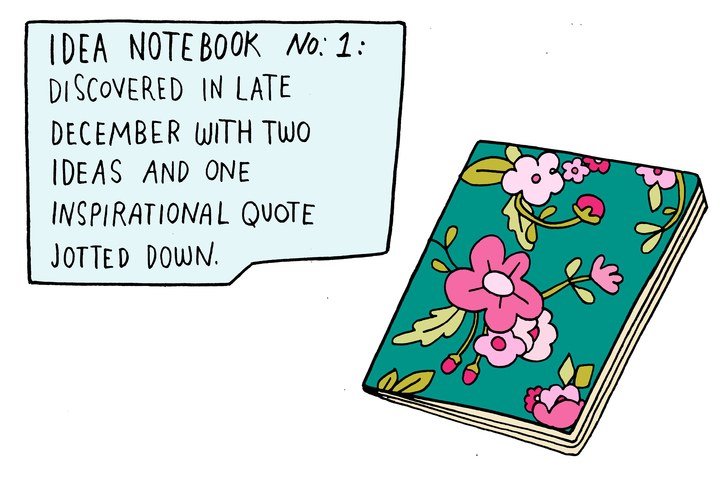
Idea Notebook No. 1: Discovered in late December with two ideas and one inspirational quote jotted down.
See the rest: Notebooks I Abandoned Last Year | The New Yorker
Another notebook addict spotted on Instagram, where she posted this photo of her 2018 sketchbooks and notebooks:

You can follow her on Instagram at @elizabethalley, where she also sometimes posts photos from inside her sketchbooks.
I picked these Nomad Notebooks up from a Kickstarter campaign in 2017. ( I wrote about it in this post.) They raised over $26,000 in a successful campaign, and are still selling notebooks, notebook covers and other products on their website. Their notebooks are were also available on Amazon. (Sometime after I started drafting this post, I guess they went out of stock, and there is no re-stock date listed.)
The Nomad founders are two graphic designers who found themselves using mixed up paper scraps in their studio, and wanted to reproduce that experience in a notebook. The idea is that a notebook with only one kind of paper isn’t as conducive to creativity, while a mix of paper types will stimulate the imagination.
I chose their Sea+Air+Space pack. It comes as a shrink-wrapped bundle of 3 staple-bound notebooks, very much like the Field Notes or Word. Notebooks concept. Each notebook has a different design.

Sea has nautical charts on the cover, and the inside cover celebrates JFK’s nautical style. The papers are a mix of colors, dot grid, and sea chart patterns.

Air has pilots’ charts on the cover, and pays homage to the Tuskeegee Airmen on the inside cover. Again the inside sheets are a nice mix of the chart pattern and coordinating colors and squared sheets.

Space features a star chart cover, and a tribute to John Glenn on the inside cover. Star charts and cross-grid pages are among the mixed papers within.

I love the design of the Nomad notebooks. I do wish they hadn’t cut the corners off diagonally, but I’m sure this makes them easier to fit into notebook covers. The covers are made of a smooth, sturdy-feeling card stock– I’d be interested to hear how people who have used these long-term feel about the sturdiness, though, as I popped the cover off a staple while trying to open the notebook flat to take photos, and the top and bottom of the spine were already tearing a bit.


The paper within all seems to be a good weight with a nice smooth feel. The colors and patterns coordinate nicely, and are mostly not so bold as to distract too much from writing, though some of the chart pages may not work as well with finer nibs, lighter ink colors or tiny handwriting.
I wondered if the paper was actually the same throughout the notebooks, with all the mixed designs are just printed on, but I didn’t find anything on their site that explicitly confirmed this one way or the other. (It sounds like the designers started out making notebooks out of actual recycled/reused mixed papers, but for the Kickstarter notebooks were just trying to recreate that concept in a new way.) Since the consistency of the paper isn’t clear, I wasn’t quite sure how to present pen tests for these notebooks– it would be kind of a drag to test every single type of paper used within! So what I’ve done is one full page of pen tests in one notebook, and then numbered all the pages in all 3 notebooks with one of my fountain pens to see if any differences jumped out.
Based on my tests, I would guess that the papers are slightly different– it is hard to tell by touch, but some of the colored sheets and charts feel a little heavier, or maybe being printed with more color makes them feel that way. They do seem to resist bleed-through better. My full test page on the Air notebook chart page had very little bleed, but of course the pattern really camouflages what little bleed and show-through there is! Plain white sheets seemed to have the most bleed-through when numbered with the medium Preppy filled with Pilot Iroshizuku Ku-Jaku ink, so I tested a few other pens there too. Definitely some bleed-through with wetter inks. Doing the test on the chart page shows the disadvantages of using certain kinds of pens/inks and even harder pencils on a busy pattern. And yet it is not dark enough to give visible contrast to a white ink. The pens that look best on the chart pages are unfortunately the ones that are most likely to bleed and show through on non-chart pages.


Nomad has other designs available, including a planner format, and a version that comes in a larger size. Prices start at $9.99 for their “Graph Pack.” I can’t really call these “fountain pen friendly,” as I don’t think it counts if you can’t use fountain pens consistently on all pages. The design of these notebooks is a nice change from others on the market. I do like them, and think they’d be fun for collages and more of a scrapbook kind of use. But if you just want a notebook to write in, depending on your pen preferences, you may find them a little frustrating.
On my recent post about adding NY Times front pages to my Nolty diary, a commenter asked how she might be able to do this herself. Mine were clipped from a special section in the print edition of the paper, and those miniature front page images didn’t seem to appear in the online edition. But there is a way you can print any NY Times front page.
Go to the home page of the NY Times, www.nytimes.com. In the upper right hand side of the header, you’ll see a link for “Today’s Paper.”

That takes you to a page where you can see what appeared in that day’s print edition of the Times. You can also enter a previous date to see that day’s print edition. If you scroll partway down that page, you’ll see a small reproduction of that day’s front page on the right side of the screen, under the header “Today’s Front Pages.” Click the link just below it that says “Enlarge this Image.”

This brings you to a screen where it gives you the option to view the front page as a PDF. Click “View PDF,” and then you can save or print it.

My first attempt at reducing it to 30% turned out a little too big, but I found that printing at 25% resulted in an image dimension of about 3″ by 5.5″, perfect for pasting into most pocket size notebooks. At this size, all the headlines should be legible, and depending on your eyesight and the quality of your printer, you might even be able to read the stories. The proportions are a bit narrower than a typical 3.5 x 5.5″ pocket notebook but you can play with the percentage to scale the printout correctly for whatever notebook you prefer.

Hope you enjoy archiving the year’s big news in your notebook! I’m planning to do this throughout the year to capture major headlines. For those who aren’t NY Times readers, other papers may also offer a similar service, but at least in the case of the Wall Street Journal and the Washington Post, it’s behind a paywall.
I thought I’d share what has become my ritual for setting up a new notebook. My new notebooks don’t always coincide with the New Year, but this year, I started a new daily journal just a few days before January 1, so close enough!
For a new daily journal, which is usually a pocket-size hardcover squared Moleskine, after I unwrap it, I tuck the bellyband and the Moleskine history into the back pocket. For many years, I just threw these out, but I’ve been saving them so that I can someday do a comparison on this blog, tracing the way the design and wording of Moleskine’s branding has evolved over the years.


The next step is to pull out the ribbon marker and coat the tip with nailpolish. This keeps the end from getting frayed.

Then I write my name, phone number and email address on the front inside cover. I also write the date I start using the notebook.

I also flex the spine a bit. I try to make sure it is folding inwards so that the corners of the spine won’t tear.

Sometimes I also go through the notebook and number all the pages, but I haven’t done this in my last few notebooks. It is a bit time-consuming, and I haven’t found myself actually using the page numbers actively.
That’s basically it! I like to keep things simple.
For 2018 and 2019, I’ve also been starting a new planner for the calendar year. 2018 was my first year using a Nolty diary, and for 2019, I’m using the Nolty Gold.

There is also a little set-up involved with these, but not much: I write my name and contact info in the front, write in any already scheduled events on the appropriate dates, and carry over unfinished tasks from my to-do list, which I revise each week. I stick a few post-its and colored flags in the front, and a $20 bill in the back.


I keep a list of important phone numbers for close friends and family in the back, in case I lose my phone. I also keep several long-term lists (books, movies, blogging tasks, etc.). In the 2018 Nolty, I used the note pages in the back of the main diary booklet for these lists, but for 2019, I put them in one of the supplemental notebooks that tuck in the back cover. This way, I’ll be able to transfer the whole booklet to next year’s diary rather than rewriting all those lists.

What’s your new notebook set-up routine?
Last week’s post about new Moleskine products for Spring 2019 got me looking back at my various posts over the years with ideas for what I thought Moleskine should be doing. They’ve sort of done a few of them, but here’s my current favorite ideas I think they should try.
In this 2014 post, I suggested creating some kind of daily art journal, a combination of the Moleskine Daily Planner, the Hobonichi Techo, and a sketchbook. I still think this would fill a gaping hole in the market. It would have a slightly thicker paper, chunky format, available in pocket and large sizes. An unlined page per day for the whole year, with a page header noting the day and month, but no day of the week, so it can be used in any year. Or they could do a dated version every year, with some slight difference each year– a few pages of frontmatter or backmatter, maybe an essay by a writer or artist, or a different pattern stamped on the cover. Just a little something to get people excited about the new version each year. The other option would be to make thinner booklets, each with a month’s worth of daily pages. They could be sold in a set like the old Color-a-Month Planner. With either of these options, just get a few Instagram influencers to start using it and legions of aspiring daily art journalers will follow. Some people will just use it as a free-form planner. Some people will do a doodle a day in it. But it would be a satisfying tool that fills a need, rather than the soggy mess of tissue-thin, wrinkled, bled-through pages people get when they try to do art journals in the current daily planners.
Another audience Moleskine really needs to address is fountain pen users. Moleskine claims their 120 GSM paper found in Sketch Albums and Smart Notebooks is fountain pen friendly, but from my 2015 tests of a Sketch Album, that claim doesn’t hold up. (I only tested two fountain pens in that review, but I’ve since tested others with even worse results– lots of feathering and bleed-through. I really wonder what pens Moleskine tested themselves.) Even the 165 GSM paper in the hardcover Moleskine Sketchbook isn’t good with fountain pens– they may not feather or bleed, but many inks will bead up, as watercolors sometimes do because of the smooth surface of the paper. This makes everything look blotchy and washed-out. I have older Moleskines in which the regular notebook paper can be used with one or two of my fine nib pens and certain inks without too much bleed-through or feathering, but even in those, it’s not really a good option. There are cheapo notebooks I’ve found on Amazon that are far more fountain pen friendly than any Moleskine.
Back in the early days, maybe Moleskine thought fountain pen users were a bunch of cranky old guys who were too small a niche in the market to be worth catering to, but it seems like fountain pen use is becoming more and more popular. I don’t have any hard numbers on this, and of course I may be biased in my view of this market, but I think there has been a huge surge in interest in calligraphy, hand-lettering and handwriting in general, especially among young women, largely due to Instagram and the popularity of Bullet Journaling. Fountain pens and markers are very popular tools for these users, and Moleskine should want to get a bigger share of this market, which they’ve been alienating for their entire 20+ year history*.
So why not do some kind of limited edition partnership? “Moleskine Tomoe River Edition?” I thought they could just find their own paper and do a “Moleskine Fountain Pen Notebook,” but that would force them to admit they were lying about their other paper. A partnership with a name associated with high-end, high-quality paper from Japan would justify a premium price and side-step the question of why their regular paper doesn’t have the same qualities.
It isn’t unheard of for two notebook brands to join forces: if Leuchtturm could partner with Whitelines, why couldn’t Moleskine also partner with Clairefontaine? Moleskine + Rhodia might be too much of a team of rivals, but Clairefontaine, even though it’s from the same parent company as Rhodia, doesn’t compete directly in the same formats or pricepoints as Moleskine and Rhodia’s Webnotebook. And people love Clairefontaine paper. Do a hardcover Moleskine that is plain on the outside and has an iconic retro Clairefontaine pattern on the endpapers, and luscious Clairefontaine paper inside. Stamp both company logos on the back cover. Talk about European Unity! (Of course in envisioning these fantasy products, I want the cover to have the quality of the late 1990s/early 2000s Moleskines, not their current clunkier ones.)
The other big notebook trend Moleskine hasn’t addressed is the modular Traveler’s Notebook-type binder. In a 2009 wishlist for new Moleskine products, I suggested that they consider offering modular cahier-style inserts for some sort of cover. I compared it at the time to the Kolo Essex Travel Book (see my Kolo Essex review), because that cover was a bit more structured and Moleskine-like than the floppy leather Midori Traveler’s Notebook. They could make something that holds the existing Cahier journals, and offer planner inserts (including monthly page-per-day booklets), city map inserts, and other formats along the lines of the Passions series so users could mix and match. If I had one of these right now, it might contain a January page-per-day art journal insert with heavy sketchbook pages, a month-per-spread planner insert for jotting appointments, a squared page insert for general notes, and a travel insert with maps and info about Tokyo. (I’m not going there anytime soon, but I can dream!) There are so many people making travelers notebook covers now, Moleskine almost wouldn’t need to design a binder, but it would make sense for them to have something that fits their own aesthetic for those who want it. It could have the usual Moleskine hardcover design, and instead of elastics, perhaps use some sort of hidden metal pin to grip the notebooks, like X47.
I’m still waiting for the Moleskine underwear.
Those are my favorite ideas for how Moleskine could re-connect to some of their core audience that has slipped away. Would you buy these products? What other products or improvements would you like to see from Moleskine?
*In writing this, I just realized that the Moleskine brand is now over 20 years old: Modo e Modo launched their first notebooks in 1997. Most companies would celebrate an anniversary like that, but I suppose that would put Moleskine in an awkward position. You can’t celebrate being 20 years old when you’ve spent that entire time pretending to be the notebook used by the long-deceased Hemingway, Picasso and Chatwin!
I haven’t written about the Zequenz brand in quite a while. I did a detailed Zequenz notebook review in 2010, and ever since then have meant to try using one as a daily notebook, but I never got around to it. It will be at least a few months before I can give my old Zequenz notebook a try as that part of my collection is currently buried in a storage unit!
In the meantime, I noticed a couple of new (or at least new to me) products on Amazon:
This one seems to be the same as their basic notebooks other than having a perforated cover design. The product description notes “premium paper,” but the Zequenz website indicates that this line has 70 GSM paper, vs the 80 GSM or 100 GSM paper found in some of their other notebooks. Other reviews I’ve read say that even the 70 GSM paper performs ok with some fountain pens, but the 100 GSM is much better (see this one. Also this one.)

The “Galaxy” notebooks have metallic covers, and offer a taller 4×7″ size option. These have 70 GSM paper.

Zequenz seems to have quite a lot of other product lines shown on their website, including a series with cork covers, which look very nice! Unfortunately there is not much description to tell you what distinguishes some of the other lines.

I’m tempted to pick up a new Zequenz to see if I love it as much as the one I reviewed. So many brands have declined in quality over the last few years–it would be nice to find an exception to the rule!