What a gorgeous and unusual handmade journal:


As of this writing, one is available for sale at French metallic blank book : Scorcha – ArtFire Paper/Books.

What a gorgeous and unusual handmade journal:
As of this writing, one is available for sale at French metallic blank book : Scorcha – ArtFire Paper/Books.
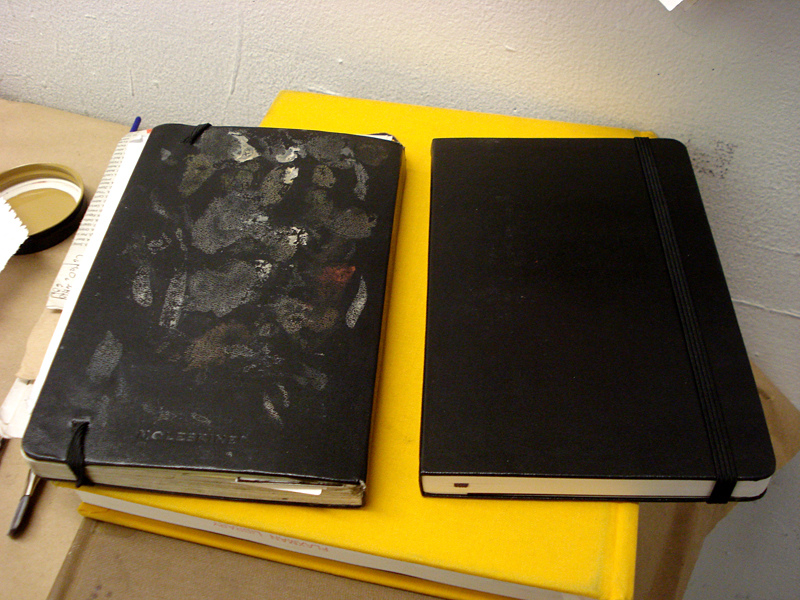
Here’s someone who has just finished one Moleskine sketchbook and is about to start another:
I love what she wrote about using her notebooks:
I carry my moleskine almost everywhere I go — it’s my calandar, it’s my reference book, it’s my crossword-puzzle-holder, it’s my playground,it’s my portfolio, it’s my storybook, it’s my notebook, it’s my refuge, it’s my science lab, it’s my hospital, it’s my diary. I’m not sure what I did before my discovery of these sketchbooks, and I can never see myself without one. They’re beyond just sketchbooks to me, they’re complete extensions of myself, where I can be un-selfconcious and immediate and unreserved. Some magic happens in these books that I never quite expected — and as I unwrapped the fourth moleskine I’ve ever owned, the transformation that these books go through becomes strikingly obvious. The white edges of the pages collect finger grease, city grime, or purse detritus – the book swells and the covers bend to accommodate. The front has been carved into, the back was used as a gouache palette once. Compared with the pristine new book, the one I’m shelving truly does look worse for wear. It has acquired a lot of miles in this past year and I’m proud it shows.
I also like her artwork:
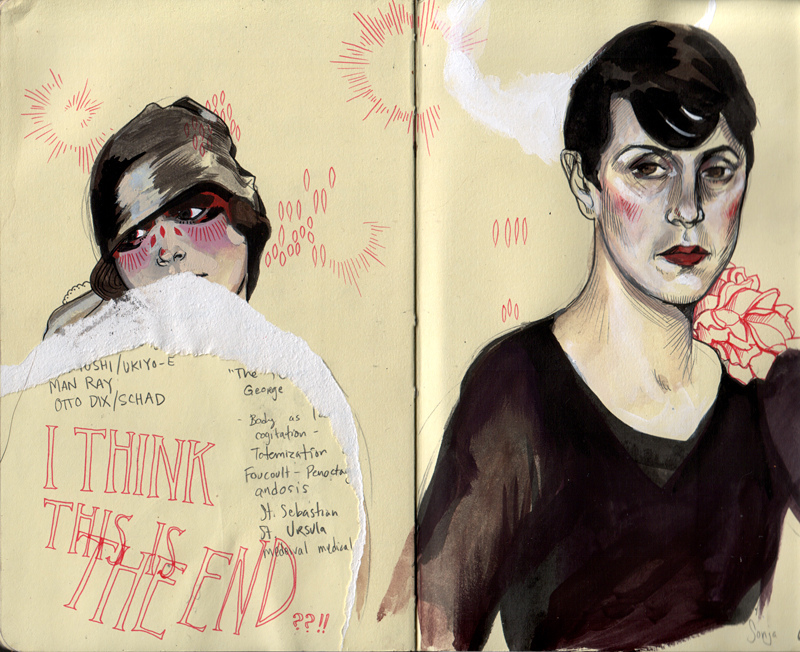
Read more at Hunter/Gatherer › Old and new..
This week, we have a Kiwi Notebook Addict, a “petite, geeky journalist-in-training living in New Zealand.”
Here’s her stash:
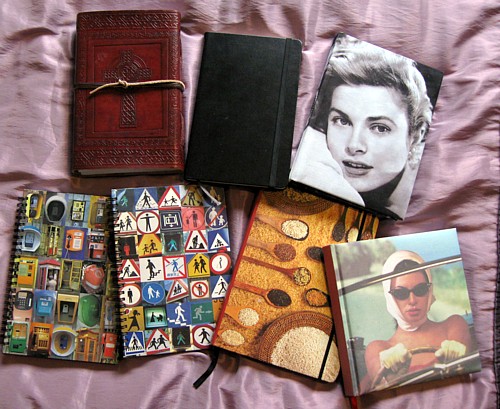

I really like those wire-bound ones with the photo collages on the covers. The leather journal is also quite beautifully made, there are more closeups of it in the original post. I don’t see any brands I recognize here other than the one I assume is a Moleskine.
Some thoughts from the owner:
I’ve always felt that there was something inherently stylish about notebooks and journals. They harken back to a time before digital technology, when it was commonplace to see wet glistening flowing script emerging from the tip of a fountain pen. There is something very romantic about handwriting, the smell of paper and the sound of a nib scratching its surface.
Yep, got that right!
Read more and see close up photos at The Notebook « Style of Mine.
An article from the Huffington Post that is well worth reading:
These days, it seems that everyone knows everything about us. Through Facebook, Twitter, and blogs, your friends and co-workers can learn about all the details of your life–your emotions, your day-to-day experiences, and your thoughts and opinions. But what will your grandchildren know about your life? What will you have to pass on to them, to give them insight into your family, your experiences, and your life journey? When you are older, what will you have to remind yourself of your youth–when the text messages and emails have long been deleted and your photo CDs can no longer be opened?
Because we are sharing so much of out lives digitally all of the time, we may not realize that we really aren’t “capturing” any of it for the future. We have all of our photos on our computers and share our thoughts on our blogs and Facebook, but unless you are one of the few people who actually print these out, they will all disappear when the technology changes. And it will. Maybe not in the next few years, but 50 years from now the technology will all be completely different. Even in the years since I’ve graduated from college, I can’t access any of my college papers that I kept on floppy disks. Technology changes, and along with it go all of your memories. This is why it is important to record your memories the old-fashioned way–with pen on paper….
A journal is not just important for future generations to learn about you, but it is also a useful tool for you to learn about yourself. Through its pages you can look back on different stages of your life and see yourself grow. As you capture experiences in a journal you can see how your personality evolves and get a big-picture view of your life. And it can be so fun to re-read about the good times you’ve had, your time spent traveling, and even the funny comments that made you laugh and laugh. When I look back over my journals from college, I can see how much I’ve learned and changed. I also smile at the great times I had back then. I had forgotten all about the day playing mud football in the rain, until I pulled out my journal and re-lived the experience–the jokes, the friends, and the mud-splattered mess. When you look back at your journal and re-read your words, a flood of memories will come back to you and you can travel back in time for a bit.
Read more at Vivian Larkins: Will Our Memories Disappear When Technology Changes? The Virtues of Pen and Paper.
This is interesting:
In reviewing volumes of diaries, mostly written by women, [a researcher] found many terse records about what was happening in daily life in the same style demanded by Twitter’s 140-character limit. Many diary entries ranged, for example, from what was for dinner to reports of deaths, births, marriages and travel, such as “April 7. Mr. Fiske Buried. April 27. Made Mead. At the assembly,” from the 1770 diary of Mary Vial Holyoke of Salem, Mass.
Diarists wrote under the constraints of small notebooks that allotted only a few lines per date entry, and some historians argue that diary writers — who lived busy, stressful lives in a time when leisure existed only for the rich — found such constraints freeing. Diaries of the era were intended to be semi-public documents to be shared with others, Humphreys said. The modern notion of confessional, reflective entries hadn’t come into play.
“Our whole notion of privacy is a relatively modern phenomenon,” she added. “You really don’t get a sense of personal, individual self until the end of the 19th century, so it makes perfect sense that diaries or journals prior to that time were much more social in nature.”
I would argue that the cost of a diary and ink must have also played into those brief entries, at least for some. I’d love to know what a notebook the size of today’s Moleskines would have cost in relation to the average person’s income…
Read more at Researcher finds diary entries are akin to tweets | R&D Mag.
Here’s a question that I’ve been contemplating for a while: do you think men are more likely to love notebooks than women? Perhaps I should phrase that differently: are men more likely be notebook addicts than women are likely to be notebook addicts? Some time ago, I had to correct a blogger who had referred to me as “he”– for the record, I am female. Last week, I made the same mistake myself, and was corrected by someone who pointed out that the Notebook Addict of the Week, “The Archer,” is female, a fact I just hadn’t realized from reading her blog.
When you think of people who love notebooks, do they tend to be male or female? I have never personally known any male notebook collectors, aside from bloggers I’ve only “met” online. I do know a few women who like notebooks, though none are as obsessed as I am. And I think the Notebook Addicts of the Week I’ve featured are probably a pretty even mix of men and women, though I haven’t counted. But let’s not be unscientific about it: please help me gather some data by voting in the poll below!
[poll id=”2″]
Here’s a fun Moleskine hack I found on Flickr, taking the pages out of a planner and using the cover to hold 3 cahiers.
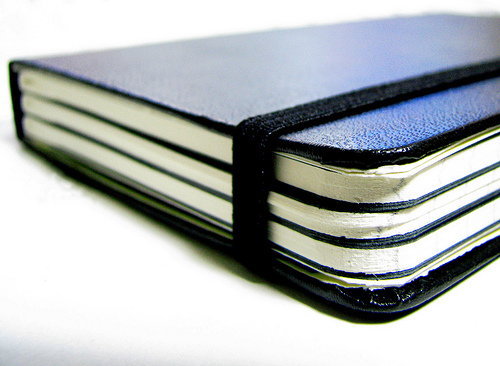
I’ve been wanting to try something similar myself, but with the cahiers somehow bound to the cover rather than remaining loose when the elastic is opened. Haven’t quite figured out how yet… and I also haven’t yet steeled myself for the emotional pain of having to do surgery on a notebook– it’s always nerve-wracking!
It’s long overdue that I call attention to this week’s addict, who blogs at Rants of the Archer. Here’s part of her notebook collection:
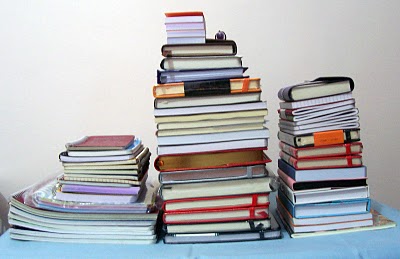
There are 57 notebooks in that photo. But wait, there’s more! Another 55 notebooks are shown below:

She mentions that some of the notebooks are being used, but I also spy quite a bit of undisturbed shrinkwrap and pristine-looking edges in those piles! But then, whoever said all the fun of notebooks was in using them!
You can read more at I Love Notebooks and I Love Notebooks, Part 2, where you’ll learn that The Archer also collects fountain pens, toys, shotglasses, elephant figurines, and tea bags. I hope she lives in a big house to store all those collections!
A while back, I wrote a post mentioning Ecosystem notebooks. Someone at Ecosystem actually noticed, and even though I more or less trashed their whole brand identity, they were kind enough to send me a sample so I could actually review the quality of the product. (Now that’s good marketing.)
So, let’s take a look…
The basic package is very similar to other notebooks on the market– size is supposedly 3.5 x 5.5″, though it’s actually slightly larger. I measured it as 3 11/16 x 5 5/8″. The paper band runs vertically, similar to the Rhodia Webnotebook, rather than horizontally like Moleskine and Piccadilly.
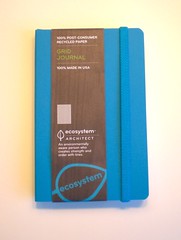
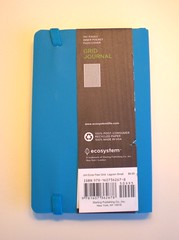
The back cover features the usual stamped logo. In the photo below, you’ll also notice that the elastic is quite thick and substantial, as is the ribbon marker. It feels as though it would be more durable than the thinner ones on most other notebooks. You can also see a bit of the cover texture below. The notebook is softcover, but a bit stiffer than a Moleskine, and the cover material has less texture to it. Again, it feels a bit more substantial than the softcover Moleskine, which tends to get beat up on the corners pretty quickly.
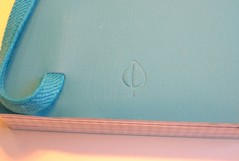
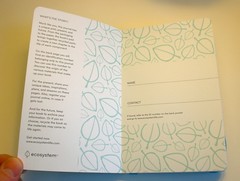
The inside front cover is a bit more decorated than other brands. You get a bit of information about about the notebook, and space for your name and contact info. It also notes that there is a unique ID number inside the back cover, which can be used to trace the owner if the notebook is lost.
I rather like the leaf pattern in the background– I love books with fancy endpapers, and I wish more notebooks were made that way. It’s like having a jacket with a really cool lining: style that is for your own enjoyment, not just to flash around to others. I’ve actually customized notebooks with pasted-in endpapers when giving them as gifts, but as far as I’ve seen, TeNeues Coolnotes is the only brand that really has fun with that space.
The fun leaf pattern continues on the inside back cover, where the standard expanding pocket also appears.
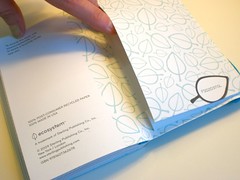
Here’s a closeup of that identification number. I wonder how much this feature will really be used– if someone found a notebook would they really bother to go to a website to reconnect it with its owner? And wouldn’t it be simpler for all concerned for the owner just to put some form of contact info inside the front cover? Maybe some people don’t want their contact info to appear there, but if you’re concerned about privacy, why would you be registering the notebook with Ecosystem in the first place?

This is about as flat as the notebook will easily open– not as flat as Moleskine or Piccadilly. You can sort of see below that every page is perforated, which is a nice touch many other brands don’t have. The perforations are quite fine, and I don’t think pages are likely to come loose unintentionally unless you really, severely abuse the notebook and bend it right on the perforations a lot.
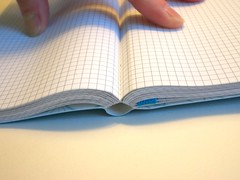
As for the paper, it’s pretty smooth– not as smooth as Clairefontaine or Moleskine, but smoother than at least some of the Piccadillies I’ve used. And it performed much better than average in terms of holding up to bleed-through.
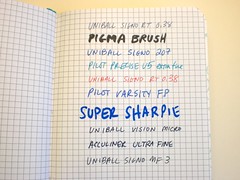
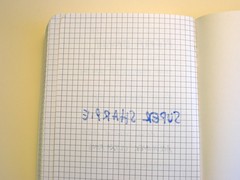
But the paper ended up being the main reason I will probably not actually use this notebook. When I first saw the paper, I noticed that the squares were a lot smaller than most graph paper notebooks– only 1/8″, rather than the more typical 3/16″. The lines also seem a bit dark, and the overall effect ended up being really distracting when I wrote in the notebook. Maybe I’d get used to it, or maybe it would be better if I used thick pens all the time, or had larger handwriting, I don’t know. But if the unlined paper has the same texture, I think I’d be quite happy with it. The notebook has 192 pages, and though the paper weight is not specified, I’d guess it’s probably 80 gsm, as it bulks up about the same as a Piccadilly.
Ecosystem notebooks are available in quite a few options: small and large sizes, hard cover, flexi cover or cahier-style, various colors, and lined, plain or graph paper, as well as planners. They also offer some insert booklets like calendars and to-do lists that can be tucked into the back pocket, adding a bit of Filofax-like customizability to the notebooks– this is a great touch, though the notebook I received doesn’t seem built to accommodate extra pages like that without starting to appear really overstuffed. (Moleskine’s planners that come with the little index page booklets are made with a bit of extra room in the spine so the covers will still lie flat.)
The small notebooks retail for $9.95. So far, I believe they’re only available at the Ecosystem website or in Barnes & Noble, though I believe I heard somewhere that they were going to be expanding their retail distribution. Given that this is a US-made, 100% post-consumer recycled paper product, with specs comparable to or arguably better than a Moleskine, this seems like a very good price.
So, bottom line, it’s actually a very nice notebook and a good value, and their eco-friendly, local manufacturing is very admirable. But I can’t help saying it: their marketing still drives me nuts!
This week’s notebook addict is food writer Elissa Altman, who calls herself a “journal junkie” and shares these images at her blog Poor Man’s Feast:
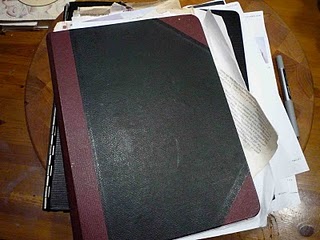
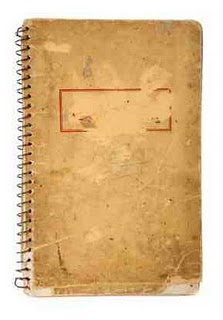
Here’s some of her thoughts about her addiction:
I don’t know when it happened, exactly, or why, but for as long as I can remember, I’ve been fanatical about notebooks. When I was a child, I could never decide between spiral and stitch-bound for school (spiral always seemed to be sort of non-committal), and when I was old enough for a loose leaf, my father gave me a small, leather three-ring binder that his sister had given him when he was not yet ten. I still have it—it sits on my desk, filled with the same lined paper from 1974, which has not yet yellowed. For years, I’ve wanted to use it as my kitchen notebook, but I just can’t bring myself to; on the one hand, I worry that regular use will harm it after almost eighty years, and on the other, I worry that forcing utilitarianism upon it will somehow render it less meaningful to the universe. Which is just plain nuts, when it gets right down to it.
And more thoughts specifically about notebooks and cooking:
When it comes to the subject of food, and cooking, though, I find almost nothing more enticing to read than kitchen notebooks because they place the reader in the kitchen of the cook, with the cook. Given the choice between M.F.K. Fisher’s narrative and her notebooks, I’d grab the latter first. My best college friend once sent me James and Kay Salter’s Life is Meals, and after years of perusing it, the book now falls open to the entry about their old kitchen notebook. Recently, my colleague and fellow blogger, Heidi Swanson, published a post about creating a new cookbook manuscript, and it was an amazing look at her creative process, involving lots of notebooks. And her photo of all those notebooks? Oh Heidi. So sultry.
I’m getting hungry just thinking about it… hungry for food, and for a look at some of those kitchen notebooks!
Read more at Poor Man’s Feast: Notebook Lust: Confessions of a Journal Junkie.